










Indian Renewable Energy Development Agency Revenue Rises 14% in Q2
Key highlights
- IREDA reported Q2 FY27 revenue of ₹2,345.9 crore, up 14.0% year on year and 4.3% quarter on quarter.
- Operating profit increased 16.1% year on year to ₹901.4 crore in Q2 FY27.
- Credit-cost impairment rose 168.4% year on year to ₹187.7 crore from ₹69.9 crore.
- IREDA's net margin was 23.5% in Q2 FY27, compared with 29.9% a year earlier.
powered by IRIS
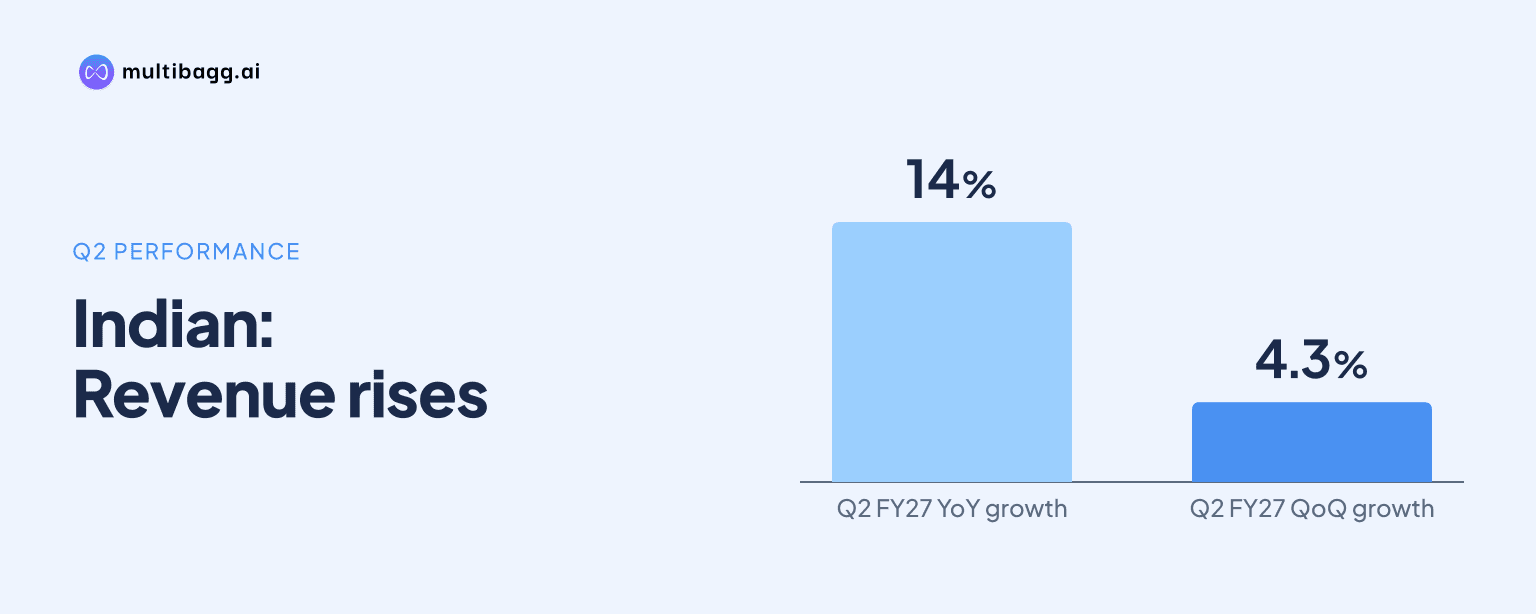
Indian Renewable Energy Development Agency reported Q2 FY27 revenue of ₹2,345.9 crore, up 14% year on year, while its reported credit-cost impairment increased to ₹187.7 crore from ₹69.9 crore. The quarterly update shows continued revenue growth and stronger sequential profit, but also highlights pressure on net margins from higher impairment costs.
Know IND Renewable Energy inside out
Results, valuation, peers and who's buying, in one view.
What did IREDA report for Q2 FY27?
IREDA reported revenue of ₹2,345.9 crore for the quarter ended September 2026, compared with ₹2,057 crore in the corresponding quarter a year earlier. Revenue was also 4.3% higher than the ₹2,249 crore recorded in the June 2026 quarter, according to the quarterly figures provided.
Operating profit increased 16.1% year on year to ₹901.4 crore. Profit before tax was ₹704.5 crore, representing a 70.3% increase from the preceding quarter. The company’s employee cost rose 16.0% year on year to ₹30.1 crore, while other expenses declined 12.1% to ₹37.1 crore.
The reported numbers place the September quarter within the ongoing FY27 earnings season. The supplied information identifies the results as consolidated figures for the quarter ended September 2026 and says they were filed on October 19, 2026.
Why did IREDA's net margin decline despite revenue growth?
IREDA's net margin declined because credit-cost impairment rose sharply during the quarter. The reported impairment charge was ₹187.7 crore, up 168.4% from ₹69.9 crore in Q2 FY26, while the net margin fell to 23.5% from 29.9% a year earlier.
Credit costs are an important measure for a lender because they reflect impairment charges associated with its loan portfolio. The rise in this expense reduced the benefit of higher revenue and operating profit at the net-profit level. The supplied quarterly summary specifically identifies higher credit costs as a factor behind the lower margin.
The figures provided contain two different net-profit references. One quarterly-results summary states net profit of ₹552.2 crore, down 10.2% year on year and up 63.1% sequentially. A separate investor-presentation summary cites net profit of ₹554 crore, up 0.9% year on year and 63.9% sequentially. The source material does not explain the difference, so the two figures should not be treated as directly reconciled.
How did the September quarter compare with the June quarter?
IREDA's September-quarter revenue and reported profit were higher than in the June quarter. Revenue increased by 4.3% quarter on quarter to ₹2,345.9 crore, while the quarterly-results summary reported a 63.1% sequential rise in net profit to ₹552.2 crore.
Profit before tax increased 70.3% from the preceding quarter to ₹704.5 crore. Other income was ₹1.0 crore, compared with ₹1.1 crore in June 2026. Employee cost declined sequentially by 7.6% from ₹32.6 crore, although other expenses increased 7.3% from ₹34.5 crore.
The sequential movement suggests that the September quarter had stronger reported profitability than the June quarter. However, the year-on-year movement in net margin and the higher impairment charge show that revenue growth did not translate into an equivalent expansion in net profitability.
Got a follow-up? Ask IRIS
What does the result mean for IREDA investors and the lending sector?
IREDA's result matters to investors because it combines double-digit revenue growth with a substantial rise in impairment costs. The 14% increase in revenue and 16.1% increase in operating profit indicate growth in the company’s core operations, while the 168.4% rise in credit-cost impairment is relevant to the quality and cost of its lending book.
For the broader financing market, the quarter illustrates why revenue growth alone is not sufficient to assess lender performance. Profitability is also shaped by provisions and impairments, which can affect net margins even when operating income rises. IREDA’s net margin of 23.5%, compared with 29.9% a year earlier, quantifies that effect in this quarter.
The supplied investor-presentation information also states that earnings per share was ₹3.17 as of September 30, 2026, compared with ₹2.88 a year earlier, a 10.07% increase. The source notes that no earnings-call transcript had been published for the quarter, so the available information reflects reported presentation data rather than subsequent management guidance.
What should be monitored after IREDA's Q2 FY27 results?
IREDA investors should monitor future credit-cost impairment, net-margin movement and any clarification of the differing net-profit figures included in the supplied results summaries. These items are particularly relevant because the quarter showed both revenue expansion and a significant increase in impairment charges.
The next reported quarterly figures can show whether the September-quarter improvement over June is sustained and whether credit costs moderate or remain elevated. Any subsequent company communication, including an earnings-call transcript or updated investor presentation, could also provide context on the reported profit and lending-book performance.
Conclusion
IREDA delivered 14% year-on-year revenue growth to ₹2,345.9 crore in Q2 FY27 and increased operating profit by 16.1% to ₹901.4 crore. But the quarter also recorded a 168.4% rise in credit-cost impairment to ₹187.7 crore, which corresponded with a decline in net margin to 23.5% from 29.9% a year earlier.
The main areas to watch are the company’s next quarterly disclosure, the course of credit costs and margins, and any official reconciliation of the ₹552.2 crore and ₹554 crore net-profit references in the supplied data. The available material does not provide management guidance because no earnings-call transcript was reported for the quarter.