










Pricol Limited Clears DICVS Demerger, Unit Had 61% Revenue
Key highlights
- Pricol's DICVS business generated ₹2,424.63 crore in FY2026, equal to 61% of consolidated turnover.
- Pricol shareholders are proposed to receive 1 Pricol Autotech share for every 1 Pricol share held.
- Promoters held about 38.51% and public shareholders about 61.49%, a structure proposed to be mirrored in Pricol Autotech.
- CRISIL expected the approval process to take 15-18 months, with an effective date of 1 April 2027.
powered by IRIS
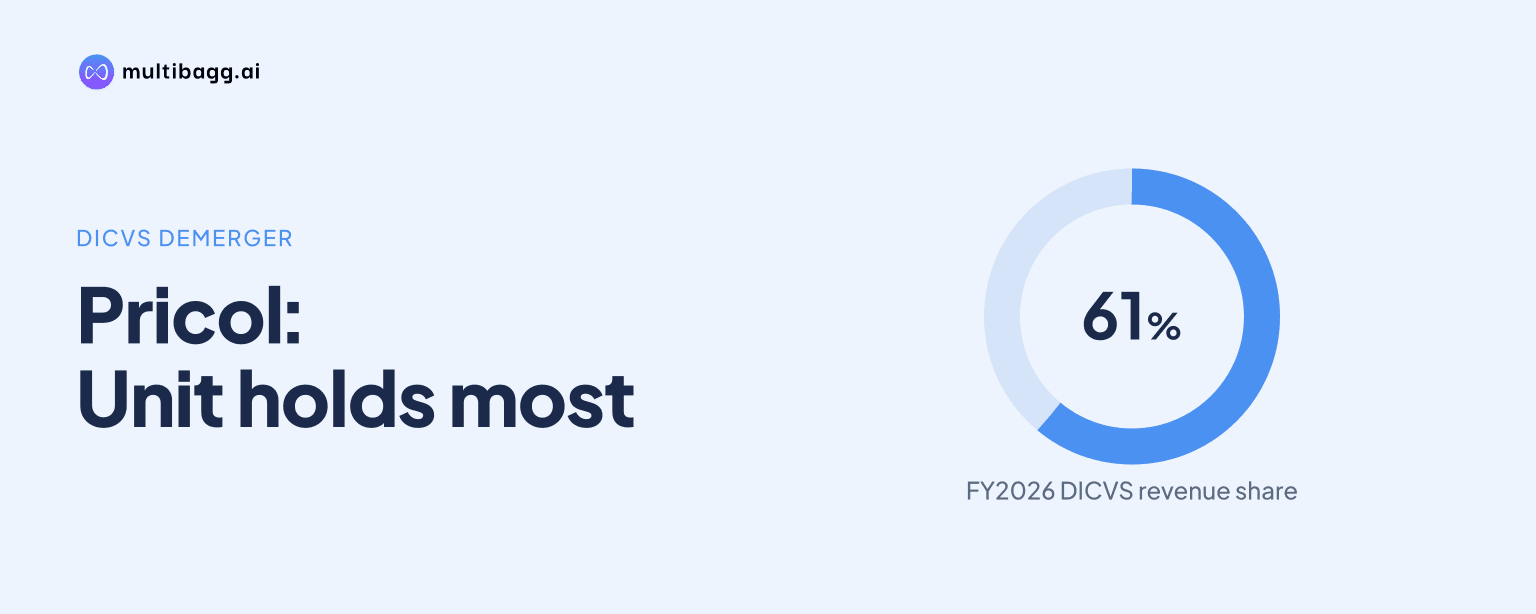
Pricol Limited approved the demerger of its Driver Information & Connected Vehicle Solutions business on 27 June 2026, separating a unit that generated ₹2,424.63 crore, or 61% of consolidated FY2026 turnover, into proposed listed company Pricol Autotech Limited. Existing shareholders are set to receive shares in a 1:1 ratio, subject to approvals.
Know Pricol inside out
Results, valuation, peers and who's buying, in one view.
What did Pricol approve for its DICVS business?
Pricol approved a Scheme of Arrangement to transfer its Driver Information & Connected Vehicle Solutions business to Pricol Autotech Limited, a currently wholly owned subsidiary. The decision was approved by the board on 27 June 2026 and remains at the proposal stage until regulatory, judicial, creditor and shareholder clearances are secured.
The DICVS business includes instrument clusters, digital cockpits, telematics, battery-management electronics, sensors and other connected-vehicle technologies. Under the proposed structure, Pricol Autotech will operate as a focused automotive electronics and connected mobility company, separate from the mechanical and polymer operations that will remain with Pricol.
The scale of the division makes the transaction significant for investors. DICVS recorded revenue of ₹2,424.63 crore in FY2026, accounting for 61% of Pricol's consolidated turnover for the year. The planned separation will therefore create two independently listed businesses with distinct operating portfolios.
Which businesses will remain with Pricol?
Pricol will retain its Actuation, Control & Fluid Management Systems business and its Precision Products business after the proposed demerger. The Actuation, Control & Fluid Management Systems portfolio includes pumps, disc brakes, throttles and fuel-pump modules, while Precision Products refers to the P3L polymer business acquired from the TVS group in 2025.
This separation places connected electronics in Pricol Autotech and leaves Pricol with the actuation, fluid-management and precision-products portfolio. The source material describes the retained operations as the mechanical half of the group, while the new entity will concentrate on electronics-led automotive products and connected vehicle applications.
The board's scheme does not involve a cash payment to shareholders. Instead, the transaction is structured as a direct distribution of shares in Pricol Autotech to eligible Pricol shareholders on the record date. The record date has not been stated in the material provided.
How will the 1:1 share issue work for investors?
Every shareholder of Pricol will receive one fully paid-up equity share of Pricol Autotech for each fully paid-up equity share held in Pricol on the record date. Each Pricol Autotech share will have a face value of ₹1, and the proposed entitlement ratio is 1:1.
Pricol Autotech's shareholding is intended to mirror Pricol's ownership structure. Promoters held about 38.51%, while public shareholders held about 61.49%, according to exchange filings cited in the source. The scheme states that Pricol Autotech's existing 100% holding under Pricol will be cancelled on the effective date, with shares issued directly to Pricol shareholders.
As a result, the proposed structure does not leave Pricol with a residual stake in Pricol Autotech. The source also states that the arrangement involves no dilution and no change in the relative promoter and public ownership percentages between the two entities. Pricol Autotech is proposed to list on both NSE and BSE after the scheme becomes effective.
Got a follow-up? Ask IRIS
What approvals and timeline does the demerger require?
The demerger requires no-objection or other approvals from stock exchanges, followed by proceedings before the National Company Law Tribunal's Chennai bench. It must also obtain approval through meetings of shareholders and creditors as directed by the tribunal, as well as the tribunal's final sanction and other applicable statutory approvals.
As of July 2026, only board approval had been obtained. CRISIL placed Pricol's rating on 'Watch Developing' on 7 July 2026 and expected the process to take 15 to 18 months, with an effective date of 1 April 2027. That timeline is an expectation cited by CRISIL rather than confirmation that the demerger will be completed on that date.
The company has also addressed reports of a possible fundraising. A Pricol spokesperson said the information regarding a fundraise was speculative, while confirming that the board had approved the DICVS demerger and that approvals from stock exchanges and other authorities were pending. Separate source material said discussions were at an early stage and promoters would not dilute their stake, but Pricol's formal clarification characterised the fundraising information as speculative.
Why does the demerger matter for Pricol's valuation and operations?
The proposed transaction separates a business responsible for 61% of FY2026 consolidated turnover from Pricol's remaining operating portfolio. It gives shareholders direct holdings in both the automotive-electronics business and the retained actuation, fluid-management and precision-products businesses, rather than maintaining the new business solely inside the parent company.
For operations, the separation creates two distinct stated areas of focus. Pricol Autotech will be dedicated to driver information, electronics and connected mobility solutions, while Pricol will continue with products such as pumps, brakes, throttles and polymer components. The market effect cannot be measured until the scheme receives approvals, the record date is set and the proposed shares are listed.
The process will also be relevant to lenders, creditors and investors because the scheme remains subject to their required approvals and tribunal review. CRISIL's 'Watch Developing' designation reflects that the demerger was still under development following the board decision. The disclosed revenue split is central to assessing the future composition of both companies once financial information for the separated entities is available.
Conclusion
Pricol's board approval starts the process of separating DICVS, its ₹2,424.63 crore FY2026 revenue business, into Pricol Autotech. The 1:1 share entitlement and mirrored ownership structure mean eligible Pricol shareholders are proposed to hold shares directly in both companies, while Pricol retains its ACFMS and Precision Products operations.
Investors should watch for stock-exchange clearances, NCLT filings and directions on shareholder and creditor meetings, followed by the record date and listing process. CRISIL's cited expectation is for a 15 to 18 month process and an effective date of 1 April 2027, though completion remains conditional on the required approvals.