










Pricol says inflation may shave 1-2 EBITDA margin points
Key highlights
- Pricol reported Q2 FY2027 revenue of Rs 1,334.02 crore and an EBITDA margin of 11.82%.
- Management estimated that abnormal PCB, memory and labour inflation could affect EBITDA margin by 1 to 2 percentage points.
- Pricol said customer discussions are under way, but it does not expect full recovery of the first-time cost increases.
- P3L reported Q2 revenue of Rs 312 crore and a 9.9% EBITDA margin.
powered by IRIS
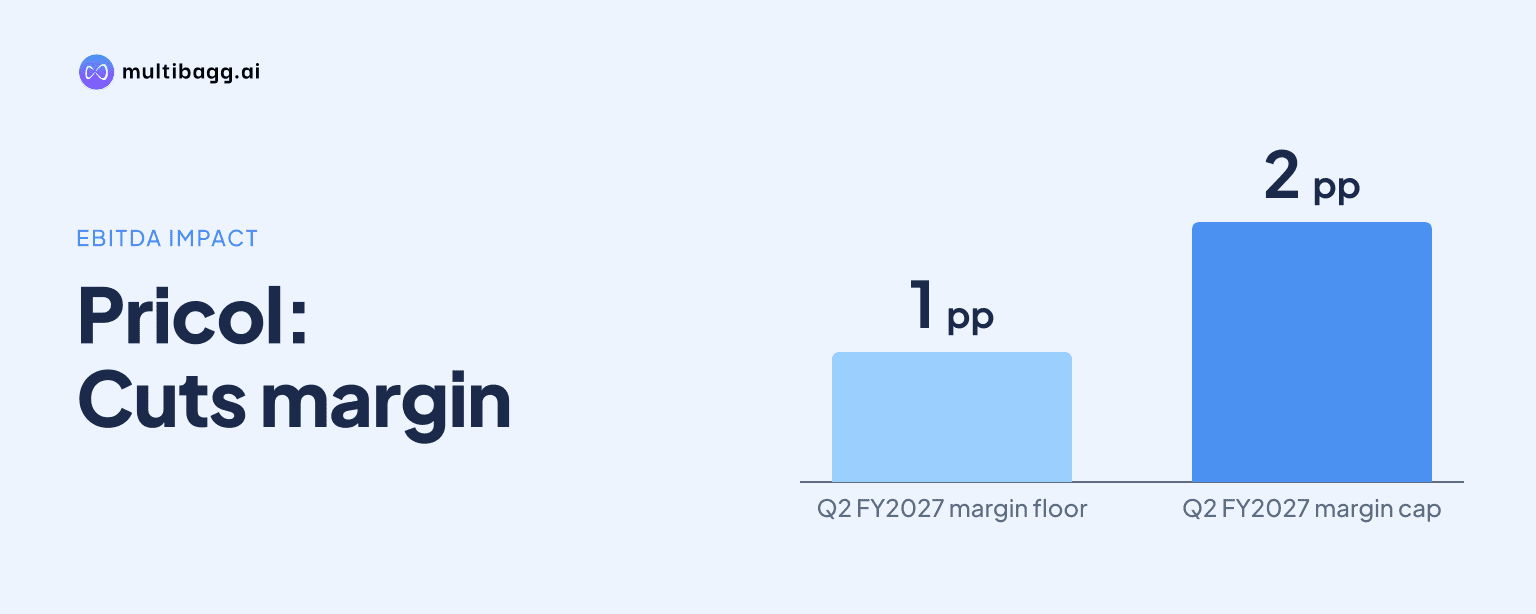
Pricol Limited said on November 5, 2026 that abnormal increases in bare printed circuit board, memory and labour costs could reduce earnings before interest, tax, depreciation and amortisation, or EBITDA, margin by 1 to 2 percentage points until customer settlements are concluded, after reporting an 11.82% Q2 FY2027 EBITDA margin on revenue of Rs 1,334.02 crore.
Know Pricol inside out
Results, valuation, peers and who's buying, in one view.
Why is Pricol facing EBITDA margin pressure?
Pricol is facing margin pressure because imported content, bare printed circuit boards, memory and labour-related inputs have increased beyond its regular pass-through arrangements. Management said the weakening rupee against the US dollar lifted bill-of-material costs because its products have substantial import content. It also cited higher bare PCB costs linked to the West Asia crisis and rising memory costs associated with artificial-intelligence demand.
The cost pressure began in Q1 FY2027 and continued through Q2 FY2027, according to management. Pricol said its regular quarterly indexing mechanism with customers covers raw-material and foreign-exchange movements, but the newer increases are outside that usual framework. The additional escalation includes higher casting, machining, power and labour costs, with management citing sharp labour-cost increases in northern India.
How large could Pricol's unresolved cost impact be?
Pricol estimated that the first-time cost escalation since Q1 FY2027 could affect EBITDA by 1 to 2 percentage points, although management described this as a rough estimate that differs by product. It did not disclose a cost split for PCB, memory or labour exposure. Management said the combination of imported electronics, PCB content and labour intensity varies across its product lines.
Pricol reported a Q2 FY2027 EBITDA margin of 11.82%, compared with a first-half FY2027 margin of 11.64%. Q2 revenue from operations was Rs 1,334.02 crore, while first-half revenue was Rs 2,417.60 crore. Management said Q2 revenue grew 35.03%, whereas EBITDA grew 27.87%, indicating that profit growth lagged the increase in sales amid input-cost headwinds.
Profit after tax, or PAT, was Rs 85.21 crore in Q2 FY2027, representing a 6.39% margin, compared with a 6.30% PAT margin for the first half. Pricol did not provide a first-half PAT amount in the call. The 0.18 percentage-point difference between Q2 and first-half EBITDA margins shows that the company remained within a similar reported profitability range while negotiations over abnormal costs were unresolved.
Pricol did not endorse an analyst's calculation that complete recovery would place EBITDA margin at 12.5% to 13%. Management said it could not simply add the estimated 1 to 2 percentage-point effect to reported profitability because cost exposure differs product by product. In ACFMS, management said import content is not major but labour costs have increased; in DICVS, memory and bare PCB costs are relevant factors.
When could Pricol settle these costs with customers?
Pricol hopes to conclude customer discussions during the next quarter, but management said it cannot confirm either the timing or the percentage of recovery. Many cases had already been raised with customers by the November 5, 2026 call, and customers were evaluating them. Management said customers may be unable to pass every cost increase to their own end markets.
Management expects the identified headwinds to continue for a few more quarters before conditions normalise. That expectation covers the three principal pressures cited in the call: dollar appreciation against the rupee, higher bare PCB prices and memory-cost inflation. Pricol did not provide a margin forecast for the next quarter because input costs were still increasing and customer discussions remained incomplete.
The usual quarterly pass-through process is separate from the negotiations over exceptional increases since Q1 FY2027. Pricol said normal raw-material and foreign-exchange changes are indexed with customers and recovered regularly every quarter. The unresolved issue concerns newer increases in electronics, labour, power, casting and machining inputs that management described as first-time or abnormal escalation.
Got a follow-up? Ask IRIS
What supported Pricol's Q2 revenue despite cost inflation?
Pricol's Q2 FY2027 revenue growth was supported by domestic demand, particularly in two-wheelers, which management said grew about 35% during the quarter. The festive season contributed to demand, and management said two-wheelers are a significant part of Pricol's sales base. All three business verticals grew at broadly the same rate as the company's 35% overall revenue growth, according to management.
New product launches also raised value addition in Q2 FY2027. Management cited the Bajaj Pulsar launch using Pricol's new-generation thin-film-transistor, or TFT, cluster as a contributor. In ACFMS, domestic two-wheeler fuel pumps and exports of larger water pumps to Caterpillar in the United States were leading growth drivers.
Management said it had gained some market share through new products launched in Q2 across DICVS, plastics and ACFMS. It attributed growth above the broader market primarily to the 35% two-wheeler expansion, new value-added clusters and higher sales of fuel pumps and heavy-duty water pumps. These growth drivers helped lift revenue even as electronics and labour costs reduced the conversion of sales growth into EBITDA growth.
What are Pricol's capacity and separation plans?
P3L, Pricol's plastics entity, reported Q2 revenue of Rs 312 crore and an EBITDA margin of 9.9%. Management said the operation was running at almost 100% capacity, making capacity creation its immediate priority. It expects larger growth in the plastics business from FY2028 onward after new capacity becomes operational.
Pricol has budgeted Rs 350 crore of capital expenditure in P3L over the next six quarters, with management expecting an asset turn of about 3 to 3.25. Management also said P3L had recorded close to Rs 950 crore to Rs 1,000 crore of revenue in the previous year, but did not give a closing-year revenue forecast. It cited a good business pipeline and sizable wins from other original equipment manufacturers, or OEMs.
The demerger process was ongoing as of the November 5 call, and management said it expected final orders to take a couple of quarters. Pricol began internal divisionalisation from October 2026, including internal-control changes and movement of employees. Management plans to operate fully as two divisions, DICVS and ACFMS, from April 1, 2027.
Conclusion
Pricol delivered Q2 FY2027 revenue of Rs 1,334.02 crore and PAT of Rs 85.21 crore, but its 11.82% EBITDA margin reflected input costs rising faster than its ordinary recovery mechanism could address. Regular raw-material and foreign-exchange indexing remains in place, while exceptional PCB, memory, labour, power and production-input increases are subject to separate customer negotiations.
The next quarterly update should show whether Pricol has concluded customer settlements and how much of the estimated 1 to 2 percentage-point EBITDA effect can be recovered. Management's disclosed milestones include full operational separation into DICVS and ACFMS from April 1, 2027, while P3L's Rs 350 crore capacity programme is scheduled over the next six quarters.