










ITC cigarette gross revenue rose 78% while net revenue fell
Key highlights
- ITC reported Q2 FY27 cigarette gross revenue growth of 78%, while net revenue declined 21%.
- ITC reported a 27% decline in cigarette results in Q2 FY27.
- FMCG Others consolidated revenue grew 19% year on year, the highest rate in 14 quarters.
- Paperboards, Paper and Packaging revenue rose 36% year on year and profit before interest and tax increased 48%.
powered by IRIS
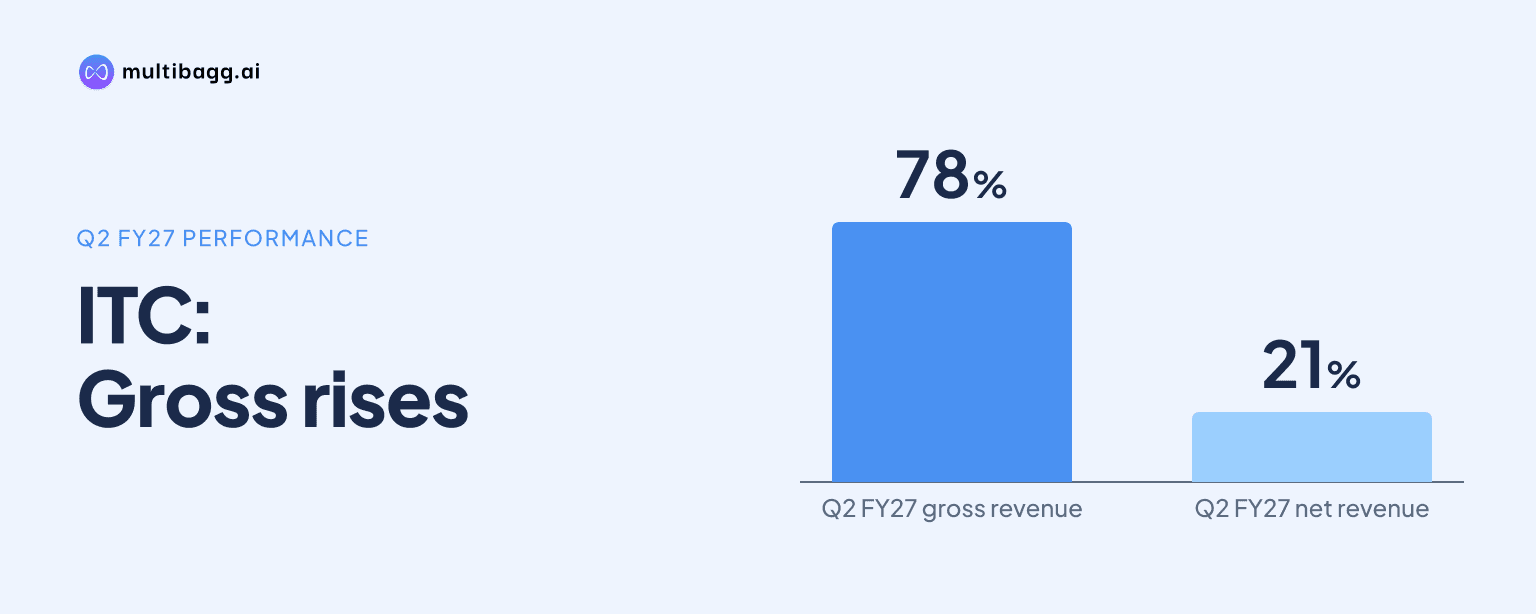
ITC reported in Q2 FY27 that cigarette gross revenue rose 78%, while net revenue declined 21% and results fell 27%, following an unprecedented tax increase. ITC said its calibrated response was intended to limit a disproportionate consumer shift to illicit trade while protecting its consumer franchise, without disclosing rupee revenue or volume data.
Know ITC inside out
Results, valuation, peers and who's buying, in one view.
Why did ITC's cigarette gross and net revenue diverge?
ITC reported a 99-percentage-point difference between 78% cigarette gross-revenue growth and a 21% net-revenue decline in Q2 FY27. The same disclosure showed cigarette results down 27%, but did not define the results measure or provide absolute values for gross revenue, net revenue or results.
ITC linked the Q2 FY27 outcome to an unprecedented increase in cigarette tax and pressure on legal-industry volumes. Management said its response sought to mitigate the risk of disproportionate volume migration to illicit trade, but the presentation did not disclose the tax rate, timing of the increase, pricing changes or a gross-to-net revenue reconciliation.
The reported figures show that cigarette results declined 6 percentage points more than net revenue in Q2 FY27. Because ITC did not disclose Q2 FY26 base values, the presentation does not allow calculation of the rupee change in any of the three measures.
How is ITC responding to the cigarette tax increase?
ITC said its cigarette response combines calibrated action, powerful trademarks, portfolio re-architecture, and execution speed and agility. The stated objective is to minimise disproportionate losses to illicit trade and protect the consumer franchise, rather than to meet a disclosed price, volume or market-share target.
ITC described portfolio re-architecture through insight-led innovation and value-accretive offers, supported by multiple interventions in a short span of time. The presentation does not quantify the number of interventions, their price points, or the contribution of individual actions to the 78% gross-revenue increase or 21% net-revenue decline.
The Q2 FY27 presentation identified Classic and Gold Flake World Series, Gold Flake Indie Paan Sleek and Players Magic Mix as innovations. It also listed Classic Balance Taste Sleek, Connect Express and Connect Lounge, plus Gold Flake Longs, Deluxe and Indie Deluxe variants, as recent additions.
Which cigarette brands has ITC added or fortified?
ITC listed new variants and portfolio fortification across Classic, Gold Flake, American Club, Players, Wave, Scissors and Flake in Q2 FY27. The disclosed portfolio fortification also covered Bristol and Flake Special, while the presentation did not provide sales, distribution or volume data for any individual brand.
American Club additions included Magic Mix Sleek, NY Cool Premium Sleeks, Doubles, Longs and Clove Mint Fresh. Players additions included Magic Mix RSFT, Deluxe Filter and Turbo, with RSFT used in the presentation as a product descriptor without expansion.
ITC also listed Rothmans GT and XT and B&H Bold and Go RSFT among international brands owned by ITC. Other recent products included Wave Deluxe Filter, Scissors Deluxe Filter and Flake Premium Deluxe, reflecting the company's disclosed effort to reinforce market standing after the tax increase.
Got a follow-up? Ask IRIS
What does ITC say about illicit cigarette trade?
ITC said enforcement agencies recorded a sharp increase in seizures of smuggled cigarettes across the country, signalling greater exploitation of the widening tax-arbitrage opportunity. The presentation did not provide seizure numbers, quantities, dates, locations or an estimate of the illicit-cigarette market.
Management linked its calibrated cigarette response to legal-industry volume pressure and the risk of consumers moving to illicit products. This is ITC's stated rationale for its Q2 FY27 actions, not a disclosed forecast for legal cigarette volumes or a quantified estimate of market-share movement.
The cigarette tax increase also continued to affect ITC's overall leaf tobacco business, according to the agri-segment disclosure. Agri revenue grew 12% year on year despite West Asia conflict-led disruptions and delayed customer call-offs, while value-added agri products and leaf tobacco exports performed well.
How do ITC's cigarette trends compare with other businesses?
ITC's cigarette net revenue fell 21% in Q2 FY27, whereas FMCG Others reported consolidated revenue growth of 19% and standalone revenue growth of 16%. ITC described the FMCG Others increase as its highest revenue-growth rate in 14 quarters, contrasting with cigarette volume pressure following the tax increase.
FMCG Others recorded growth of more than 20% in biscuits, snacks, noodles, spices, salt, frozen snacks, homecare and notebooks, while daily and personal wash grew at high-teens rates. Its digital-first and organic portfolio, including Yoga Bar, Prasuma, Mother Sparsh and 24 Mantra Organic, grew more than 70% year on year and had an annual revenue run rate above Rs 1,800 crore.
Paperboards, Paper and Packaging revenue rose 36% and profit before interest and tax rose 48% in Q2 FY27. Fresh Food gross merchandise value rose 53%, with an annual run-rate gross merchandise value of about Rs 320 crore, while FMCG Others segment earnings before interest, tax, depreciation and amortisation increased 28% and its margin expanded by more than 50 basis points year on year and quarter on quarter.
Conclusion
ITC's Q2 FY27 disclosure shows an unusually wide reported split in cigarettes: gross revenue rose 78%, net revenue fell 21%, and results declined 27%. Management attributes the setting for those movements to the unprecedented tax increase, legal-industry volume pressure and the risk that consumers migrate to illicit trade.
What to watch next is ITC's execution of the disclosed portfolio re-architecture, value-accretive offers and recent variants across brands such as Classic, Gold Flake, American Club and Players. The presentation identifies these interventions as its response to the tax increase, but does not set a numerical target for volumes, revenue, pricing or market share.