










ITC reports about 51% renewable energy use in FY26 and sets targets
Key highlights
- ITC reported that about 51% of its energy came from renewable sources in FY26.
- ITC targets a 50% reduction in specific GHG emissions by 2030 and net-zero operations by 2050.
- ITC reported plastic neutrality in FY26 for the fifth consecutive year and 100% plastic collection since FY22.
- ITC reported 9 million sustainable livelihoods against its 2030 target of 10 million.
powered by IRIS
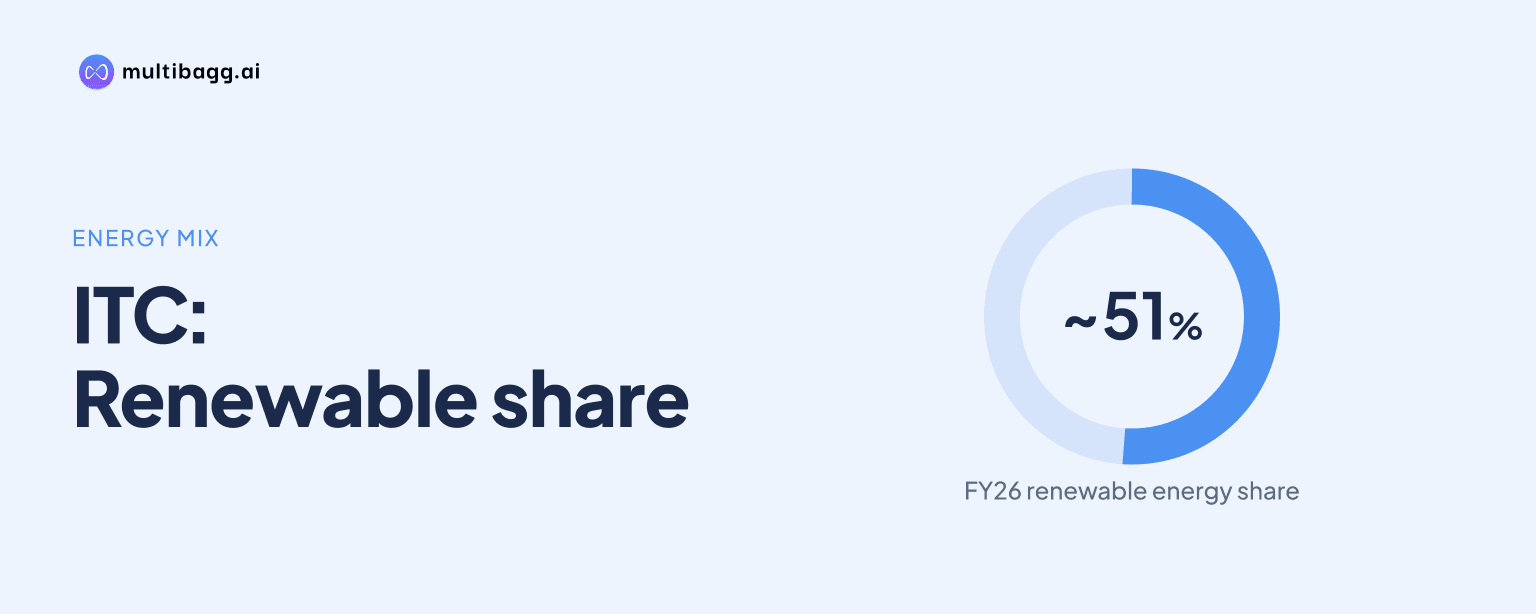
ITC reported that renewable sources supplied about 51% of its energy in FY26, while its Sustainability 2.0 framework displays a 50% renewable-energy target for 2030. ITC also set targets for a 50% reduction in specific greenhouse-gas emissions, 100% recyclable plastic packaging and water security equal to five times net consumption.
Know ITC inside out
Results, valuation, peers and who's buying, in one view.
How much renewable energy did ITC use in FY26?
ITC said renewable sources accounted for about 51% of its energy use in FY26. The company reported the figure in its sustainability highlights and separately displayed renewable energy of 50% within its Sustainability Targets 2030 framework.
The reported FY26 share is about 1 percentage point higher than the displayed 2030 marker. However, the presentation does not provide total energy consumed, the renewable-source mix, a target baseline or confirmation that the target and FY26 measure use the same boundary, so the comparison cannot establish progress against a defined annual pathway.
What climate and water targets has ITC set?
ITC targets a 50% reduction in specific greenhouse-gas, or GHG, emissions by 2030 and net-zero operations by 2050. Its Sustainability 2.0 framework lists decarbonisation, climate adaptation and resilience, circularity, green infrastructure, nature-based solutions and inclusive value chains as strategic interventions to combat climate change.
The 50% GHG target is expressed as a reduction in specific emissions rather than absolute emissions. ITC does not state the base year, the output measure used for the intensity calculation, or its FY26 absolute GHG emissions in the supplied presentation; therefore, the disclosed target cannot be converted into an amount of emissions reduction from this source.
ITC also aims to provide water security equal to five times its net consumption by 2030, while setting a 2035 deadline for Alliance for Water Stewardship, or AWS, certification at high-water-stressed sites. The company reported that nine ITC units had received AWS Platinum certification, but it did not disclose the total number of high-water-stressed sites covered by the 2035 objective.
What has ITC reported on plastic packaging and collection?
ITC targets 100% recyclable plastic packaging by 2030 and says it has maintained 100% plastic collection since FY22. The company also reported sustained plastic neutrality in FY26 for the fifth consecutive year, in line with extended producer responsibility, or EPR, requirements.
The FY26 plastic-neutrality statement and the since-FY22 collection statement describe different timeframes. Plastic neutrality had run for five consecutive years by FY26, whereas ITC specifically dates 100% collection from FY22; the presentation does not disclose plastic-packaging tonnage placed on the market, collected, recycled or reused.
Circularity is one of ITC’s six listed Sustainability 2.0 interventions, alongside decarbonisation and nature-based solutions. The 100% recyclable-packaging target is therefore a 2030 packaging commitment, while the FY26 disclosure records continuation of the company’s stated plastic-neutrality status rather than a new volume-based collection target.
Got a follow-up? Ask IRIS
How do ITC’s agriculture and livelihood figures compare with its targets?
ITC reported supporting 9 million sustainable livelihoods against a 2030 target of 10 million, leaving 1 million to reach the stated target. The company’s 2030 biodiversity and agriculture framework also identifies 1 million acres for biodiversity conservation, 4 million acres for climate-smart agriculture and 1.5 million acres for social farm and forestry.
In its social-performance disclosures updated through FY26, ITC reported climate-smart agriculture coverage of 31.93 lakh acres and water-stewardship coverage of 20.33 lakh acres. Climate-smart agriculture coverage is numerically below the 4 million-acre target, but the presentation does not explicitly state that the FY26 coverage uses the same methodology, geography or programme boundary as the 2030 target.
ITC also reported afforestation coverage of 15.76 lakh acres, e-Choupal empowerment of 4 million farmers and livestock-development reach of 10.85 lakh animal owners. The company does not equate its afforestation figure with the separate 1.5 million-acre social farm and forestry target, so the two measures should not be treated as directly comparable.
Beyond farm-linked programmes, ITC reported that about 6 lakh women were gainfully engaged, more than 1.52 lakh youth had been skilled and more than 29.57 lakh children had been reached through education support. The education total includes initiatives facilitated through public-private partnerships where applicable, according to the presentation.
What supplier and governance measures did ITC disclose?
ITC said it trained more than 1,000 suppliers, including 100% of critical tier-1 suppliers, on environmental, social and governance, or ESG, aspects. It also reported assessing about 90% of critical tier-1 suppliers on ESG aspects, creating a roughly 10-percentage-point difference between reported training coverage and assessment coverage for that supplier category.
The company said it strengthened 14 policies in response to evolving stakeholder expectations. ITC also reported continued inclusion in the Dow Jones Best-in-Class Emerging Markets Index, a CDP Water A List position, a CDP Climate leadership-level score of A-, and CDP Forest A List inclusion in its first year of participation.
The supplier disclosures specify the percentage coverage of critical tier-1 suppliers but do not state their total number, the assessment criteria or actions required after assessment. Likewise, the 14-policy figure identifies the number strengthened but does not list the policies or quantify their operational effect in FY26.
Conclusion
ITC’s FY26 update combines an energy mix of about 51% from renewable sources with ongoing plastic neutrality, nine AWS Platinum-certified units and 9 million sustainable livelihoods supported. Its 2030 framework links these operating disclosures to targets for a 50% reduction in specific GHG emissions, 100% recyclable plastic packaging, water security at five times net consumption and 10 million sustainable livelihoods.
The next disclosed milestones are the 2030 targets, including the remaining 1 million sustainable livelihoods and 4 million acres of climate-smart agriculture. ITC’s subsequent disclosures will also need to show progress on AWS certification for high-water-stressed sites by 2035 and net-zero operations by 2050, particularly because the presentation does not provide an emissions baseline or absolute-emissions data.