










IZMO standalone first-half profit halves as receivables rise
Key highlights
- IZMO’s standalone first-half profit after tax fell to Rs 24.65 lakh from Rs 51.72 lakh a year earlier.
- IZMO’s standalone revenue from operations declined to Rs 21.40 crore from Rs 22.25 crore.
- IZMO’s trade receivables increased Rs 7.17 crore to Rs 33.89 crore at September 30, 2026.
- IZMO’s operating cash outflow narrowed to Rs 1.98 crore from Rs 5.04 crore in the prior-year half.
powered by IRIS
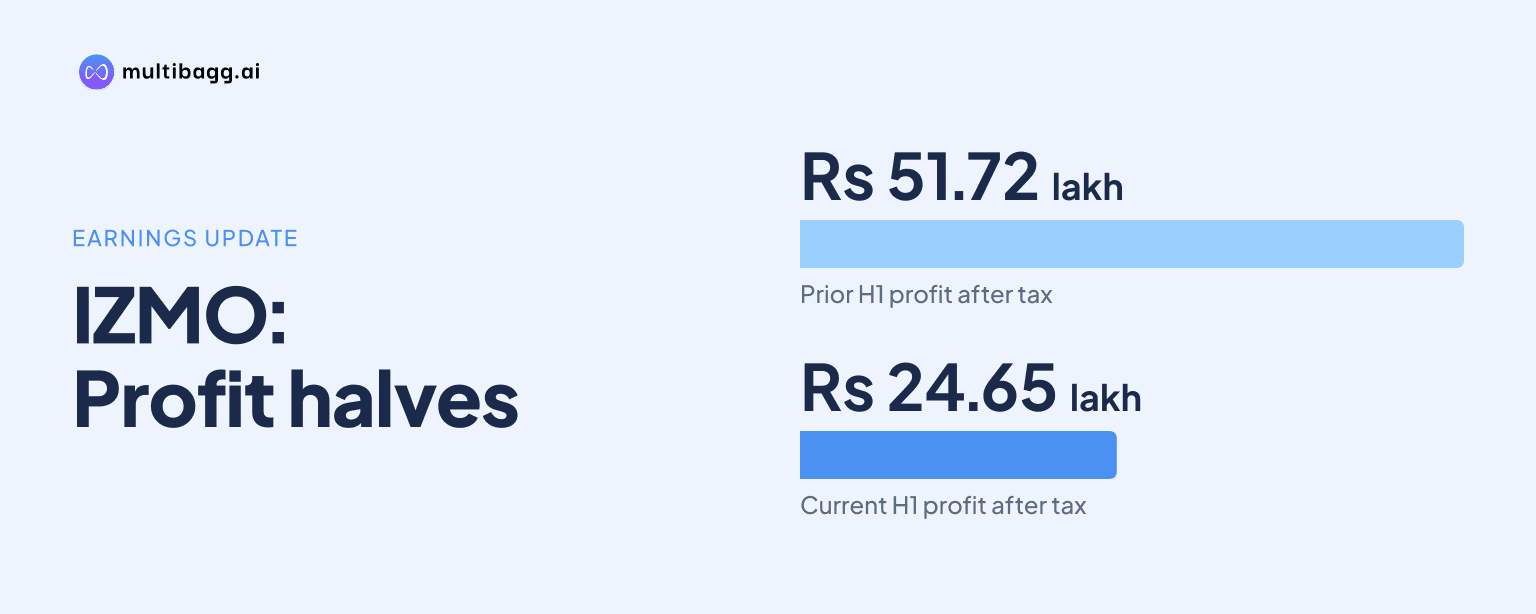
Izmo Limited (IZMO) reported standalone profit after tax of Rs 24.65 lakh for the half year ended September 30, 2026, down from Rs 51.72 lakh a year earlier, while trade receivables increased Rs 7.17 crore to Rs 33.89 crore and operating activities used Rs 1.98 crore of cash.
Know IZMO inside out
Results, valuation, peers and who's buying, in one view.
Why did IZMO’s first-half standalone profit decline?
IZMO’s first-half standalone profit declined because a fall in income was larger than the reduction in total expenses. Profit after tax was Rs 24.65 lakh for the half year ended September 30, 2026, compared with Rs 51.72 lakh for the half year ended September 30, 2025. Profit before tax fell to Rs 87.87 lakh from Rs 1.12 crore over the same periods.
Revenue from operations declined to Rs 21.40 crore from Rs 22.25 crore, while total income decreased to Rs 23.31 crore from Rs 24.30 crore. Total expenses fell to Rs 22.43 crore from Rs 23.17 crore, which partly cushioned the lower income but did not prevent the profit decline.
Employee benefit expense decreased by Rs 1.56 crore to Rs 17.89 crore in the 2026 half year. That reduction was partly offset by purchase of traded stock, described as direct cost, rising to Rs 55.24 lakh from Rs 26.31 lakh, and other expenses increasing to Rs 2.62 crore from Rs 2.05 crore.
The September 2026 quarter generated most of the half-year profit. Quarterly profit after tax was Rs 19.58 lakh, against Rs 5.07 lakh in the June 2026 quarter, as quarterly revenue from operations rose to Rs 11.46 crore from Rs 9.94 crore. However, September-quarter profit remained below the Rs 24.84 lakh reported in the September 2025 quarter.
How did receivables affect IZMO’s operating cash flow?
The increase in trade receivables was the largest disclosed use of working capital and contributed to IZMO’s negative operating cash flow. Receivables increased by Rs 7.17 crore in the half year ended September 30, 2026, compared with an increase of Rs 4.51 crore in the prior-year half. The closing receivables balance was Rs 33.89 crore, up from Rs 26.72 crore at March 31, 2026.
Net cash used in operating activities was Rs 1.98 crore, compared with Rs 5.04 crore in the half year ended September 30, 2025. The outflow narrowed year on year even though the receivables increase was larger, because the prior-year period had a broader working-capital cash outflow and IZMO recorded a Rs 6.27 crore increase in current liabilities and provisions in the 2026 half year.
Operating profit before working-capital changes was Rs 1.89 crore, down from Rs 3.32 crore a year earlier. Along with receivables, an increase of Rs 2.52 crore in short-term loans and advances used cash. These movements resulted in cash generated from operations of negative Rs 1.54 crore, versus negative Rs 4.22 crore in the prior-year half.
Direct taxes paid, net of refunds, were Rs 44.47 lakh, down from Rs 81.75 lakh in the comparable 2025 period. After those tax payments, the operating cash outflow was Rs 1.98 crore. The filing does not provide an ageing analysis of receivables or explain the collection timing behind the Rs 7.17 crore increase.
Got a follow-up? Ask IRIS
What changed in IZMO’s standalone balance sheet?
IZMO’s total standalone assets rose to Rs 242.50 crore at September 30, 2026 from Rs 235.54 crore at March 31, 2026, while cash and cash equivalents fell by about half. Cash and cash equivalents closed at Rs 3.02 crore, compared with Rs 6.04 crore at the beginning of the financial year, reflecting a net cash decrease of Rs 3.02 crore during the half year.
Current assets increased to Rs 70.21 crore from Rs 63.41 crore, mainly reflecting the receivables increase to Rs 33.89 crore. Other financial assets also increased to Rs 33.30 crore from Rs 30.65 crore. In contrast, non-current assets changed only modestly to Rs 172.29 crore from Rs 172.13 crore.
Investments, the largest disclosed non-current asset category, increased to Rs 162.33 crore from Rs 161.39 crore. Property, plant and equipment increased to Rs 1.92 crore from Rs 1.73 crore, while right-of-use assets declined to Rs 1.81 crore from Rs 2.42 crore over the same March-to-September period.
Total equity increased to Rs 217.20 crore from Rs 214.93 crore, including other equity of Rs 202.22 crore at September 30, 2026. Current liabilities rose to Rs 19.41 crore from Rs 12.88 crore, led by other current liabilities rising to Rs 12.41 crore from Rs 4.80 crore. Non-current borrowings decreased to Rs 1.41 crore from Rs 2.29 crore.
What did IZMO’s limited review identify?
IZMO’s independent auditor said balances of sundry debtors, inventories, loans and advances, and current liabilities are subject to confirmation and reconciliation. The limited review covered the unaudited standalone results for the quarter ended September 30, 2026 and was dated November 13, 2026.
The auditor nevertheless stated that nothing had come to attention that caused a belief that the standalone results contained a material misstatement or failed to disclose required information under the applicable accounting standards and listing regulations. The report was a limited review, not an audit, and the auditor described that work as providing moderate assurance.
The confirmation and reconciliation observation is relevant to the Rs 33.89 crore trade-receivables balance and the Rs 12.41 crore other-current-liabilities balance at September 30, 2026. The filing does not provide a completion date for those confirmations or reconciliations.
IZMO’s board approved the standalone and consolidated results on November 13, 2026. On the same date, it allotted 50,726 fully paid equity shares under the Employee Stock Option Plan 2013, increasing paid-up share capital to Rs 15.03 crore from Rs 14.98 crore.
Conclusion
IZMO’s standalone first-half results combined lower revenue, a decline in profit after tax to Rs 24.65 lakh and an operating cash outflow of Rs 1.98 crore. Although operating cash use narrowed from Rs 5.04 crore a year earlier, the balance sheet showed a Rs 7.17 crore rise in trade receivables alongside a Rs 6.53 crore increase in current liabilities.
The next disclosed matters to watch are the confirmation and reconciliation of sundry debtors, inventories, loans and advances, and current liabilities identified in the November 13, 2026 limited review. Investors can also track the effect of 116,050 employee stock options granted under the Employee Stock Option Plan 2013 at an exercise price of Rs 10 per option.