










J. Kumar Infraprojects H1 cash flow negative; debt ₹823 crore
Key highlights
- J. Kumar reported net cash used in operating activities of ₹18 crore in H1FY27, versus a ₹411 crore inflow in H1FY26.
- J. Kumar’s H1FY27 working-capital movement was a ₹424 crore outflow, compared with a ₹34 crore inflow in H1FY26.
- J. Kumar’s gross debt increased to ₹823 crore at September 2026 from ₹619 crore at March 2026.
- J. Kumar’s H1FY27 profit after tax rose 9% year on year to ₹211 crore on revenue of ₹3,050 crore.
powered by IRIS
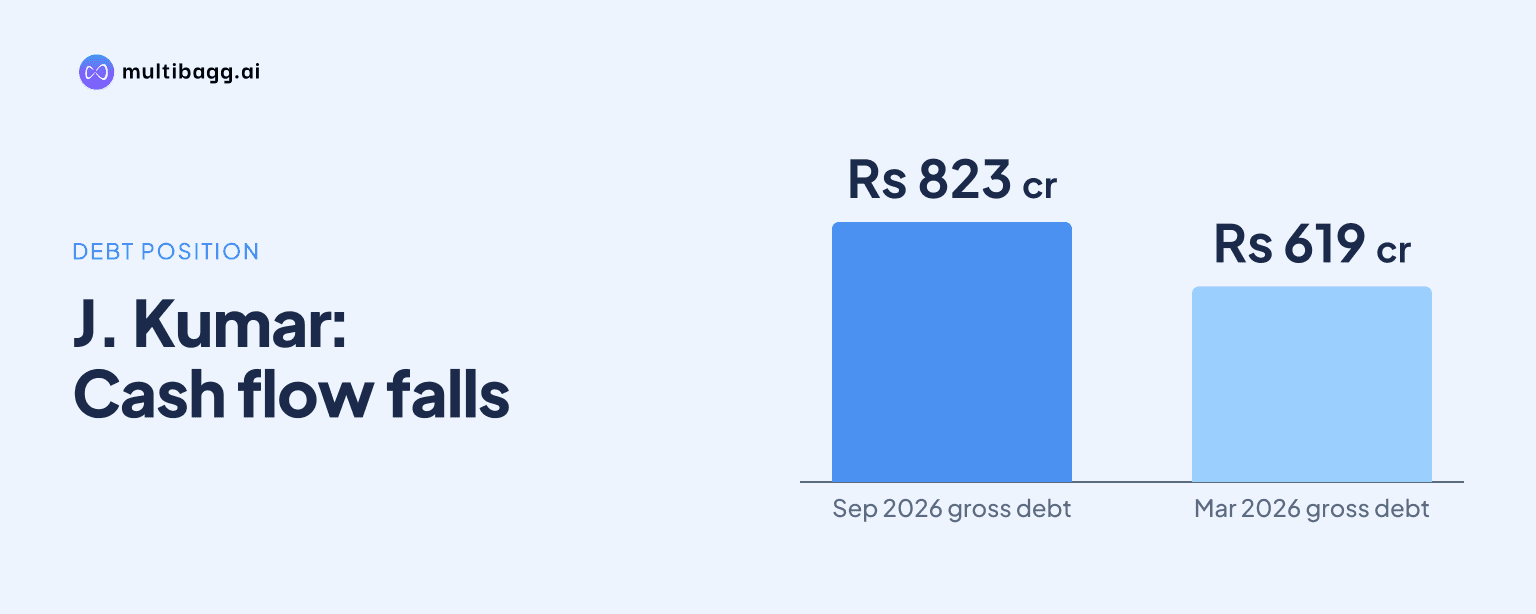
J. Kumar Infraprojects recorded an ₹18 crore net operating cash outflow in H1FY27 after a ₹424 crore working-capital outflow, despite profit after tax rising 9% year on year to ₹211 crore; gross debt reached ₹823 crore at September 2026, up from ₹619 crore at March 2026.
Know J Kumar Infraprojects inside out
Results, valuation, peers and who's buying, in one view.
Why did J. Kumar’s operating cash flow turn negative in H1FY27?
J. Kumar’s operating cash flow turned negative because a ₹424 crore working-capital outflow largely offset ₹452 crore of operating profit before working-capital changes in H1FY27. Cash generated from operations was therefore ₹28 crore, and direct taxes paid, net of refunds, were ₹46 crore. Net cash used in operating activities was ₹18 crore in the first half of FY27.
The cash outcome differed sharply from the comparable period. In H1FY26, J. Kumar generated ₹441 crore of cash from operations after a ₹34 crore positive working-capital movement, then reported ₹411 crore of net operating cash inflow after ₹30 crore of taxes. In FY26, net cash from operating activities was ₹1,128 crore, supported by ₹1,344 crore of cash generated from operations.
What changed in J. Kumar’s working-capital position?
J. Kumar reported the H1FY27 working-capital change as a combined ₹424 crore outflow and did not provide a cash-flow bridge by individual balance-sheet account. The balance sheet showed trade receivables increasing by ₹23 crore to ₹1,514 crore between March 2026 and September 2026, while trade payables declined by ₹180 crore to ₹674 crore.
Other current-account movements went in different directions during the six months. Inventories fell by ₹69 crore to ₹262 crore and other current assets declined by ₹24 crore to ₹995 crore. Other financial liabilities within current liabilities decreased by ₹123 crore to ₹214 crore, while other current liabilities fell by ₹75 crore to ₹651 crore. The presentation does not assign a specific portion of the ₹424 crore outflow to any of these items.
How much did J. Kumar’s debt increase in H1FY27?
J. Kumar’s gross debt increased by ₹204 crore, from ₹619 crore at FY26-end to ₹823 crore in H1FY27. Long-term debt rose by ₹53 crore to ₹336 crore, while short-term debt increased by ₹151 crore to ₹487 crore. The gross debt-to-equity ratio moved to 0.23 from 0.18 at FY26-end, returning to the 0.23 reported in FY25.
The debt increase coincided with ₹85 crore of net cash from financing activities in H1FY27, compared with a ₹34 crore financing cash outflow in H1FY26. The presentation does not state that the entire movement in reported borrowings caused the financing cash flow. Shareholders’ funds increased by ₹193 crore to ₹3,561 crore, while cash and cash equivalents declined by ₹63 crore from ₹203 crore to ₹140 crore.
J. Kumar also reported ₹561 crore of bank balances other than cash and cash equivalents at September 2026, up from ₹490 crore in March 2026. Its stated net debt-to-equity ratio was negative 0.02 in H1FY27, compared with negative 0.08 in FY26. The presentation lists an ICRA A+ rating with a Positive outlook for fund-based and non-fund-based limits, without further explanation of rating drivers.
Got a follow-up? Ask IRIS
Did J. Kumar’s earnings improve despite the cash outflow?
J. Kumar’s reported earnings improved in H1FY27 even as operating cash flow turned negative. Revenue from operations increased 8% year on year to ₹3,050 crore, earnings before interest, tax, depreciation and amortisation (EBITDA) increased 8% to ₹443 crore, and profit after tax increased 9% to ₹211 crore. Cash profit after tax increased 10% to ₹309 crore.
Margins were largely stable but not uniformly higher. EBITDA margin was 14.5% in H1FY27, compared with 14.6% in H1FY26, while profit-after-tax margin was unchanged at 6.9%. Finance cost increased to ₹87 crore from ₹80 crore. The reported cash-flow outcome therefore coincided with the working-capital movement rather than a decline in reported profit.
The second quarter grew faster than the half year. Q2FY27 revenue rose 15% year on year to ₹1,539 crore, EBITDA rose 18% to ₹229 crore, and profit after tax increased 25% to ₹113 crore. Q2 EBITDA margin was 14.9%, up from 14.5% a year earlier, while profit-after-tax margin rose to 7.4% from 6.7%.
What operating base will J. Kumar carry into the next period?
J. Kumar reported an order book of ₹22,711 crore as of September 30, 2026, and said it received ₹5,547 crore of orders during H1FY27. Elevated corridors and flyovers accounted for 47% of the order book, followed by civil and other projects at 23% and roads and road tunnels at 19%. The company also stated that it was executing more than 40 ongoing projects.
Revenue in H1FY27 was concentrated in elevated corridors and flyovers, which represented 42% of ₹3,050 crore revenue. Roads and road tunnels contributed 19%, metro-elevated projects 15%, civil and other work 14%, and metro-underground projects 9%. Maharashtra accounted for 60% of H1FY27 revenue and Tamil Nadu for 15%, compared with 64% and 14%, respectively, of the September 2026 order book.
Conclusion
J. Kumar combined higher H1FY27 revenue, EBITDA and profit after tax with a markedly different cash-conversion result. A ₹424 crore working-capital outflow moved net cash from operating activities to an ₹18 crore outflow, versus a ₹411 crore inflow in H1FY26, while gross debt increased by ₹204 crore to ₹823 crore.
The next reported period will show whether cash generated from operations recovers from ₹28 crore and whether gross debt changes from its September 2026 level. J. Kumar has also disclosed plans to expand into other states, while its ₹22,711 crore order book and ₹5,547 crore of H1FY27 awards provide the disclosed base for tracking execution, collections and borrowings.