










Jagran print operating profit fell 34% as newsprint costs rose
Key highlights
- Jagran print advertising revenue rose 4% to Rs 281 crore in Q2FY27.
- Jagran print operating profit fell 34% to Rs 48 crore in Q2FY27.
- Jagran print operating margin declined to 12.9% from 20.3% a year earlier.
- Jagran consolidated operating expenses rose 9% as raw-material prices increased 27%.
powered by IRIS
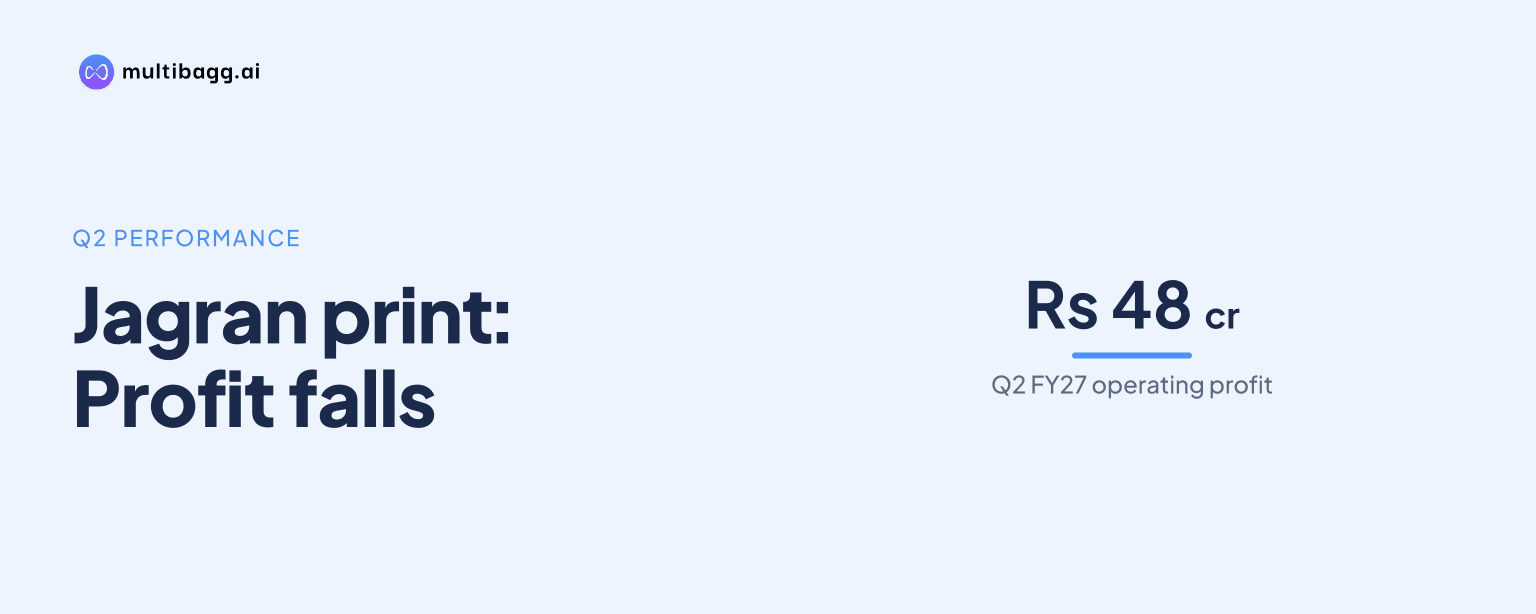
In Q2FY27, Jagran’s print operating profit fell 34% year on year to Rs 48 crore and its operating margin narrowed to 12.9%, despite a 4% rise in advertising revenue to Rs 281 crore. Jagran attributed the profitability pressure to higher newsprint prices amid geopolitical disruption to supply chains.
Know Jagran Prakashan inside out
Results, valuation, peers and who's buying, in one view.
Why did Jagran print operating profit fall in Q2FY27?
Jagran’s print operating profit declined by Rs 25 crore, from Rs 73 crore in Q2FY26 to Rs 48 crore in Q2FY27, because higher newsprint prices affected profitability. The company linked those prices to the ongoing geopolitical situation and resulting supply-chain disruptions, rather than citing a decline in advertising revenue as the reason for the profit movement.
The margin effect was substantial: print operating profit as a percentage of operating revenue dropped from 20.3% in Q2FY26 to 12.9% in Q2FY27, a decline of 7.4 percentage points. Profit before tax fell more sharply, by 40%, from Rs 84 crore to Rs 50 crore, while the corresponding profit-before-tax margin moved from 21.8% to 12.9%.
Jagran’s wider financial results provide further context on input costs. Consolidated operating expenses increased 9% to Rs 436 crore in Q2FY27, versus a 6% rise in operating revenue to Rs 493 crore; the company said operating expenses increased primarily because raw-material prices rose 27%. That group-level disclosure is consistent with the stated pressure from newsprint in print, although Jagran did not provide a standalone newsprint-cost amount for the segment.
Did advertising revenue offset Jagran’s print cost pressure?
No, Jagran’s 4% year-on-year increase in print advertising revenue did not offset the cost pressure, as segment operating profit still declined 34% to Rs 48 crore in Q2FY27. Advertisement revenue increased by Rs 11 crore to Rs 281 crore, even though the company said the entire festive season had shifted to Q3FY27.
Circulation revenue moved in the opposite direction, declining 1% from Rs 81 crore in Q2FY26 to Rs 80 crore in Q2FY27. Jagran said initiatives in its circulation business supported stabilisation and that it expects improvement going forward, but it did not quantify a circulation target, timetable, price change or volume outcome in the presentation.
The combined movement shows the difference between top-line growth and profitability in the quarter. Advertising added Rs 11 crore while circulation declined by Rs 1 crore, yet operating profit declined by Rs 25 crore. The figures do not establish a precise cost bridge, but Jagran’s stated explanation is that higher newsprint prices and supply disruption outweighed the revenue growth.
How did Dainik Jagran perform against the print business?
Dainik Jagran’s advertising revenue rose 5% to Rs 237 crore in Q2FY27, faster than the 4% growth reported for Jagran’s total print advertising revenue of Rs 281 crore. Its circulation revenue fell 1% to Rs 67 crore, matching the direction of the wider print business, where circulation revenue also declined 1% to Rs 80 crore.
Dainik Jagran’s operating profit fell 27% from Rs 69 crore to Rs 50 crore, while its operating margin declined from 23.0% to 16.1%. That was a smaller percentage profit decline than the print business’s 34% decline to Rs 48 crore, though both sets of results show margins falling amid the company’s cited rise in newsprint prices.
The profitability comparison also extends to profit before tax. Dainik Jagran’s profit before tax decreased 33% from Rs 81 crore in Q2FY26 to Rs 54 crore in Q2FY27, and its margin moved from 25.1% to 16.5%. Jagran said Dainik Jagran’s leadership position remained intact, but the presentation did not provide circulation share, readership data or advertising market-share figures to measure that position.
Got a follow-up? Ask IRIS
What does Jagran’s group performance say about print pressure?
Jagran’s consolidated operating profit declined 14% to Rs 57 crore in Q2FY27, a smaller fall than the print segment’s 34% decline to Rs 48 crore. Consolidated operating revenue rose 6% to Rs 493 crore, while operating expenses rose 9% to Rs 436 crore, indicating that other businesses partly reduced the impact of the print margin contraction at the group level.
Radio delivered a contrasting result: operating revenue rose 8% from Rs 38 crore to Rs 41 crore, operating expenses fell 20% from Rs 43 crore to Rs 35 crore, and operating profit changed from a Rs 5 crore loss to a Rs 6 crore profit. Jagran attributed Radio City’s profitability change to cost-rationalisation initiatives and operational-efficiency measures; Radio City’s market share was 19% in Q2FY27.
Digital and outdoor and events also reported higher revenue, although their profit contributions differed. Group digital revenue, excluding radio digital, rose 24% from Rs 22 crore to Rs 27 crore and operating profit improved from a Rs 3 crore loss to Rs 1 crore profit. Outdoor and events revenue grew 10% from Rs 52 crore to Rs 57 crore, while operating profit remained Rs 2 crore; Jagran said new outdoor inventories were in a gestation period.
What should readers watch in Jagran’s next print update?
Readers should watch whether advertising revenue benefits when the festive season shifts into Q3FY27, since Jagran specifically said the entire season moved out of Q2FY27. The relevant comparison will be whether print revenue growth translates into an improvement from the 12.9% operating margin reported in Q2FY27, rather than only a higher advertising-revenue figure.
Newsprint prices and supply-chain conditions remain the other disclosed variables. Jagran has identified geopolitical disruption as the mechanism behind higher newsprint prices, while the group reported a 27% increase in raw-material prices in Q2FY27. The presentation gives no price forecast, procurement plan or margin target, so the future effect of those inputs remains unresolved.
Conclusion
Jagran’s Q2FY27 print results show a business in which revenue held up better than profit: advertising revenue increased 4% to Rs 281 crore despite the festive-season shift, but circulation revenue slipped 1% and operating profit fell 34% to Rs 48 crore. The margin decline from 20.3% to 12.9% places the company’s stated newsprint and supply-chain pressure at the centre of the quarter’s financial outcome.
The next disclosed catalyst is the festive season’s placement in Q3FY27, which management said was entirely outside the reported Q2FY27 period. Readers should also monitor whether circulation initiatives produce the improvement Jagran expects and whether geopolitical supply disruptions continue to affect newsprint prices, as the presentation does not set a numerical cost or margin target.