










Jai Balaji Industries Q1 Revenue Rises 24% to ₹1,683 Crore
Key highlights
- Jai Balaji Industries reported Q1 FY27 revenue of ₹1,683 crore, up 24% year-on-year.
- Q1 FY27 net profit increased 21% to ₹85 crore, while EPS rose to ₹0.93 from ₹0.77.
- Value-added products contributed 42% of Jai Balaji Industries' Q1 FY27 sales.
- Jai Balaji Industries reported net term debt of ₹188 crore and scheduled its Q2 FY27 board meeting for 5 November 2026.
powered by IRIS
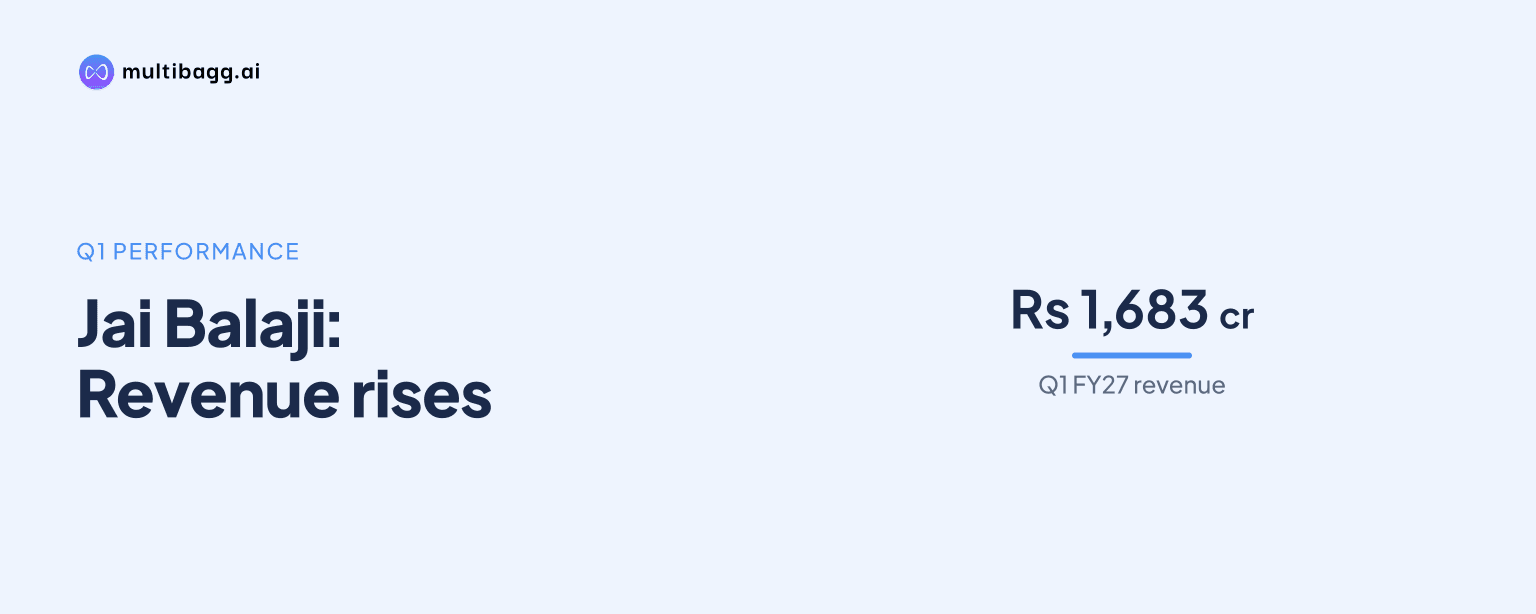
Jai Balaji Industries Limited reported Q1 FY27 revenue of ₹1,683 crore, a 24% year-on-year increase, while net profit rose 21% to ₹85 crore and earnings per share reached ₹0.93. The result matters because the integrated steel producer combined higher sales with improved operating performance and a lower net term debt position despite subdued demand in the ductile iron pipe market.
Know Jai Balaji Industries inside out
Results, valuation, peers and who's buying, in one view.
What did Jai Balaji Industries report in Q1 FY27?
Jai Balaji Industries reported revenue of ₹1,683 crore for the quarter ended June 2026, compared with ₹1,357 crore in the corresponding quarter a year earlier. Net profit rose to ₹85 crore from about ₹70 crore, while EPS increased to ₹0.93 from ₹0.77 in Q1 FY26.
The company said adjusted EBITDA grew 46% year-on-year and profit after tax increased 21%. Revenue growth was supported by price normalisation, operational efficiency and a better product mix. Value-added products accounted for 42% of sales during the quarter, highlighting the contribution from products such as ductile iron pipes and specialised ferro alloys.
The reported net profit margin was 5.1%, marginally below 5.2% in Q1 FY26. This indicates that profit growth did not fully match the pace of revenue growth, even as the company recorded a substantial increase in adjusted EBITDA.
What drove Jai Balaji Industries' quarterly performance?
Jai Balaji Industries attributed the Q1 FY27 performance to price normalisation, higher operating efficiency and an improved sales mix. The company manufactures and markets iron and steel products, with operations focused on value-added areas including ductile iron pipes and specialised ferro alloys.
The 42% contribution from value-added products was a material feature of the quarter. These products form part of the company's effort to move beyond commodity steel and increase its presence in specialised segments used in infrastructure and industrial applications.
The operating-profit trend also improved from the immediately preceding reported quarters. Operating profit was ₹151 crore in the June 2026 quarter, compared with ₹92 crore in the March 2026 quarter and ₹127 crore in the June 2025 quarter. These figures provide context for the company’s stated 46% increase in adjusted EBITDA.
Why does the ductile iron pipe market remain important?
Jai Balaji Industries is an integrated Eastern India steel producer with a focus on ductile iron pipes and specialised ferro alloys. Ductile iron pipes are a key value-added category for the company, making demand conditions in that market relevant to its production utilisation and sales mix.
Management said the ductile iron pipe market remained subdued during Q1 FY27, affecting utilisation. This was an operational constraint even as the company delivered higher revenue and profit. The source does not quantify the level of utilisation or the volume impact from the weaker market.
The company has also revised its capital expenditure outlay upward. No revised capex amount, project timeline or funding structure was disclosed in the information provided. Investors therefore have a confirmed indication of higher planned spending, but not enough detail to assess its financial effect.
Got a follow-up? Ask IRIS
How has Jai Balaji Industries reduced debt?
Jai Balaji Industries lowered net term debt to ₹188 crore in Q1 FY27, according to its quarterly summary. The reduction is relevant because debt levels can affect interest costs, balance-sheet flexibility and the ability to fund capital expenditure in a cyclical steel industry.
The company did not disclose a comparable net term debt figure for the prior period in the supplied information. As a result, the precise amount of debt reduction cannot be calculated from the available data. Still, the reported ₹188 crore level is part of the company’s stated progress on deleveraging.
The debt update should be viewed alongside the higher capex outlay. Lower term debt and increased investment plans can both be important to future financial performance, but the source does not state whether additional borrowing, internal accruals or other funding sources will be used for the revised expenditure.
When will Jai Balaji Industries release Q2 FY27 results?
Jai Balaji Industries has scheduled a board meeting on 5 November 2026 to consider and approve unaudited financial results for the quarter ended 30 September 2026, which is Q2 FY27. The meeting will also consider the company’s unaudited first-half FY27 results.
The company said its trading window was closed from 1 October and will remain closed until 48 hours after the results announcement, in line with SEBI regulations. This restriction applies to trading by designated persons under the company’s insider-trading compliance framework.
The next disclosure will provide an update on whether Q1 revenue momentum, product mix gains and debt reduction continued into the September quarter. It may also give additional information on ductile iron pipe demand, utilisation and the revised capex programme.
How did the market react to the Q1 FY27 result?
The supplied quarterly data records a share-price move from ₹68.87 to ₹70.60 following the Q1 FY27 release, a gain of 2.5%. The data table lists the release date as 14 August 2026, while a separate earnings reference is dated 15 August; the supplied material does not resolve this date difference.
For valuation context, the source states that the average forward price-to-earnings ratio for India’s metals and mining industry was 18 times. It does not provide Jai Balaji Industries' own forward P/E ratio, so a direct valuation comparison cannot be made from the available information.
Conclusion
Jai Balaji Industries delivered Q1 FY27 revenue growth of 24% to ₹1,683 crore and net profit growth of 21% to ₹85 crore. Improved pricing, operating efficiency and a higher contribution from value-added products supported the result, while the company also reported net term debt of ₹188 crore. Subdued ductile iron pipe demand and the small decline in net profit margin remain relevant operating considerations.
The immediate event to watch is the board meeting scheduled for 5 November 2026, when Jai Balaji Industries will consider Q2 FY27 and first-half FY27 unaudited results. Investors will look for disclosed progress on ductile iron pipe utilisation, debt reduction and the higher capital expenditure plan.