










Jain Resource uses local sourcing to manage lead disruption
Key highlights
- Lead volume increased about 8% sequentially to 34,851 metric tons in Q2 FY27.
- Domestic sourcing represented about 38% to 39% of Jain Resource’s overall purchases.
- Working-capital days fell to 49 at September 2026 from 66 at FY26-end.
- Management expected Kuwait machinery to ship within 30 days after containers became available.
powered by IRIS
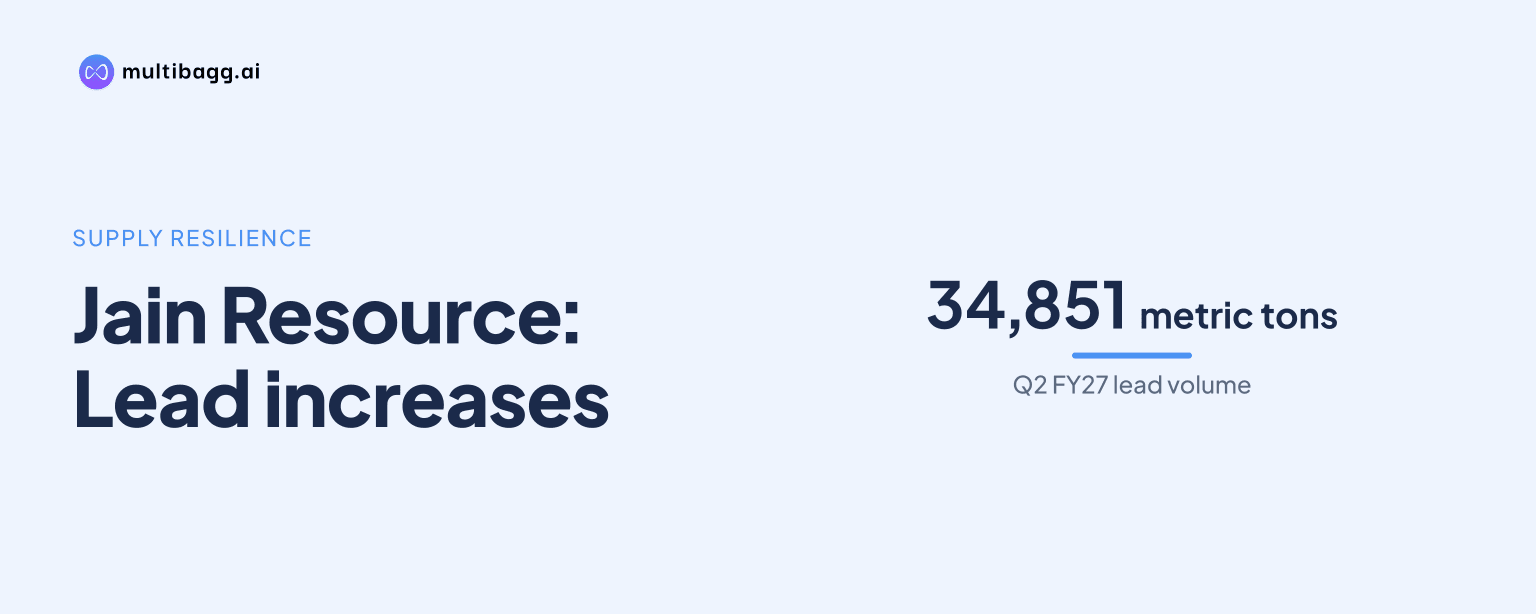
Jain Resource said in Q2 FY27 that local purchases and new sourcing geographies would help it manage lead-scrap disruption, after Middle East shipping constraints and higher freight costs. Lead and lead-alloy ingot volume rose sequentially to 34,851 metric tons from 32,150 metric tons, while domestic sourcing represented about 38% to 39% of total purchases.
Know Jain Resource Recycling inside out
Results, valuation, peers and who's buying, in one view.
How is Jain Resource managing lead-scrap shipping disruption?
Jain Resource is managing the disruption through greater local procurement and new sourcing areas for lead feedstock. Management said Middle East supplies had become stuck because of shipping disturbance, while freight costs had risen sharply, creating a raw-material challenge for the lead business. It nevertheless said Q3 sourcing should be manageable through domestic purchases and new locations being explored.
The immediate operating evidence was a sequential improvement in Q2 FY27 lead output. Lead and lead-alloy ingot volume rose to 34,851 metric tons from 32,150 metric tons in Q1 FY27, while segment earnings before interest, tax, depreciation and amortisation, or EBITDA, increased to Rs 67 crore from Rs 60 crore. Management said lead volume remained below the year-earlier quarter because supply disruption persisted.
Management told an analyst that Jain Resource had arranged raw material for the following four months and did not expect a sourcing problem through March. That was a management outlook rather than a formal volume target. The company also said recycling growth depends on sourcing, while freight levels and shipping routes remain outside its control.
What share of Jain Resource purchases is sourced domestically?
Jain Resource said domestic sourcing currently represents about 38% to 39% of overall purchases across copper, lead and aluminium. This was management’s clarified company-wide measure after an earlier comment that local sourcing had become “more than 50%, 60% now” while discussing the lower capital requirement from buying closer to its plants.
The domestic mix is not confined to end-of-life lead-acid batteries. Management said Jain Resource is buying crude lead locally and also procuring copper in India, while retaining overseas purchases and identifying new foreign locations. The approach therefore combines local supply with broader import diversification rather than replacing imports entirely.
Local purchases change the working-capital mechanism because imported material formerly required payment against loading and could take around two months to reach the factory. Management said liquidity was tied up during that transit period. At September 2026, Jain Resource’s working-capital cycle was 49 days, compared with 66 days at the end of FY26, and net debt to equity was 0.5 times against 0.7 times at March 2026.
Management said the working-capital cycle could move by about 10 days above or below the Q2 FY27 level, with a broad range of 50 to 70 days. It attributed the variation to scrap shipments arriving from 120 countries at different times and ports. The 49-day September 2026 result is therefore not a fixed commitment for subsequent quarters.
Got a follow-up? Ask IRIS
Can Kuwait become a new lead sourcing route for Jain Resource?
Jain Resource said Kuwait is intended as a future sourcing point for lead-ingot raw-material requirements, but the project still depends on transporting manufactured machinery. Management said war-related logistics issues had delayed the project because carriers and specialised containers to move the equipment were unavailable.
Management said the situation had improved during the two weeks before the call, with specialised containers becoming available. It expected machinery to be shipped within the next 30 days and said implementation could proceed quickly after arrival because other preparations were ready. Jain Resource did not disclose a commissioning date, plant capacity or production target for Kuwait.
The update was more specific than the opening remarks, when Jain Resource declined to give a firm Kuwait execution timetable because West Asia’s geopolitical and logistical conditions were beyond its control. The company described the investment as part of a long-term plan for raw-material security and a presence in the Middle East recycling market, rather than a completed answer to Q2 FY27 lead constraints.
What do the sourcing changes mean for Jain Resource’s output and finances?
Jain Resource’s Q2 FY27 revenue growth was led by copper volumes and the initial contribution from value-added products rather than lead alone. Consolidated revenue from operations reached Rs 3,337 crore, compared with Rs 2,724 crore in Q1 FY27 and Rs 2,113 crore in Q2 of the prior year. Management said lead volume remained constrained against the year-earlier period.
Copper and copper-ingot sales volume increased to 16,411 metric tons in Q2 FY27 from 14,683 metric tons in Q1 FY27 and 9,434 metric tons a year earlier. Copper EBITDA rose to Rs 61 crore from Rs 46 crore sequentially, while EBITDA per ton increased to Rs 37,237 from Rs 31,825. By comparison, lead EBITDA per ton rose to Rs 19,310 from Rs 18,660.
The cash-flow figures give further context to the sourcing strategy. Jain Resource generated Rs 129 crore of net cash inflow from operating activities in H1 FY27, while first-half revenue rose 65% year-on-year to Rs 6,061 crore. However, H1 FY27 EBITDA was Rs 248 crore against Rs 250 crore a year earlier, and EBITDA margin was 4.1% against 6.8%.
Conclusion
Jain Resource is responding to lead-scrap shipping disruption with domestic purchases, new overseas origins and a proposed Kuwait sourcing base. The approach coincided with an 8% sequential increase in lead volume and a 17-day reduction in the working-capital cycle from FY26-end. However, management’s clarified figure puts domestic sourcing at 38% to 39% of all purchases, leaving the company exposed to international freight and logistics conditions.
The next disclosures to watch are whether Kuwait machinery is shipped within the stated 30 days, whether Jain Resource maintains raw-material availability through March as management expects, and whether working capital stays within the indicated 50-to-70-day range. Management also targets Q3 FY27 commissioning of copper wire rod, busbar and profiles facilities, with commercial benefits expected to build as output stabilises and utilisation increases.