










Jay Bharat Maruti H1 FY'27 margin falls to 9.83% on incentives
Key highlights
- Jay Bharat Maruti's H1 FY'27 total income rose 27.62% to Rs 1,455.65 crore.
- Jay Bharat Maruti's H1 FY'27 EBITDA margin declined to 9.83% from 11.25%.
- Jay Bharat Maruti's incentive eligibility fell by Rs 24.65 crore to Rs 64.05 crore in H1 FY'27.
- Jay Bharat Maruti's H1 FY'27 PAT rose 27.30% to Rs 52.32 crore after the tax rate changed to 25.17%.
powered by IRIS
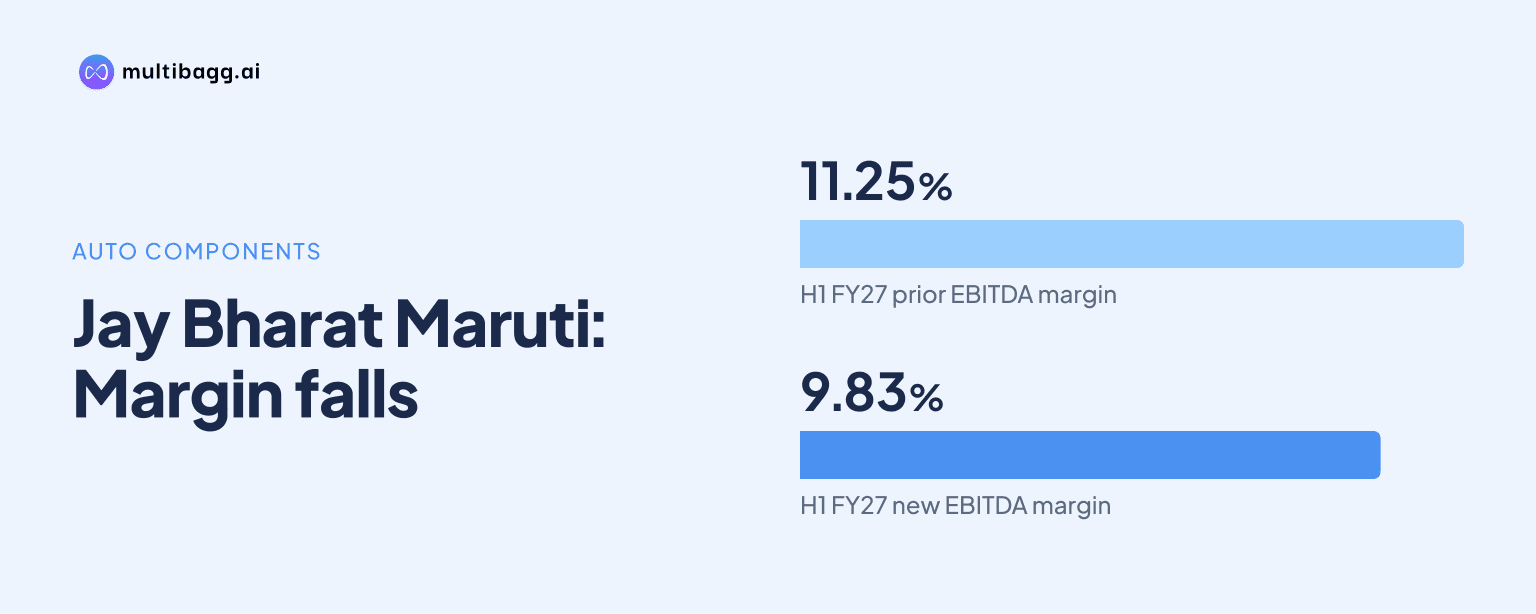
Jay Bharat Maruti Ltd reported a 9.83% EBITDA margin in H1 FY'27, down 1.42 percentage points from H1 FY'26, as incentive eligibility fell to Rs 64.05 crore from Rs 88.70 crore; total income still increased 27.62% to Rs 1,455.65 crore.
Know Jay Bharat Maruti inside out
Results, valuation, peers and who's buying, in one view.
What caused Jay Bharat Maruti's H1 FY'27 EBITDA margin decline?
Jay Bharat Maruti's earnings before interest, tax, depreciation and amortisation (EBITDA) margin declined mainly because its incentive eligibility was lower in H1 FY'27. Incentive eligibility was Rs 64.05 crore, compared with Rs 88.70 crore in H1 FY'26, a reduction of Rs 24.65 crore. Jay Bharat Maruti said lower incentive eligibility reduced the EBITDA percentage, while EBITDA excluding incentives remained positive.
The margin decline occurred even though absolute EBITDA increased. EBITDA rose 11.52% to Rs 143.06 crore from Rs 128.29 crore, but this increase lagged the 27.62% rise in total income. Consequently, the EBITDA margin fell to 9.83% from 11.25%, showing that operating profit grew more slowly than sales.
How did Jay Bharat Maruti's income growth compare with profit growth?
Jay Bharat Maruti's total income rose by Rs 315.07 crore to Rs 1,455.65 crore in H1 FY'27, while EBITDA increased by Rs 14.77 crore to Rs 143.06 crore. The 27.62% income increase exceeded the 11.52% EBITDA increase, resulting in the 1.42-percentage-point EBITDA-margin reduction.
The company identified higher MSIL volumes as a positive operating factor because they improved capacity utilisation and operating performance. It also reported that Sheet Metal turnover rose 34% in H1 FY'27 compared with H1 FY'26. These volume-related benefits supported higher profit in rupee terms but did not offset the lower incentive eligibility in the reported margin.
PBT rose 9.46% to Rs 69.97 crore from Rs 63.92 crore, slower than both income and EBITDA growth. PBT represented 4.81% of total income in H1 FY'27, compared with 5.60% in H1 FY'26. The pressure at the EBITDA level therefore continued through the pre-tax result despite increases in absolute profit.
Which costs put pressure on Jay Bharat Maruti's H1 FY'27 margin?
Jay Bharat Maruti reported higher material, employee and other-expense ratios in H1 FY'27. Material cost was 74.22% of total income, up from 73.01% in H1 FY'26, and management cited adverse commodity prices in the context of the West Asia conflict as a negative factor.
Employee cost was 9.07% of income, compared with 9.05% a year earlier, while other expenses were 6.89%, compared with 6.70%. Management attributed higher employee cost to a hike in Haryana minimum wages. The presentation did not quantify the rupee effect of commodity prices, wage changes or the higher utilisation on H1 EBITDA.
Got a follow-up? Ask IRIS
Did lower financing and depreciation ratios offset the operating pressure?
Jay Bharat Maruti's lower interest-expense and depreciation ratios partly moderated the operating pressure in H1 FY'27. Interest expense was 1.48% of total income, down from 1.67%, and depreciation was 3.54%, down from 3.98%. Management described finance cost as stable despite expansion of new plants.
The lower ratios did not prevent a decline in the PBT margin because the EBITDA-margin movement was larger. EBITDA margin declined 1.42 percentage points to 9.83%, whereas the interest-expense ratio declined 0.19 percentage points and the depreciation ratio declined 0.44 percentage points. EBIT increased 10.38% to Rs 91.54 crore, still below the 27.62% rate of total-income growth.
Jay Bharat Maruti disclosed ratios rather than H1 amounts for interest expense and depreciation. It also gave no separate monetary estimate for the effects of its new-plant expansion, commodity prices or Haryana wage increases. The available figures establish that these cost and funding items moved alongside the lower incentive eligibility, but do not allocate the margin movement among them.
Why did Jay Bharat Maruti's PAT grow faster than EBITDA?
Jay Bharat Maruti's PAT grew 27.30% to Rs 52.32 crore because it adopted a new tax regime with a revised tax rate of 25.17%, compared with 34.94% previously. The company specifically said the lower tax rate was the reason H1 FY'27 PAT was higher.
The tax-rate change kept the PAT margin almost unchanged despite the operating-margin decline. PAT was 3.59% of total income in H1 FY'27, versus 3.60% in H1 FY'26, while EBITDA margin fell to 9.83% from 11.25%. In absolute terms, PAT increased by Rs 11.22 crore, compared with a Rs 14.77 crore increase in EBITDA.
The presentation gives no H2 FY'27 EBITDA-margin target, incentive-eligibility forecast or quantified commodity-cost outlook. Management's disclosed positive factors were 34% growth in Sheet Metal turnover, higher MSIL volumes and stable finance cost, while its listed negative factors were adverse commodity prices and higher Haryana minimum wages.
Conclusion
Jay Bharat Maruti delivered higher H1 FY'27 income, EBITDA, EBIT, PBT and PAT, but profitability relative to sales narrowed at the operating and pre-tax levels. Total income increased 27.62% to Rs 1,455.65 crore, while EBITDA grew 11.52% to Rs 143.06 crore and the margin fell to 9.83%, principally alongside a Rs 24.65 crore decline in incentive eligibility.
The next results will indicate whether higher MSIL volumes, improved capacity utilisation and 34% Sheet Metal turnover growth continue to support earnings while material costs and Haryana wages remain headwinds. Jay Bharat Maruti has not disclosed an H2 FY'27 margin target or an expected incentive-eligibility amount, leaving both as unresolved factors for the second half.