










Jayant Agro-Organics gains Vithal control, adds Rs 2.16 crore goodwill
Key highlights
- Vithal Castor Polyols became a Jayant Agro-Organics subsidiary from 21 May 2026.
- Jayant Agro-Organics recorded Rs 25.37 crore of consideration for the controlling stake.
- Goodwill on consolidation was Rs 2.16 crore at 30 September 2026.
- Consolidated inventories rose to Rs 540.29 crore from Rs 266.34 crore at 31 March 2026.
powered by IRIS
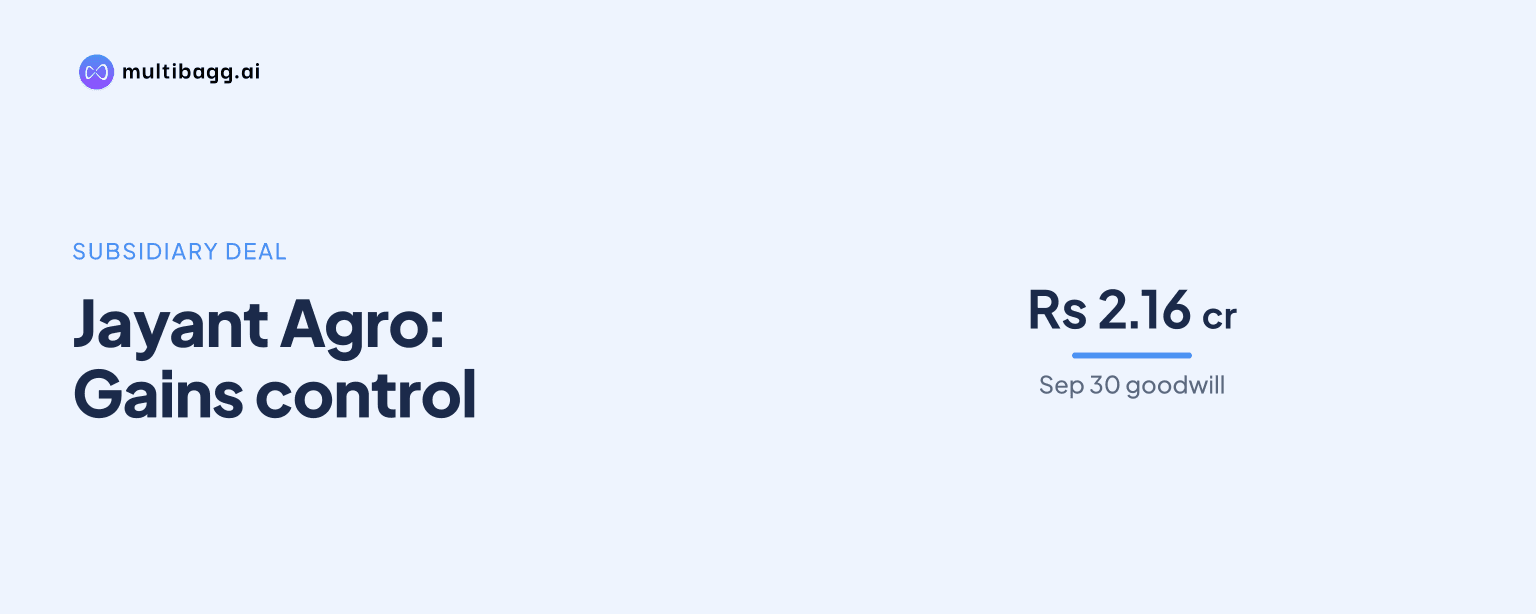
Jayant Agro-Organics Limited made Vithal Castor Polyols Private Limited a subsidiary from 21 May 2026, paying Rs 25.37 crore for the controlling stake and reporting Rs 2.16 crore of goodwill on consolidation at 30 September 2026. Consolidated inventories simultaneously rose to Rs 540.29 crore from Rs 266.34 crore at 31 March 2026.
Know Jayant Agro Organics inside out
Results, valuation, peers and who's buying, in one view.
When did Vithal Castor Polyols become a Jayant Agro-Organics subsidiary?
Vithal Castor Polyols became a Jayant Agro-Organics subsidiary on 21 May 2026, having been classified as a joint venture until 20 May 2026. The independent auditor’s report lists Vithal Castor Polyols among subsidiaries from 21 May and separately identifies it as a joint venture only up to the preceding day. This changed the entity’s treatment in the consolidated accounts for the remainder of the half year ended 30 September 2026.
The filing does not disclose the ownership percentage acquired, the seller, or Vithal Castor Polyols’ individual revenue and profit. It therefore does not allow readers to isolate the acquired entity’s direct contribution to the group’s Rs 1,583.95 crore revenue from operations in the half year. The consolidated statement still records Rs 10.54 lakh as the share of profit of a joint venture, compared with Rs 20.14 lakh a year earlier, but does not identify that joint venture.
How much did Jayant Agro-Organics pay for the controlling stake?
Jayant Agro-Organics paid Rs 25.37 crore for the controlling stake in the joint venture during the half year ended 30 September 2026. The amount appears in investing cash flows as consideration for a controlling stake, with no comparable payment reported for the half year ended 30 September 2025. Net cash used in investing activities consequently rose to Rs 43.03 crore from Rs 12.42 crore.
The cash-flow statement also includes Rs 1.48 crore of cash and cash equivalents added on account of taking control. Opening cash and cash equivalents were Rs 11.95 crore, while closing cash was Rs 8.35 crore after a net decrease of Rs 5.08 crore during the half year. The filing does not provide a detailed purchase-price allocation or specify the acquired assets and liabilities underlying the consideration.
Goodwill on consolidation was reported at Rs 2.16 crore under non-current assets at 30 September 2026, whereas no such balance appeared at 31 March 2026. The new goodwill balance coincides with the control transaction, but Jayant Agro-Organics does not explain whether it represents expected operating benefits, an assembled workforce, or another acquisition-accounting component. No impairment assessment detail is included in the interim filing.
What changed in Jayant Agro-Organics’ balance sheet?
Jayant Agro-Organics’ consolidated assets increased to Rs 1,323.87 crore at 30 September 2026 from Rs 982.27 crore at 31 March 2026. Inventories were the largest reported movement, rising by Rs 273.95 crore to Rs 540.29 crore from Rs 266.34 crore. The filing reports both the Vithal Castor Polyols consolidation and the inventory increase, but does not allocate inventory growth between the acquired subsidiary, procurement volumes or pricing movements.
Trade receivables rose to Rs 340.01 crore from Rs 300.16 crore, while other current assets increased to Rs 51.26 crore from Rs 36.63 crore. Property, plant and equipment reached Rs 339.66 crore, up from Rs 323.47 crore, and capital work-in-progress increased to Rs 16.37 crore from Rs 10.04 crore. Cash expenditure on purchases of property, plant and equipment was Rs 17.72 crore in the half year, compared with Rs 12.42 crore in the prior-year period.
Current borrowings increased to Rs 447.30 crore at 30 September from Rs 121.59 crore at 31 March, while non-current borrowings declined to Rs 3.60 crore from Rs 5.03 crore. Other equity rose to Rs 632.22 crore from Rs 595.07 crore, and non-controlling interest increased to Rs 36.99 crore from Rs 31.71 crore. Jayant Agro-Organics does not assign the borrowing increase specifically to the acquisition, inventory build-up or any individual business segment.
Got a follow-up? Ask IRIS
How did inventory growth affect cash flow and borrowings?
Jayant Agro-Organics used Rs 259.32 crore in operating activities in the half year ended 30 September 2026, compared with Rs 46.35 crore used in the corresponding period of 2025. The cash-flow statement identifies a Rs 269.99 crore increase in inventories as the largest working-capital use of cash, versus a Rs 178.40 crore increase a year earlier. The Rs 41.04 crore increase in trade receivables also consumed cash, while receivables had generated Rs 117.31 crore in the prior-year half.
Profit before tax nevertheless increased to Rs 57.26 crore from Rs 34.58 crore, and operating profit before working-capital changes rose to Rs 85.29 crore from Rs 56.33 crore. After inventory, receivable, payable and other working-capital movements, cash used in operations was Rs 249.32 crore before Rs 10.01 crore of taxes paid. This means the cash outflow reflected balance-sheet funding needs despite higher reported pre-tax profit.
Financing activities generated Rs 297.27 crore of net cash, compared with Rs 60.15 crore in the earlier half year. Net borrowing proceeds were Rs 324.28 crore, against Rs 79.15 crore, while payments of finance costs increased to Rs 14.51 crore from Rs 9.87 crore. Dividends paid remained Rs 10.50 crore in both periods, so the increase in financing cash flow was principally linked to the reported borrowing movement.
Which business segments recorded the largest half-year activity?
Jayant Agro-Organics’ castor oil segment generated the highest half-year revenue at Rs 855.74 crore, ahead of Rs 725.13 crore from castor oil derivatives and Rs 3.08 crore from power generation. Castor oil revenue increased from Rs 586.59 crore in the half year ended 30 September 2025, while derivative revenue rose from Rs 583.44 crore. The company defines the castor oil segment as manufacturing and exporting grades of castor oil, and derivatives as value-added castor-oil products.
Castor oil derivatives produced the largest segment result at Rs 55.88 crore, compared with Rs 38.66 crore a year earlier. The castor oil segment result rose to Rs 14.32 crore from Rs 4.55 crore, while power generation contributed Rs 1.81 crore against Rs 0.94 crore. Total segment results increased to Rs 72.02 crore from Rs 44.15 crore before unallocable income and finance costs.
Castor oil segment assets were Rs 620.54 crore at 30 September 2026, up from Rs 349.91 crore at 31 March 2026. Derivative segment assets were Rs 651.70 crore, compared with Rs 594.46 crore at the March year-end. The filing does not state whether Vithal Castor Polyols is reported within the castor oil or castor oil derivatives segment, so the segment disclosures cannot measure its contribution separately.
Conclusion
Jayant Agro-Organics’ acquisition changed Vithal Castor Polyols from a joint venture into a subsidiary on 21 May 2026, creating Rs 2.16 crore of goodwill after Rs 25.37 crore of consideration. The change occurred alongside a Rs 341.60 crore increase in consolidated assets, including a Rs 273.95 crore rise in inventories, and a Rs 325.70 crore increase in current borrowings over the six months.
The next results announcement should provide a longer period of post-control consolidation for Vithal Castor Polyols. Matters still unresolved in the current filing include the ownership percentage acquired, the purchase-price allocation and Vithal Castor Polyols’ standalone sales and earnings, while inventory levels, operating cash flow and current borrowings remain disclosed balance-sheet items to watch.