










Jaysynth Orgochem operating cash flow turns positive in half year
Key highlights
- Jaysynth Orgochem generated Rs 3.51 crore of consolidated operating cash in the half year ended 30 September 2026, versus an Rs 11.61 crore outflow a year earlier.
- Jaysynth Orgochem’s consolidated inventory cash outflow fell to Rs 3.61 crore from Rs 11.96 crore year on year.
- Jaysynth Orgochem’s consolidated trade receivables rose to Rs 76.11 crore at 30 September 2026 from Rs 65.32 crore at 31 March 2026.
- Jaysynth Orgochem used Rs 4.66 crore for property, plant and equipment acquisitions in the half year ended 30 September 2026.
powered by IRIS
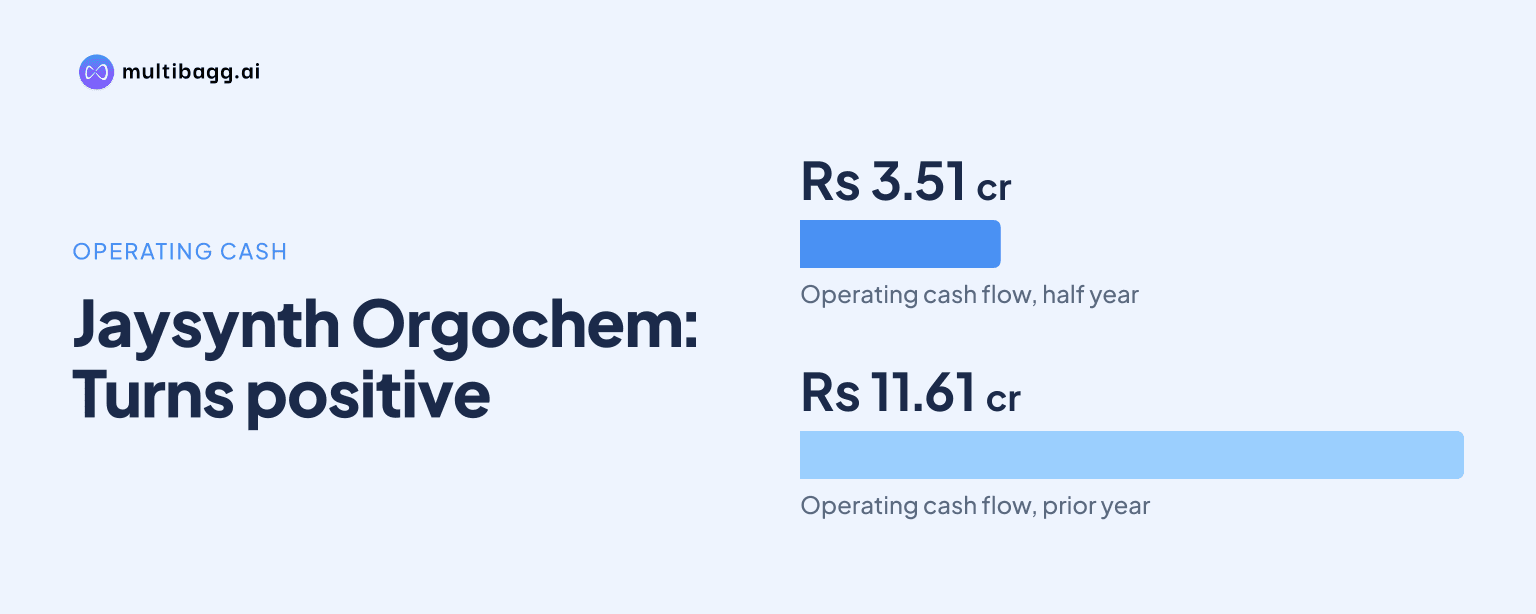
Jaysynth Orgochem Limited generated Rs 3.51 crore of consolidated net cash from operating activities in the half year ended 30 September 2026, reversing an Rs 11.61 crore outflow a year earlier. Cash generated from operations reached Rs 6.19 crore, as inventory cash absorption declined and trade and other payables increased.
Know Jaysynth Orgochem inside out
Results, valuation, peers and who's buying, in one view.
Why did Jaysynth Orgochem’s operating cash flow turn positive?
Jaysynth Orgochem’s operating cash flow turned positive because cash generated from operations was Rs 6.19 crore in the half year ended 30 September 2026, compared with cash used of Rs 11.54 crore in the corresponding 2025 period. Operating profit before working-capital changes increased to Rs 16.60 crore from Rs 10.68 crore, creating a larger base before inventory, receivable and payable movements.
The change also reflected higher reported profit before tax, which rose to Rs 14.07 crore from Rs 9.36 crore. Depreciation and amortisation, a non-cash adjustment in the reconciliation, was Rs 1.33 crore against Rs 1.39 crore, while finance costs added back were Rs 1.26 crore against Rs 1.42 crore. The 2026 reconciliation also included an Rs 40.41 lakh exchange-difference loss.
Direct-tax payments were Rs 2.69 crore in the 2026 half year, substantially above Rs 6.71 lakh in the prior-year half. After those payments, net cash from operating activities was Rs 3.51 crore, compared with the Rs 11.61 crore outflow reported for the half year ended 30 September 2025.
How did working capital affect Jaysynth Orgochem’s cash generation?
Jaysynth Orgochem still recorded cash outflows from inventories and receivables in the half year ended 30 September 2026, but both were lower than a year earlier. The consolidated inventory movement used Rs 3.61 crore, compared with Rs 11.96 crore in the 2025 half year, reducing this source of working-capital cash absorption by Rs 8.35 crore.
Trade and other receivables used Rs 11.07 crore of cash, against Rs 12.73 crore in the previous-year half. Receivables remained the largest disclosed working-capital cash outflow in both periods. The lower inventory and receivable outflows helped move cash generated from operations to Rs 6.19 crore from a negative Rs 11.54 crore.
Trade and other payables were the offsetting cash source, contributing Rs 4.27 crore in the 2026 half year versus Rs 2.46 crore a year earlier. The three disclosed working-capital lines produced a net outflow of Rs 10.41 crore, compared with an Rs 22.22 crore outflow in the half year ended 30 September 2025.
Did receivables and inventories still increase at Jaysynth Orgochem?
Jaysynth Orgochem’s consolidated trade receivables and inventories both rose between 31 March 2026 and 30 September 2026, despite the year-on-year easing in their cash-flow impact. Trade receivables increased to Rs 76.11 crore from Rs 65.32 crore, while inventories rose to Rs 94.73 crore from Rs 91.13 crore.
The balance-sheet changes correspond broadly with the cash-flow statement, although its receivables line covers trade and other receivables. Consolidated current assets rose to Rs 202.91 crore at 30 September 2026 from Rs 190.16 crore at 31 March 2026, and total assets increased to Rs 235.75 crore from Rs 219.62 crore.
Consolidated current liabilities rose to Rs 51.01 crore from Rs 45.63 crore over the same six months. Payables to micro and small enterprises increased to Rs 19.62 crore from Rs 16.28 crore, while payables to other creditors declined to Rs 12.99 crore from Rs 14.81 crore. The Rs 4.27 crore cash-flow contribution covers trade and other payables, not only the listed trade-payable categories.
Got a follow-up? Ask IRIS
How did Jaysynth Orgochem’s standalone cash flow compare?
Jaysynth Orgochem reported Rs 1.77 crore of standalone net operating cash in the half year ended 30 September 2026, compared with an Rs 11.12 crore outflow in the previous-year half. The consolidated operating-cash figure was Rs 3.51 crore for the same 2026 period.
Standalone cash generated from operations was Rs 4.46 crore, compared with cash used of Rs 11.06 crore a year earlier. Standalone inventory movement used Rs 2.94 crore against Rs 12.51 crore in 2025, trade and other receivables used Rs 12.66 crore against Rs 13.44 crore, and payables added Rs 4.54 crore against Rs 4.35 crore.
The consolidated review names Jaysynth (Europe) Ltd. as the subsidiary included in the group. Jaysynth Orgochem also disclosed that VarnaTex Limited was incorporated as a wholly owned subsidiary on 17 July 2026 and had not commenced operations as of the 13 November 2026 filing date; the filing does not quantify any cash-flow effect from VarnaTex.
What happened to Jaysynth Orgochem’s cash after operating activities?
Jaysynth Orgochem’s consolidated cash and cash equivalents increased by Rs 69.57 lakh during the half year ended 30 September 2026. The Rs 3.51 crore operating inflow was partly used for Rs 4.66 crore of property, plant and equipment acquisitions, while sale of investments supplied Rs 1.73 crore and financing activities used Rs 13.50 lakh.
Closing consolidated cash and cash equivalents were Rs 14.19 crore at 30 September 2026, compared with Rs 13.49 crore at the beginning of the half year. The closing reconciliation included Rs 7.82 crore of short-term bank deposits with maturities between three and 12 months, Rs 3.97 crore in current accounts and Rs 2.34 crore in an Exchange Earners’ Foreign Currency account.
Financing cash use narrowed from Rs 1.12 crore in the 2025 half year to Rs 13.50 lakh in 2026. Finance-cost payments were Rs 75.36 lakh, lease-liability repayments were Rs 7.02 lakh and bank-overdraft movements supplied Rs 68.88 lakh. At 30 September 2026, consolidated non-current borrowings were Rs 34.67 crore and current borrowings were Rs 7.36 crore.
Conclusion
Jaysynth Orgochem’s cash-flow statement shows that improved operating profit and a smaller working-capital drain changed consolidated operating cash generation from an Rs 11.61 crore outflow to a Rs 3.51 crore inflow in the half year ended 30 September 2026. Receivables remained the largest use of cash at Rs 11.07 crore, while payables provided Rs 4.27 crore.
The next financial results will show whether inventories of Rs 94.73 crore and trade receivables of Rs 76.11 crore at 30 September 2026 continue to rise or require further cash funding. They may also provide evidence of any financial contribution from VarnaTex, which had not begun operations following its incorporation on 17 July 2026.