










Laxmi India Finance reports 1.75% Stage-3 and 22.95% CRAR
Key highlights
- Laxmi India Finance reported gross Stage-3 assets of 1.75% and net Stage-3 assets of 0.50% at September 30, 2026.
- Laxmi India Finance reported a 22.95% CRAR, 3.31 debt-equity ratio and total debts equal to 76.16% of assets.
- Laxmi India Finance ended September 30, 2026 with Rs 66.36 crore of cash and cash equivalents, up Rs 24.01 crore from March-end.
- Laxmi India Finance raised and fully utilised Rs 100 crore of privately placed NCDs on September 2, 2026 without reported deviation.
powered by IRIS
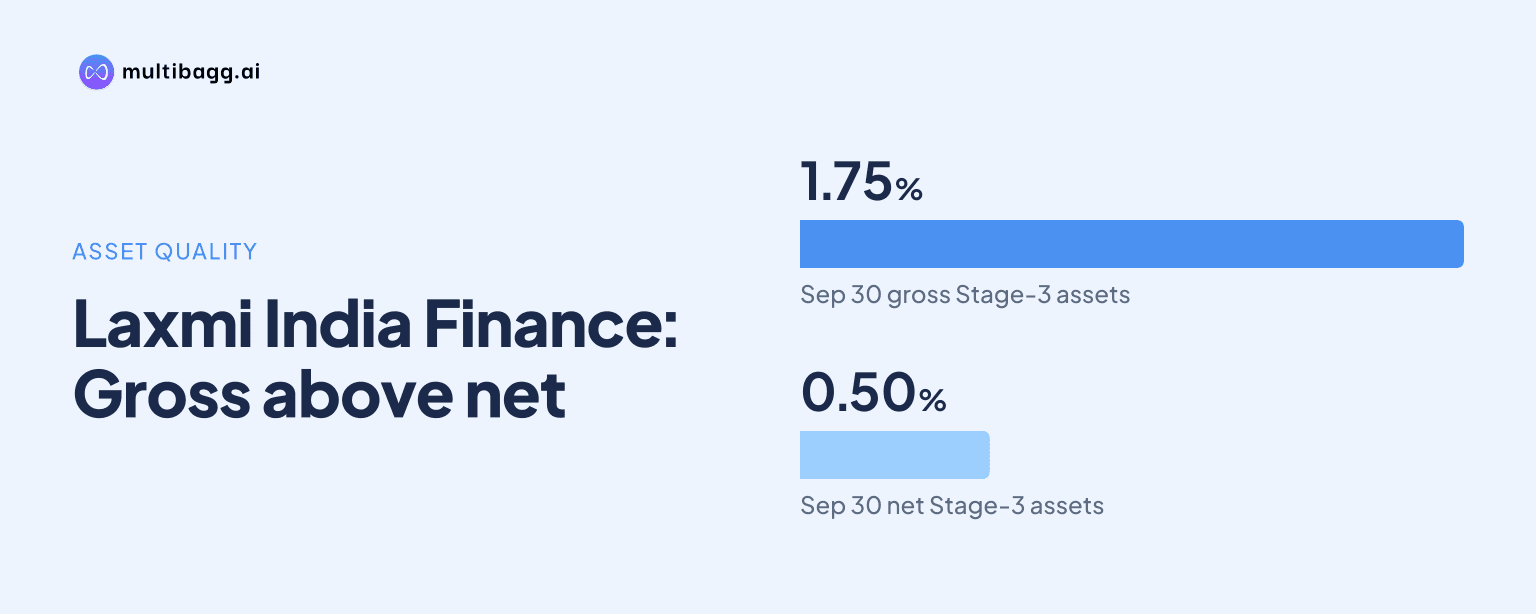
Laxmi India Finance Limited reported gross Stage-3 assets of 1.75%, net Stage-3 assets of 0.50% and a capital-to-risk weighted assets ratio, or CRAR, of 22.95% at September 30, 2026. The lender also disclosed a 3.31 debt-equity ratio and total debts equal to 76.16% of total assets.
Know Laxmi India Finance inside out
Results, valuation, peers and who's buying, in one view.
What were Laxmi India Finance's Stage-3 asset ratios at September-end?
Laxmi India Finance reported gross Stage-3 assets of 1.75% and net Stage-3 assets of 0.50% at September 30, 2026. These sector-specific ratios were included in the lender's Regulation 52(4) annexure covering the quarter and half year ended on that date.
The reported gap between gross and net Stage-3 assets was 1.25 percentage points. Laxmi India Finance did not disclose corresponding Stage-3 ratios for September 2025, June 2026 or March 2026 in this filing, so no period-on-period movement in asset quality can be calculated from the available information.
Laxmi India Finance recorded impairment on financial instruments of Rs 7.82 crore in its cash-flow statement for the period ended September 30, 2026. The statement showed Rs 14.05 crore for the year ended March 31, 2026, but the half-year and full-year periods are not directly comparable.
The lender also said it had not acquired stressed loans, transferred stressed loans, acquired loans in default through assignment, or transferred loans not in default through assignment during the period ended September 30, 2026. It further said it had not entered into any co-lending arrangement in the quarter ended September 30, 2026 under the cited Reserve Bank of India directions.
What capital and leverage metrics did Laxmi India Finance report?
Laxmi India Finance reported a CRAR of 22.95% at September 30, 2026. The company is categorised as a Middle Layer non-banking financial company, or NBFC, under the Reserve Bank of India's Scale Based Regulation framework.
Its debt-equity ratio was 3.31, while total debts represented 76.16% of total assets at September-end. The filing defines debt-equity as debt securities, borrowings other than debt securities and subordinated liabilities, divided by net worth.
Laxmi India Finance marked its liquidity coverage ratio as not applicable. It also marked debt-service coverage, interest-service coverage, current ratio, long-term debt to working capital, bad debts to accounts receivable, debtors turnover, inventory turnover and operating margin as not applicable or not relevant.
How did Laxmi India Finance's cash flows and cash balance change?
Laxmi India Finance ended September 30, 2026 with cash and cash equivalents of Rs 66.36 crore, up from Rs 42.36 crore at March 31, 2026. The Rs 24.01 crore increase reflected Rs 311.09 crore of financing cash inflows, which exceeded outflows from operating and investing activities.
Bank balances made up Rs 65.41 crore of the September-end cash-equivalent balance, while cash in hand was Rs 0.96 crore. At March 31, 2026, cash in hand was Rs 0.73 crore and bank balances were Rs 41.62 crore, showing that both disclosed components increased by September-end.
Net cash used in operating activities was Rs 185.70 crore for the period ended September 30, 2026, compared with Rs 279.99 crore used in the year ended March 31, 2026. The main working-capital movement in the September-ended period was a Rs 241.36 crore increase in loans, while income tax paid was Rs 13.25 crore.
Investing activities used Rs 101.38 crore during the September-ended period, including Rs 98.58 crore for purchase or sale of investments and Rs 2.80 crore for property, plant, equipment and intangible assets. The comparable full-year investing outflow was Rs 134.36 crore at March 31, 2026, again covering a longer reporting period.
Got a follow-up? Ask IRIS
What funding and debenture disclosures did Laxmi India Finance make?
Laxmi India Finance reported Rs 311.09 crore of net cash from financing activities for the period ended September 30, 2026. The cash-flow statement included Rs 224.24 crore of borrowing proceeds, Rs 86.69 crore from debt securities, Rs 0.51 crore of share premium and Rs 0.06 crore from issue of equity shares.
The lender separately disclosed two private placements of non-convertible debentures, or NCDs, on September 2, 2026. One issue raised Rs 70 crore and the other raised Rs 30 crore, and Laxmi India Finance reported that the entire Rs 100 crore had been utilised by September 30, 2026 without deviation or variation from the stated objects.
Laxmi India Finance said all its listed NCDs were secured by a first and exclusive charge on receivables through hypothecation, to at least 100% or a higher level of the outstanding amount specified in the relevant information memorandum and key information document. The company said it maintained the asset cover stated in the offer documents to discharge principal on those debt securities.
Security receipts outstanding at September 30, 2026 included Rs 23.98 crore in one Brickwork Ratings India Private Limited-rated line, Rs 8.64 crore in another Brickwork-rated line, Rs 4.76 crore in one Infomerics Valuation and Rating Private Limited-rated line and Rs 2.84 crore in another. The filing also said 72,278 security-receipt units worth Rs 7.23 crore had been fully redeemed during the period ended June 30, 2026.
How did Laxmi India Finance's equity and reported profit figures develop?
Laxmi India Finance reported net profit after tax, including other comprehensive income net of tax, of Rs 31.71 crore in its September 30, 2026 regulatory annexure. Basic earnings per share were Rs 6.11 and diluted earnings per share were Rs 6.09, while the reported net profit margin was 16.48%.
The cash-flow statement showed profit before tax of Rs 42.35 crore for the period ended September 30, 2026, against Rs 66.05 crore for the year ended March 31, 2026. Because the latter covers a full year, the filing does not provide a like-for-like basis for measuring any change in profit before tax.
During the quarter ended June 30, 2026, Laxmi India Finance allotted 125,203 fully paid equity shares with a face value of Rs 5 each to eligible employees exercising options under its 2023 employee stock option scheme. The company said paid-up equity share capital increased from Rs 26.13 crore to Rs 26.20 crore after that allotment.
During the half year ended September 30, 2026, Laxmi India Finance granted employee stock options under its existing 2023 scheme, with May 12, 2026 as the grant date. It also vested a second tranche of 135,683 stock options for eligible employees during the period ended September 30, 2026.
Conclusion
Laxmi India Finance's September-end filing combines 1.75% gross Stage-3 assets and 0.50% net Stage-3 assets with a 22.95% CRAR and 3.31 debt-equity ratio. Its cash balance rose by Rs 24.01 crore from March-end, while operating cash use of Rs 185.70 crore was associated principally with a Rs 241.36 crore increase in loans.
The next periodic results will be the key disclosure to watch for comparable Stage-3 and CRAR figures, which this filing does not provide for earlier periods. Investors can also monitor funding after the Rs 100 crore of September 2, 2026 private-placement NCDs was fully utilised by September 30 without reported deviation.