










Laxmi India Finance MSME AUM reached Rs 1,492.90 crore
Key highlights
- LIFL reported MSME AUM of Rs 1,492.90 crore in H1 FY27, versus Rs 1,298.68 crore in FY26.
- LIFL's wholesale AUM was Rs 89.19 crore in H1 FY27, compared with Rs 52.97 crore in FY26.
- LIFL reported that 37.1% of its borrowers were first-time borrowers.
- LIFL's Stage 3 provisioning coverage ratio was 71.99% in Q2 FY27.
powered by IRIS
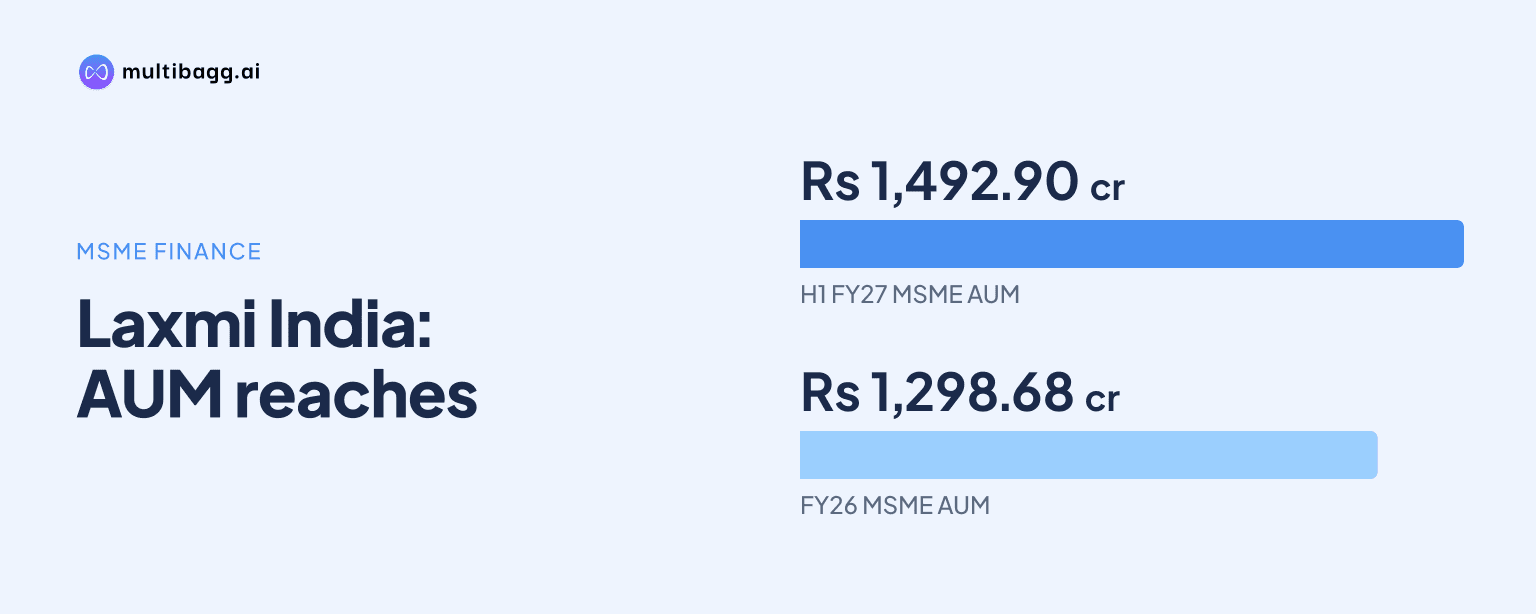
Laxmi India Finance recorded MSME assets under management (AUM) of Rs 1,492.90 crore in H1 FY27, its largest disclosed lending vertical, compared with Rs 1,298.68 crore in FY26. The company also reported that 37.1% of its borrowers were first-time borrowers across its stated customer segments and product range.
Know Laxmi India Finance inside out
Results, valuation, peers and who's buying, in one view.
How large was LIFL's MSME portfolio in H1 FY27?
LIFL's MSME AUM was Rs 1,492.90 crore in H1 FY27, making it the largest of the five verticals disclosed in its portfolio split. Construction and loan-against-property (LAP) AUM was Rs 95.74 crore, vehicle AUM was Rs 123.38 crore, wholesale AUM was Rs 89.19 crore and personal-loan AUM was Rs 42.68 crore.
MSME AUM was Rs 194.22 crore higher than the Rs 1,298.68 crore reported for FY26. The H1 FY27 MSME balance was also substantially larger than each other disclosed vertical, including the Rs 123.38 crore vehicle portfolio and the Rs 95.74 crore construction and LAP portfolio.
The comparison is between a full financial year and the first half of FY27, rather than like-for-like periods. It nevertheless shows that MSME, construction and LAP, and wholesale balances were above their FY26 levels at H1 FY27, while vehicle and personal-loan AUM were below FY26 balances.
How has LIFL's vertical AUM mix changed since FY23?
LIFL's MSME AUM increased from Rs 534.74 crore in FY23 to Rs 1,492.90 crore in H1 FY27. The disclosed MSME balance was Rs 720.55 crore in FY24, Rs 980.33 crore in FY25 and Rs 1,298.68 crore in FY26, showing that the vertical expanded in every reported period.
The presentation states an overall compound annual growth rate (CAGR) of 32.60%. It does not specify within the displayed vertical table whether this CAGR applies to a particular product category or to the combined AUM shown across the lending verticals.
Vehicle AUM followed a different path. It rose from Rs 94.98 crore in FY23 to Rs 176.44 crore in FY24 and Rs 205.88 crore in FY25, before declining to Rs 145.82 crore in FY26 and Rs 123.38 crore in H1 FY27.
Wholesale lending was Rs 5.32 crore in FY23, was not displayed for FY24, and was Rs 18.98 crore in FY25. It subsequently rose to Rs 52.97 crore in FY26 and Rs 89.19 crore in H1 FY27. Construction and LAP rose from Rs 51.73 crore in FY23 to Rs 95.74 crore in H1 FY27, while personal loans were Rs 42.68 crore in H1 FY27 versus Rs 43.18 crore in FY26.
What MSME and business products does LIFL provide?
LIFL provides MSME loans of up to Rs 25 lakh for working-capital limits and business expansion, secured by commercial or residential property. Its MSME Prime product has stated ticket sizes from Rs 25 lakh to Rs 50 lakh, with the same property types listed as security and business development, working capital and expansion as uses.
LIFL also offers unsecured business loans of up to Rs 2 crore for business development, working capital and business expansion. This product sits alongside property-backed MSME and MSME Prime lending, so the disclosed product suite includes both secured and unsecured business credit.
Wholesale lending has a stated ticket range of Rs 25 lakh to Rs 5 crore. LIFL says this product is intended for on-lending to individuals or groups for MSME and vehicle loans, with a loan portfolio listed as security. Its H1 FY27 wholesale AUM of Rs 89.19 crore was Rs 36.22 crore above the FY26 balance.
Construction and LAP loans have ticket sizes of up to Rs 25 lakh and are secured by residential property. They may be used for property purchase, house construction or renovation, and the vertical's AUM was Rs 95.74 crore in H1 FY27 compared with Rs 85.61 crore in FY26.
Got a follow-up? Ask IRIS
Which customers and distribution channels does LIFL use?
LIFL says 37.1% of its borrowers are first-time borrowers. Its stated MSME customer segment includes micro-enterprises and self-help groups (SHGs) in semi-urban and rural areas, served through small-ticket secured loans with flexible structures.
The lender also identifies self-employed business owners, including traders and service providers in Tier II and Tier III cities, as customers for working-capital and expansion loans. It describes this group as having a relationship-led, repeat-borrowing profile, while it identifies salaried professionals in the same city categories for small-ticket secured or cash-flow-backed loans.
LIFL uses branches, direct sales associates and the Laxmi Mitra app for multi-channel sourcing. These channels support the customer groups described in the presentation, including MSME borrowers, self-employed business owners, salaried professionals and vehicle owners.
Vehicle owners are another stated target group, including owners of commercial vehicles, tractors, three-wheelers and two-wheelers. The product range includes two-wheeler loans of up to Rs 1.5 lakh, commercial-vehicle loans of up to Rs 25 lakh and electric-vehicle loans of up to Rs 4 lakh for three-wheelers used in transportation and commercial activity.
How does LIFL assess vehicle loans and collections?
LIFL's vehicle-finance process begins with field screening of geography, sector and occupation. Field officers obtain the application form, know-your-customer (KYC) records and bank statements, after which branch-level checks include bureau checks, field investigations and valuation.
A branch manager, credit manager, cluster head or area sales manager visits the customer to assess the case before a credit manager or branch manager recommends it to the approving authority. At head office, LIFL describes a telephonic review and operations review that consider the client's industry default levels, valuation under the grid and whether the vehicle is moving in the market.
For collections, LIFL describes a field-intensive, branch-led framework that includes repayment monitoring, field follow-ups and physical verification. The presentation says this approach uses frequent borrower engagement, relationship-based recovery and early-warning identification, alongside a focus on prevention rather than only post-default recovery.
LIFL reported provisioning coverage ratios of 71.99% for Stage 3, 2.06% for Stage 2 and 0.37% for Stage 1 in Q2 FY27. It says its provisions are aligned with the Reserve Bank of India expected credit loss framework, while vehicle AUM stood at Rs 123.38 crore in H1 FY27.
Conclusion
LIFL's disclosed portfolio data place MSME at the centre of its lending mix, with Rs 1,492.90 crore of AUM in H1 FY27 versus Rs 1,298.68 crore in FY26. The product set combines property-backed MSME and MSME Prime loans with unsecured business lending and wholesale loans, while 37.1% of borrowers were reported as first-time borrowers.
The next portfolio disclosures will show whether the H1 FY27 pattern continues, particularly for wholesale AUM of Rs 89.19 crore and vehicle AUM of Rs 123.38 crore. They may also clarify how the presentation's stated overall CAGR of 32.60% develops across the disclosed verticals and whether Q2 FY27 provisioning coverage levels change.