










Laxmi India Finance Limited Reports 70% Q1 FY27 PAT Growth
Key highlights
- Laxmi India Finance reported Q1 FY27 PAT of ₹16.4 crore, up about 70% year on year.
- Assets under management reached ₹1,721.7 crore in Q1 FY27, up 28% year on year.
- Net interest margin improved to 11.36% from 10.43% as average borrowing cost fell to 10.66%.
- FY26 gross and net non-performing assets stood at 2.13% and 1.08%, respectively, as of March 31, 2026.
powered by IRIS
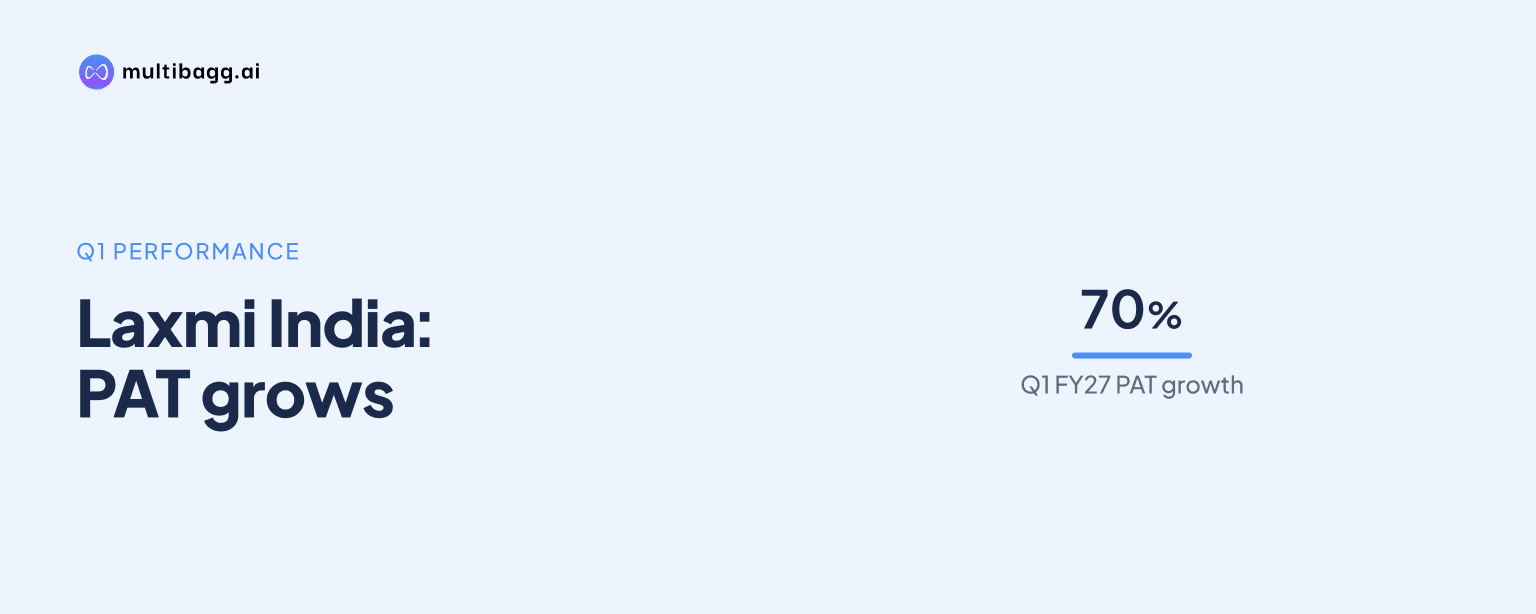
Laxmi India Finance Limited reported a 70% year-on-year increase in profit after tax to ₹16.4 crore in Q1 FY27, supported by 28% growth in assets under management to ₹1,721.7 crore and an improvement in net interest margin to 11.36%.
Know Laxmi India Finance inside out
Results, valuation, peers and who's buying, in one view.
What did Laxmi India Finance report for Q1 FY27?
Laxmi India Finance reported net interest income of ₹47.1 crore for Q1 FY27, up 39% from the year-earlier quarter. Profit before tax rose about 72% year on year to ₹21.9 crore, while profit after tax increased about 70% to ₹16.4 crore. The company reported a return on assets of 3.45%, compared with 2.75% in Q1 FY26.
The quarterly figures were discussed during the company’s earnings conference call held on August 13, 2026. Managing Director Deepak Baid led the call, which followed the company’s investor presentation for the quarter ended June 30, 2026. Separately, Laxmi India Finance informed the exchanges on November 5, 2026, about the schedule of an investor meet.
How did lending activity support the quarterly growth?
Laxmi India Finance’s assets under management stood at ₹1,721.7 crore at the end of Q1 FY27. Its own book reached ₹1,626.9 crore, reflecting 31.7% year-on-year growth. Quarterly disbursements rose to ₹232 crore from ₹166 crore a year earlier, indicating higher lending activity during the period.
MSME lending remained the central part of the business. MSME assets under management were about ₹1,395 crore at the quarter-end, accounting for a substantial portion of the overall portfolio. The company described the MSME franchise as its core business, making the segment’s performance important for both loan growth and portfolio monitoring.
Higher disbursements and portfolio expansion supported the increase in interest income. However, growth in a lending business also requires continued attention to repayment behaviour and asset quality. Management said during the call that sustainable lending growth requires constant attention to asset quality, without providing updated Q1 FY27 gross or net non-performing asset figures in the material provided.
What improved Laxmi India Finance’s margins and profitability?
Laxmi India Finance said its portfolio yield was broadly stable at 21.67% in Q1 FY27. Its average cost of borrowing declined to 10.66% from 11.33% in Q1 FY26. This reduction supported an improvement in net interest margin to 11.36% from 10.43% a year earlier.
The margin expansion is relevant because the difference between lending yields and borrowing costs is a major driver of profitability for non-bank lenders. In this case, the combination of stable portfolio yield and a lower funding cost coincided with higher net interest income, profit before tax and profit after tax.
Operating expenses rose to ₹29.9 crore from ₹22.4 crore in the corresponding quarter of the previous year. The company attributed the increase to investments in branch expansion, employee base, technology and operating infrastructure. These costs were incurred alongside the growth in the loan book and were presented as investments to build the operating platform.
Got a follow-up? Ask IRIS
What do FY26 results show about the company’s recent position?
Laxmi India Finance had reported profit after tax of ₹49.68 crore for FY26, an increase of 38.33% year on year. Its Q4 FY26 profit after tax was ₹20.58 crore, up 41.73% from the corresponding quarter. Assets under management stood at ₹1,626.26 crore as of March 31, 2026, up 27.35% year on year.
The FY26 presentation also reported gross non-performing assets of 2.13% and net non-performing assets of 1.08% as of March 31, 2026. These figures provide the latest disclosed year-end asset-quality reference point alongside the subsequent Q1 FY27 increase in assets under management and disbursements.
The company’s reported trailing twelve-month earnings per share was ₹11.00. Investors assessing the Q1 FY27 performance can compare the increase in profitability with funding costs, operating-expense growth, portfolio composition and the asset-quality metrics disclosed for FY26.
How is Laxmi India Finance positioned on funding and liquidity?
Laxmi India Finance reported liquidity of about ₹255 crore at the end of Q1 FY27. It also said its asset-liability management profile showed a cumulative surplus across maturity buckets, including a cumulative surplus of about ₹420 crore in the five-year bucket.
For a lender, liquidity and maturity matching are important because they affect its ability to meet obligations and fund fresh disbursements. The company linked the fall in its average borrowing cost to an improving funding profile and described that improvement as a structural support for profitability.
The company has continued to publish investor and earnings presentations under Regulation 30 of the SEBI Listing Obligations and Disclosure Requirements Regulations, 2015. Its filings show investor presentations for periods including the quarter ended June 30, 2025, the quarter ended December 31, 2025, and the quarter and financial year ended March 31, 2026.
Conclusion
Laxmi India Finance’s Q1 FY27 update showed faster loan growth, higher disbursements, lower average borrowing costs and improved profitability. AUM reached ₹1,721.7 crore, while PAT rose to ₹16.4 crore and net interest margin improved to 11.36%, showing how funding-cost moderation contributed alongside business expansion.
The next disclosures to watch are the details from the scheduled investor meet and subsequent quarterly updates on asset quality, operating expenses, borrowing costs and MSME portfolio growth. The company has stated that maintaining asset quality remains necessary for sustainable lending growth.