










Munjal Showa Limited to Consider Q2 FY27 Results on November 13
Key highlights
- Munjal Showa's board will consider Q2 FY27 and half-year results on November 13, 2026.
- June 2026 quarter revenue was ₹347.50 crore, up 21.49% year on year.
- June 2026 quarter net profit rose 35.55% year on year to ₹11.23 crore.
- FY26 earnings per share fell to ₹5.47 from ₹7.22 in FY25.
powered by IRIS
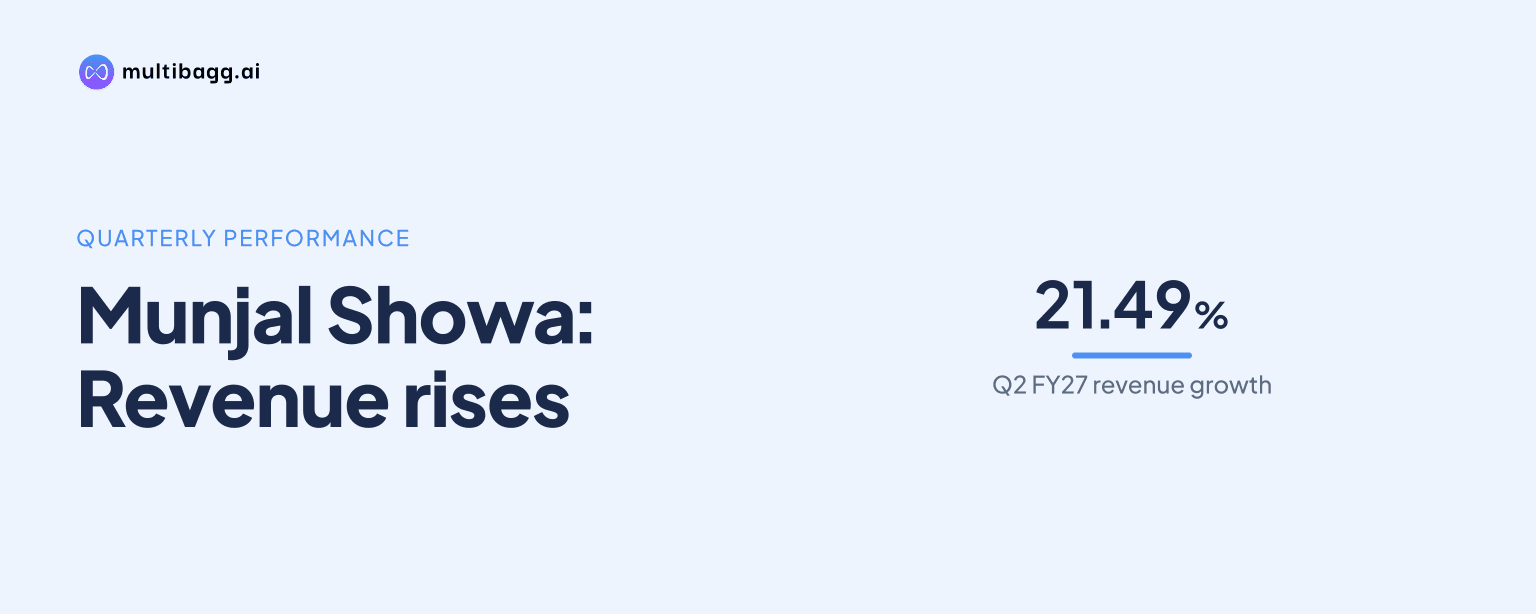
Munjal Showa Limited will consider unaudited Q2 FY27 results for the quarter and half year ended September 30, 2026, on November 13, following June-quarter revenue of ₹347.50 crore, up 21.49% year on year. The meeting will also consider Deloitte Haskins & Sells LLP's limited review report.
Know Munjal Showa inside out
Results, valuation, peers and who's buying, in one view.
What will Munjal Showa consider at its November 13 board meeting?
Munjal Showa will consider and approve unaudited standalone financial results for the quarter and half year ended September 30, 2026. The board meeting is scheduled for November 13, 2026, according to the company's regulatory intimation dated November 5.
The board will also receive the limited review report from Deloitte Haskins & Sells LLP. A limited review is part of the quarterly financial-reporting process for listed companies and provides the basis for the auditor's conclusion on the unaudited results. The announcement does not disclose the September-quarter financial figures before the board meeting.
The results will cover the July-September 2026 period, described as Q2 FY27, as well as the first half of the financial year. This makes the release relevant for investors assessing whether the revenue growth reported in the preceding June quarter continued through the following quarter.
What did Munjal Showa report in the June 2026 quarter?
Munjal Showa reported standalone revenue of ₹347.50 crore for the quarter ended June 30, 2026, an increase of 21.49% from ₹286.04 crore a year earlier. Revenue was nearly unchanged from the preceding March 2026 quarter, with reported quarter-on-quarter growth of 0.12%.
Quarterly net profit rose 35.55% year on year to ₹11.23 crore from ₹8.28 crore. EBITDA was ₹15.52 crore, compared with ₹12.59 crore in the June 2025 quarter, representing growth of 23.27%. Earnings per share increased to ₹2.81 from ₹2.07.
The June-quarter numbers showed that profit grew faster than sales on a year-on-year basis. However, commentary accompanying the results noted that the operating margin excluding other income was 0.71%, compared with 0.55% a year earlier. This indicated that the improvement in revenue and reported earnings did not translate into a high core operating margin.
Why are operating margins important for Munjal Showa?
Munjal Showa's operating profitability is important because the June-quarter revenue increase came with a reported operating margin excluding other income of 0.71%. While this was above the 0.55% recorded a year earlier, it remained below the 2.42% margin cited for the March 2025 quarter.
The available commentary attributed the pressure on core profitability primarily to higher costs, including employee expenses. It also stated that other income accounted for 101.55% of profit before tax in the June 2026 quarter. That measure indicates that non-operating income made a material contribution to the reported pre-tax result.
For the upcoming results, reported sales, EBITDA and net profit will provide separate indicators of performance. Revenue growth alone does not show how much profit the manufacturing operations generated, while EBITDA and margin data help show the impact of operating expenses on earnings.
Got a follow-up? Ask IRIS
How has Munjal Showa performed over the full financial year?
Munjal Showa reported FY26 revenue of ₹1,320 crore, up 5.2% from FY25, while net income declined 24% to ₹21.87 crore. Earnings per share for the year fell to ₹5.47 from ₹7.22 in FY25, despite the rise in annual revenue.
The annual figures underline the difference between sales growth and bottom-line performance. The June 2026 quarter subsequently showed stronger year-on-year growth in both revenue and net profit, but the company's full-year results show that higher revenue has not consistently resulted in higher annual earnings.
The financial statements for the year ended March 31, 2026 received an unmodified audit opinion from Deloitte Haskins & Sells LLP. The company has also disclosed a final dividend approval for FY26, though the provided information does not specify the dividend amount.
What should investors assess when the Q2 FY27 results are released?
Investors can assess whether Munjal Showa maintained revenue momentum after the ₹347.50 crore reported in the June quarter and whether profitability improved alongside sales. The half-year release will provide a broader view than a single quarter by covering results from April through September 2026.
Core operating metrics will remain relevant because the June-quarter commentary highlighted low operating margins and a substantial role for other income in pre-tax profit. Changes in EBITDA, operating margin and net profit can help distinguish between revenue growth, cost movements and non-operating contributions to earnings.
The source material also cites return on equity of 3.94% and return on capital employed of 2.24%. These measures provide context on capital utilisation, while the stated absence of long-term debt and the cash-rich balance-sheet position provide separate information on financial stability. The November 13 filing will determine whether these reported conditions changed during the September quarter.
Conclusion
Munjal Showa's November 13 board meeting will formally consider its Q2 FY27 and first-half unaudited results, with the limited review report from Deloitte Haskins & Sells LLP. The preceding June quarter delivered 21.49% revenue growth and 35.55% net-profit growth, but the reported 0.71% operating margin and reliance on other income remain important context for evaluating earnings quality.
The next disclosure to watch is the September-quarter and half-year financial statement approved at the board meeting. Investors will be able to compare revenue, EBITDA, margins and net profit with the June quarter and assess whether the company has improved its core operating profitability.