










Saboo Sodium Chloro Ltd Sets Q2 FY27 Results Meeting for November 13
Key highlights
- Saboo Sodium Chloro will consider Q2 and H1 FY27 unaudited results on November 13, 2026.
- Q1 FY27 net profit rose 126.52% year-on-year to ₹1.96 crore.
- Q1 FY27 net sales were nearly flat at ₹16.62 crore, down 0.09% year-on-year.
- Q1 FY27 EBITDA increased 70.49% to ₹3.12 crore.
powered by IRIS
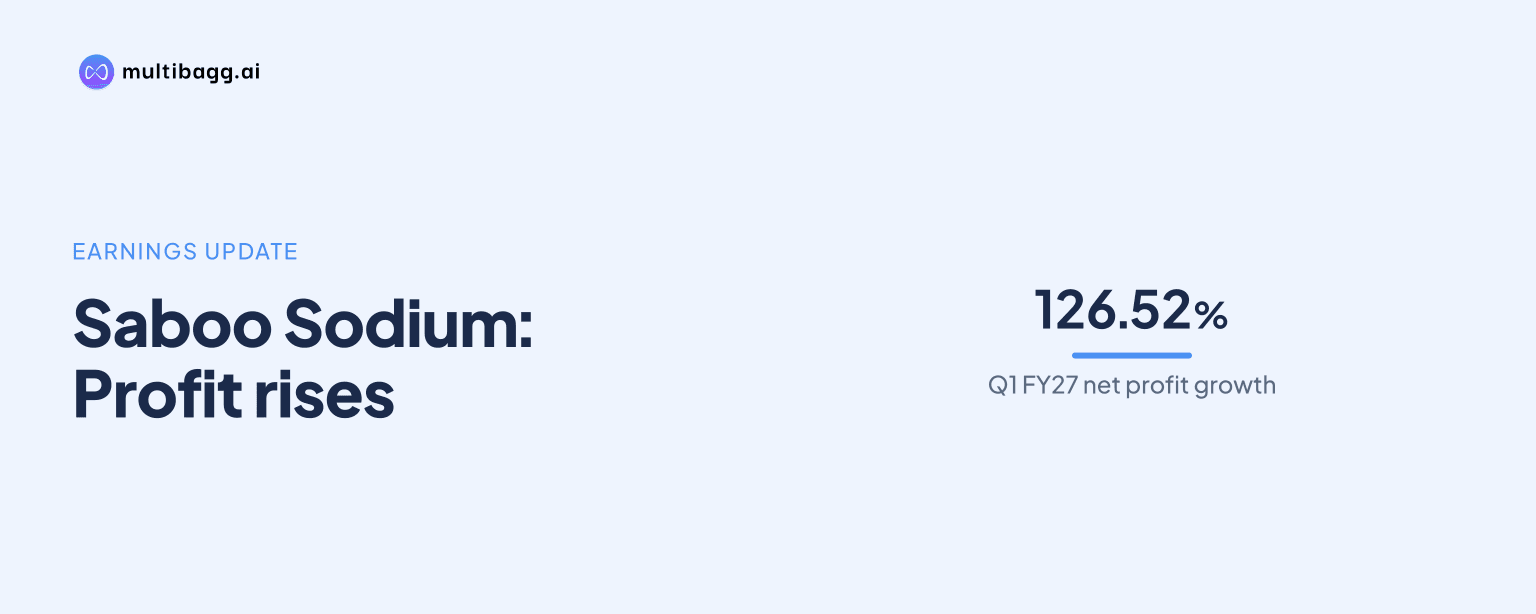
Saboo Sodium Chloro Ltd will consider its Q2 and H1 FY27 unaudited results on November 13, 2026, following a Q1 FY27 net profit increase of 126.52% year-on-year to ₹1.96 crore. The board meeting will also take on record the statutory auditors' limited review report for the September quarter.
Know Saboo Sodium Chloro inside out
Results, valuation, peers and who's buying, in one view.
When will Saboo Sodium Chloro announce Q2 FY27 results?
Saboo Sodium Chloro is scheduled to consider and approve its unaudited financial results for the quarter and half-year ended September 30, 2026, at a board meeting on November 13, 2026. The company is among several listed businesses scheduled to report September-quarter earnings on the day.
The agenda disclosed by the company covers both Q2 FY27 and the first half of FY27. Alongside the financial statements, the board will review and take on record the Limited Review Report issued by the company’s statutory auditors for the same reporting period. The outcome will provide the first official update on performance after the June 2026 quarter.
The company also closed its trading window ahead of the Q2 FY27 result announcement. This is a standard corporate-governance step that restricts trading by designated persons during the period when unpublished price-sensitive information may be available.
What did Saboo Sodium Chloro report in Q1 FY27?
Saboo Sodium Chloro reported standalone net sales of ₹16.62 crore and net profit of ₹1.96 crore for the quarter ended June 2026. Net sales were marginally lower than ₹16.63 crore in the corresponding quarter a year earlier, while profit rose from ₹0.87 crore.
The improvement in profitability was also reflected in EBITDA, which increased 70.49% year-on-year to ₹3.12 crore from ₹1.83 crore. Earnings per share rose to ₹0.47 from ₹0.21. Another reported presentation of the quarterly numbers placed net income at ₹1.96 crore and profit margin at 12%, compared with a 5.2% margin in the year-earlier quarter.
The figures indicate that the June-quarter recovery was driven by stronger profitability rather than sales growth. Revenue was effectively flat year-on-year, making the September-quarter sales trend relevant for assessing whether the earnings improvement is accompanied by a sustained expansion in business volumes.
What business does Saboo Sodium Chloro operate?
Saboo Sodium Chloro manufactures and sells salt in India and describes itself as North India’s largest salt refinery. Its products include Surya Iodized Salt, Tota Iodized Salt, Saboo Iodized Salt and industrial salt.
The company’s operations therefore span consumer-oriented iodized salt products and industrial salt categories. Its reported market capitalisation is ₹51 crore. The company’s June 2026 quarterly sales of ₹16.62 crore provide the current scale against which investors can assess the forthcoming September-quarter disclosure.
The salt business has seen uneven recent quarterly performance. Net sales were ₹15.45 crore in September 2025, ₹17.19 crore in December 2025 and ₹14.69 crore in March 2026, before recovering to ₹16.62 crore in June 2026. These reported figures show why quarter-on-quarter comparison will be important when Q2 FY27 numbers are released.
Got a follow-up? Ask IRIS
Why do the September-quarter numbers matter for investors?
The September-quarter results matter because Saboo Sodium Chloro’s Q1 profit growth sharply outpaced its revenue performance. The company reported a substantial rise in profit and EBITDA in June 2026, but sales remained broadly unchanged from the prior-year level.
Investors will be able to compare Q2 sales, profit, operating performance and per-share earnings with the June quarter and with September 2025 sales of ₹15.45 crore. The half-year results will also show how the first two quarters of FY27 combine after the March 2026 quarter, when the company reported a standalone net loss of ₹3.51 crore.
For the full year ended March 2026, Saboo Sodium Chloro reported sales of ₹63.95 crore, up 16.23% from ₹55.02 crore in the prior year. However, full-year net profit declined 25.81% to ₹0.23 crore from ₹0.31 crore. This contrast between annual sales growth and lower profit provides context for the improvement reported in Q1 FY27.
What longer-term trends should shareholders track?
Shareholders should track whether the company can translate stable or rising sales into consistent profitability. The supplied Q1 FY27 commentary described the results as mixed, citing flat revenue growth and return on equity of 0.88%, despite the large increase in net profit.
A separate reported assessment said earnings per share had increased by an average of 65% annually over the past three years, while the share price had fallen by an average of 11% annually over the same period. These are historical observations rather than forecasts, but they point to the difference between reported earnings progress and market performance.
The next disclosure will also be relevant because commentary accompanying the Q1 result raised concerns over debt levels, without providing a corresponding debt figure in the available information. The official Q2 FY27 filing and limited review report will be the relevant documents for investors seeking updated financial details.
Conclusion
Saboo Sodium Chloro’s November 13 board meeting will formally place its Q2 and H1 FY27 financial performance before investors. The key starting point is a June quarter in which net profit rose 126.52% to ₹1.96 crore and EBITDA increased 70.49%, even as net sales were almost unchanged at ₹16.62 crore.
Investors should watch the board’s disclosed Q2 FY27 outcome, including September-quarter sales, profitability, EPS and the statutory auditors’ limited review report. The half-year figures will clarify whether the improvement seen after the March 2026 loss has continued through the September quarter.