










Laxmi India Finance H1 FY27 PAT rose 66% despite provisions
Key highlights
- Laxmi India Finance reported H1 FY27 profit after tax and other comprehensive income of Rs 31.71 crore, up 66.41% year on year.
- H1 FY27 AUM reached Rs 1,843.89 crore, 32.99% above Rs 1,386.49 crore a year earlier.
- Laxmi India Finance recognised Rs 5.88 crore of current-year provision against the Up-Money direct assignment.
- NIM rose to 11.28% in H1 FY27 from 10.88% as average borrowing cost declined to 10.59%.
powered by IRIS
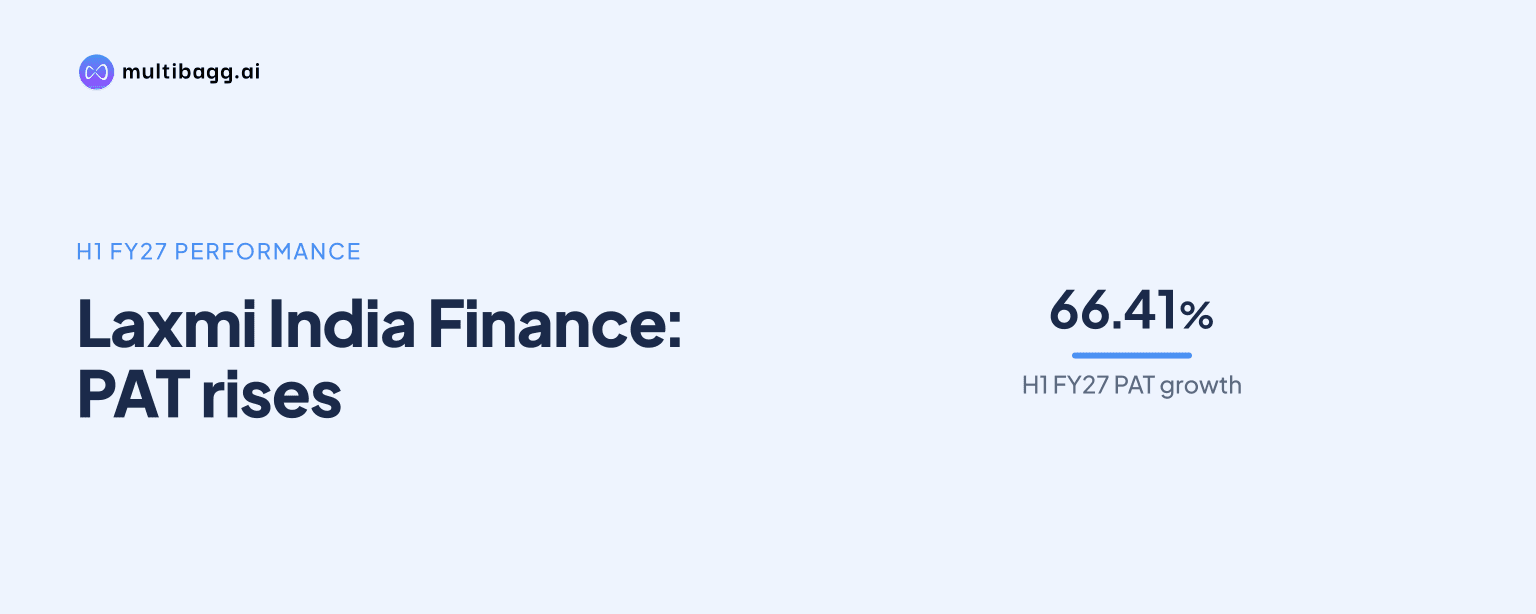
Laxmi India Finance Limited reported H1 FY27 profit after tax and other comprehensive income of Rs 31.71 crore, 66.41% above H1 FY26, after recognising Rs 5.88 crore of current-year provision on a vehicle-secured direct assignment that became non-performing. Net interest income rose 35.02% to Rs 96.84 crore.
Know Laxmi India Finance inside out
Results, valuation, peers and who's buying, in one view.
How did Laxmi India Finance's H1 FY27 profit change?
Laxmi India Finance's H1 FY27 profit after tax and other comprehensive income rose to Rs 31.71 crore from Rs 19.06 crore in H1 FY26, while profit before tax increased to Rs 42.35 crore from Rs 25.53 crore. Total income net of interest expense increased 41.17% to Rs 111.88 crore. The operational snapshot separately shows PAT growth of 63.35%, while the detailed profit and loss statement shows 66.41%.
The Q2 FY27 profit after tax and other comprehensive income was Rs 15.28 crore, compared with Rs 16.43 crore in Q1 FY27 and Rs 9.41 crore in Q2 FY26. Q2 FY27 profit before tax was Rs 20.44 crore, down from Rs 21.91 crore in Q1 FY27 but above Rs 12.78 crore a year earlier. H1 FY27 tax expense rose to Rs 10.37 crore from Rs 6.36 crore.
What drove Laxmi India Finance's income and margin expansion?
Laxmi India Finance's net interest income increased to Rs 96.84 crore in H1 FY27 from Rs 71.72 crore because interest earned rose 27.82% to Rs 177.37 crore while interest expense increased 20.11% to Rs 80.53 crore. Net interest margin, or NIM, rose to 11.28% from 10.88%, as average borrowing cost declined by 51 basis points to 10.59%.
The NIM increase occurred although yield on the average portfolio fell to 21.59% from 22.18%. Other income nearly doubled to Rs 15.04 crore from Rs 7.53 crore, while operating expense rose to Rs 61.71 crore from Rs 49.39 crore. Employee cost increased 35.49% to Rs 45.47 crore, and the company had 2,060 employees and 209 branches at 30 September 2026.
Laxmi India Finance's assets under management, or AUM, reached Rs 1,843.89 crore at September 2026, up 32.99% from Rs 1,386.49 crore a year earlier. Its own book grew 36.67% to Rs 1,761.49 crore, while H1 FY27 disbursements increased to Rs 506 crore from Rs 311 crore. The customer base rose to 45,565 from 40,711 and branches increased by 45 year on year to 209.
Got a follow-up? Ask IRIS
How did the direct-assignment default affect Laxmi India Finance's asset quality?
Laxmi India Finance created a total provision of Rs 17.64 crore, equal to 90% of a Rs 19.60 crore vehicle-secured direct assignment purchased from Up-Money that became non-performing. It recognised Rs 5.88 crore of that provision during the current financial year. Management states that reported PAT, return on equity and return on total assets include this provision's effect.
Total H1 FY27 provisions increased to Rs 7.82 crore from Rs 4.33 crore, including Rs 6.64 crore of expected credit loss provision and Rs 1.18 crore of write-offs. Credit cost rose to 0.96% from 0.72%. For FY26, the presentation shows credit cost of 1.06% including the Up-Money default, compared with 0.18% excluding it.
Gross non-performing assets, or GNPA, were 1.75% at September 2026, compared with 1.59% in H1 FY26, while net non-performing assets, or NNPA, declined to 0.49% from 0.84%. The provision coverage ratio was 71.99%. Stage 3 gross carrying amount declined to Rs 30.44 crore at 30 September 2026 from Rs 32.03 crore at 31 March 2026, while total gross carrying loans rose to Rs 1,742.72 crore from Rs 1,502.54 crore.
How is Laxmi India Finance funding loan-book growth?
Laxmi India Finance reported total equity of Rs 498.56 crore at Q2 FY27, up from Rs 435.16 crore a year earlier, while borrowings on the balance sheet increased to Rs 1,500 crore from Rs 1,098.95 crore. Loans rose 36.01% to Rs 1,713.73 crore. The debt-equity ratio was 3.31 at H1 FY27, compared with 2.57 at H1 FY26, and interest coverage improved to 1.53 from 1.38.
Liquidity stood at Rs 292.25 crore on 30 September 2026, versus Rs 197.58 crore a year earlier, and stated total borrowings were Rs 1,648.26 crore. The net debt-to-equity ratio was 2.72 times. The asset-liability management statement showed a cumulative surplus of Rs 125.80 crore up to three months and Rs 420.03 crore up to five years.
Capital to risk-weighted assets ratio, or CRAR, was 22.95% at H1 FY27, comprising Tier I CRAR of 22.54% and Tier II CRAR of 0.41%, compared with 31.90% in H1 FY26. Private banks represented 27.31% of the borrowing mix, non-banking financial companies and financial institutions represented 24.72%, and public-sector banks represented 21.15%. In incremental Q2 FY27 borrowings, non-banking financial companies and financial institutions accounted for 37.91%.
Conclusion
Laxmi India Finance's H1 FY27 earnings growth combined a Rs 457.40 crore year-on-year increase in AUM, a 51-basis-point reduction in average borrowing cost and a 40-basis-point NIM expansion. These gains lifted PAT by 66.41%, even as total provisions rose 80.69% and included Rs 5.88 crore recognised on the troubled direct assignment.
Management targets approximately 30% AUM compound annual growth, return on assets of 3.50% to 3.75%, and return on equity of 13.50% to 14.00%. Its disclosed plan includes calibrated branch additions, exploring external commercial borrowings, and technology upgrades in sourcing, underwriting and servicing. Future results will show progress on those plans alongside GNPA, credit cost and the remaining direct-assignment provision.