










GRE plans 15.5 MWp RESCO portfolio in FY27 P with 25-year PPAs
Key highlights
- GRE shows cumulative RESCO capacity of 15,525 kWp in FY27 P, compared with 3,833 kWp in FY26.
- GRE reported RESCO operational revenue of Rs 3.3 crore in H1-FY27, after Rs 2.3 crore in FY26.
- GRE lists 2,993 kWp of rooftop RESCO capacity, all contracted at Rs 5.04 per kilowatt-hour for 25 years.
- GRE's disclosed ground-mounted RESCO projects total 12,532.80 kWp, including the 9,676.80 kWp Himmatnagar plant.
powered by IRIS
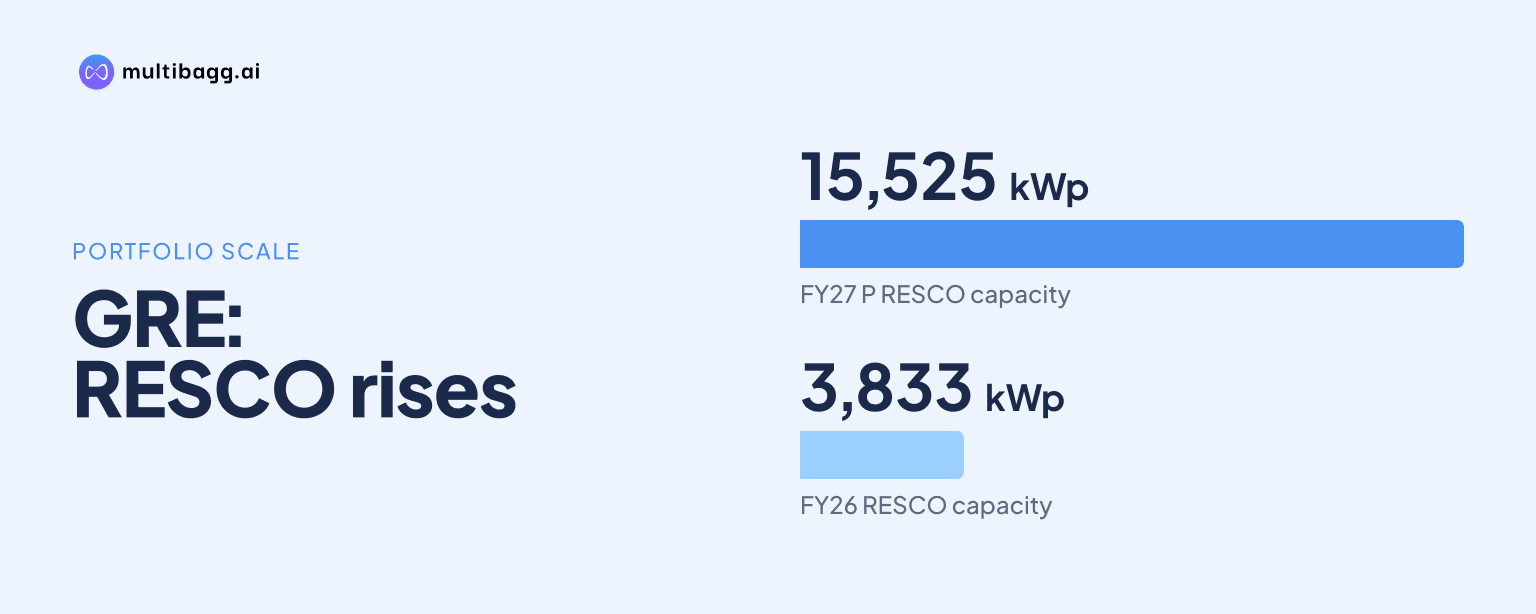
GRE plans a 15.5 MWp renewable energy service company, or RESCO, asset portfolio in FY27 P, up from 3.833 MWp in FY26, based on its portfolio schedule, with listed rooftop and ground-mounted plants contracted for 25-year power purchase agreements, or PPAs.
Know GRE Renew Enertech inside out
Results, valuation, peers and who's buying, in one view.
How does GRE's RESCO model differ from its EPC model?
GRE's RESCO model requires it to invest in, own and operate solar plants before supplying electricity to third parties under long-term PPAs. Under its capital expenditure, or CAPEX, engineering, procurement and construction, or EPC, model, customers finance and retain ownership of the solar asset while GRE provides project execution and may provide operations and maintenance, or O&M, services.
The two models produce different revenue mechanisms. GRE identifies monthly electricity tariffs of Rs 4 to Rs 6 per kilowatt-hour as RESCO revenue, while EPC generates contract value during execution, annual O&M charges and PPA-management fees for applicable third-party non-captive projects. The presentation describes RESCO cash flows as 25-year predictable cash flows, whereas the CAPEX model is asset-light for GRE.
GRE's EPC business remains larger in installed project activity. It reported more than 197 MW of cumulative solar EPC projects completed and ongoing through October 2026, covering rooftop and ground-mounted installations. Its RESCO business uses the same two solar formats but keeps the operating assets on GRE's books rather than transferring ownership to the customer.
How fast is GRE's RESCO capacity and revenue increasing?
GRE's cumulative RESCO asset portfolio increased from 840 kWp in FY25 to 3,833 kWp in FY26 and is shown at 15,525 kWp in FY27 P. Kilowatt-peak, or kWp, is the capacity unit used in the presentation; the FY27 P figure equals 15.525 MWp.
GRE reported RESCO operational revenue of Rs 40 lakh in FY25, Rs 2.3 crore in FY26 and Rs 3.3 crore in H1-FY27. The H1-FY27 result was Rs 1 crore above the full-year FY26 figure, but the presentation provides no full-year FY27 RESCO revenue target, generation forecast or expected plant utilisation for the planned portfolio.
The FY27 P capacity figure is more than four times the FY26 portfolio, following an increase of more than four times from FY25 to FY26. The FY27 P table includes a footnote stating that it includes subsidiary GRE Green Assets of 2,016 kWh, although the portfolio table itself is presented in kWp and the project schedule identifies a 2,016 kWp Indrap plant.
Which projects make up GRE's disclosed RESCO portfolio?
GRE lists seven rooftop RESCO plants totalling 2,993 kWp, each with a 25-year PPA and a tariff of Rs 5.04 per kilowatt-hour. The projects were commissioned from 12 April 2025 to 17 October 2025 at sites in Ahmedabad, Ajmer, Jaipur, Gandhinagar and Jodhpur associated with RAF, Central Reserve Police Force, Central Industrial Security Force and Border Security Force facilities.
The largest disclosed rooftop installation is the 533 kWp GC-I CRPF Ajmer project, commissioned on 17 October 2025. Five sites are 480 kWp each, while GC-II CRPF Ajmer is 300 kWp and STC BSF Jodhpur is 240 kWp. GRE states that customers provide rooftop space and procure electricity under PPAs while it handles installation, operations and maintenance.
GRE also lists four ground-mounted projects totalling 12,532.80 kWp, all with 25-year project lives. Himmatnagar is the largest at 9,676.80 kWp, commissioned on 27 May 2026 at an approximate tariff of Rs 4 per kilowatt-hour. The remaining projects are Karanpura-Reliance Jio at 535 kWp, Karanpura-Futaba Industrial at 305 kWp and Indrap at 2,016 kWp.
Ground-mounted capacity is more than four times the disclosed rooftop total of 2,993 kWp. The Karanpura-Reliance Jio project was commissioned on 15 June 2024 at an approximate Rs 4.75 per kilowatt-hour, Karanpura-Futaba Industrial on 14 September 2024 at approximately Rs 5.27, and Indrap on 30 May 2026 at approximately Rs 4. GRE says ground-mounted plants are developed on land it owns or leases and are operated by GRE.
Got a follow-up? Ask IRIS
What drives GRE's recurring RESCO revenue?
GRE's RESCO revenue depends on installed capacity, commissioning, electricity supplied and contracted tariff collection under PPAs. Across the disclosed projects, tariffs range from approximately Rs 4 per kilowatt-hour at Himmatnagar and Indrap to Rs 5.27 at Karanpura-Futaba Industrial, while all 2,993 kWp of listed rooftop capacity carries a Rs 5.04 tariff.
The 25-year contract length establishes the stated duration of the customer relationship, but the presentation does not disclose annual generation estimates, tariff escalation clauses, payment terms, plant availability or project-level financing. Therefore, the reported Rs 3.3 crore of RESCO operational revenue in H1-FY27 cannot be used from the presentation alone to calculate future revenue for the 15,525 kWp FY27 P portfolio.
GRE has other recurring revenue mechanisms in its CAPEX business, including annual O&M contracts and PPA-management fees for applicable third-party non-captive projects. These differ from RESCO tariff collections because the customer owns EPC assets. In H1-FY27, GRE reported Rs 128.9 crore of operational revenue in its CAPEX model, compared with Rs 3.3 crore reported for RESCO.
What should readers watch as GRE builds owned solar assets?
GRE is using RESCO to add owned solar assets and tariff collections alongside a substantially larger EPC operation. The capacity schedule shows a rise from 3,833 kWp in FY26 to 15,525 kWp in FY27 P, with 12,532.80 kWp of listed ground-mounted capacity providing most of the planned scale and 2,993 kWp of rooftop assets carrying a uniform Rs 5.04 tariff.
Conclusion
The disclosed portfolio indicates that GRE's recurring-revenue expansion is centred on long-duration PPAs rather than only EPC execution fees. The capacity increase is led by the 9,676.80 kWp Himmatnagar project and the 2,016 kWp Indrap project, while RESCO revenue rose from Rs 40 lakh in FY25 to Rs 3.3 crore in H1-FY27.
The next item to watch is whether GRE reaches the FY27 P portfolio figure of 15,525 kWp and converts commissioned capacity into tariff collections. The presentation also leaves an unresolved unit issue in the FY27 P footnote, which refers to 2,016 kWh while the capacity schedules use kWp, and shows a 0.8 kWp difference between the 15,525 kWp summary and the detailed project totals of 15,525.80 kWp.