










GRE Renew’s Receivables Reach Rs 80.2 Crore in H1 FY27
Key highlights
- GRE Renew’s trade receivables rose to Rs 80.2 crore at H1 FY27 from Rs 9.8 crore at FY26.
- Creditor dues outside the micro and small enterprise category increased to Rs 65.3 crore from Rs 9.2 crore at FY26.
- Combined long-term and short-term borrowings reached Rs 18.5 crore at H1 FY27, compared with Rs 1.8 crore at FY26.
- GRE Renew reported 104 working-capital days in FY26, up from 79 in FY25 and 55 in FY24.
powered by IRIS
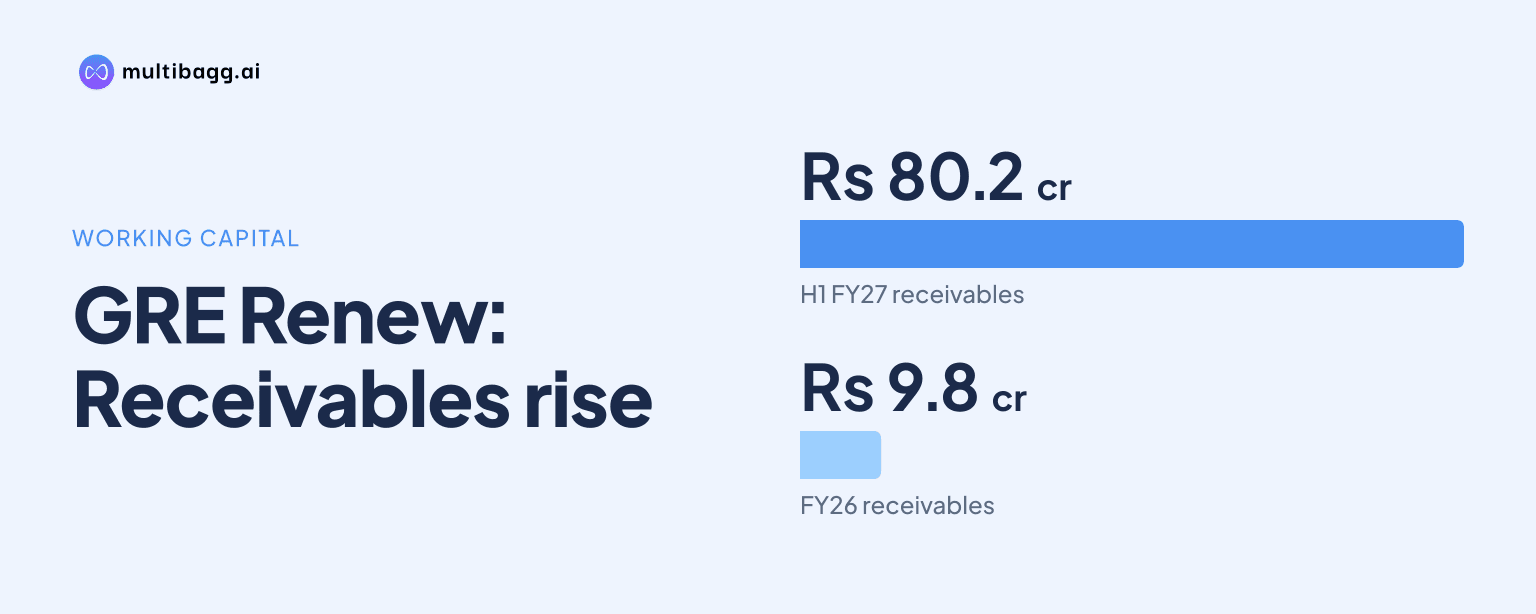
GRE Renew Enertech Ltd reported trade receivables of Rs 80.2 crore at H1 FY27, compared with Rs 9.8 crore at FY26, while dues to creditors other than micro and small enterprises rose to Rs 65.3 crore from Rs 9.2 crore. The balance-sheet movement accompanied H1 FY27 revenue of Rs 138.7 crore and higher borrowing balances.
Know GRE Renew Enertech inside out
Results, valuation, peers and who's buying, in one view.
What changed in GRE Renew’s working-capital balances?
GRE Renew’s receivables, payables and short-term funding balances all increased materially by H1 FY27. Trade receivables rose by Rs 70.4 crore from FY26 to Rs 80.2 crore, after increasing by Rs 0.8 crore between FY25 and FY26. Receivables were Rs 9 crore at FY25, Rs 9.8 crore at FY26 and Rs 80.2 crore at H1 FY27, making them the largest current-asset line.
Dues to creditors other than micro enterprises and small enterprises rose to Rs 65.3 crore at H1 FY27 from Rs 9.2 crore at FY26 and Rs 1.6 crore at FY25. In contrast, dues to micro enterprises and small enterprises were Rs 1.9 crore at H1 FY27, compared with Rs 0.5 crore at FY26. Total current liabilities consequently increased to Rs 84 crore from Rs 20.8 crore over the same period.
Current assets increased by Rs 53.7 crore from FY26 to Rs 126.8 crore at H1 FY27, while current liabilities rose by Rs 63.2 crore. Inventory declined to Rs 10.7 crore from Rs 11.5 crore, so the largest balance-sheet changes were in trade receivables and creditor dues rather than stock. Short-term loans and advances increased to Rs 24.2 crore from Rs 20.2 crore, and other current assets rose to Rs 4.1 crore from Rs 0.8 crore.
Why did GRE Renew’s receivables and payables rise?
GRE Renew’s presentation reports the balance changes but does not specify the customer collections, supplier-payment terms or project milestones behind the Rs 80.2 crore receivables balance. It does disclose H1 FY27 revenue from operations of Rs 138.7 crore, up 216.7% year on year from Rs 43.8 crore in H1 FY26. That higher activity coincided with increased receivables, creditor dues and total current liabilities.
Management said a 50 megawatt alternating current, or MW AC, and 65 MW direct current, or MW DC, back-to-back engineering, procurement and construction project represented 48% of H1 FY27 revenue. The company said it executed that project at lower margins to establish execution credibility. The presentation does not state whether this project was responsible for a particular portion of the Rs 80.2 crore receivables or Rs 65.3 crore creditor balance.
GRE Renew also reported the successful execution of a 9.676 MW DC initial-public-offering-funded solar project at Himmatnagar, Gujarat, and an additional 2 MW solar project through its subsidiary. Its cumulative solar project portfolio exceeded 197 MW in H1 FY27. These operating disclosures indicate multiple projects were under execution, but the presentation does not provide an ageing schedule for receivables or a due-date analysis for trade payables.
Got a follow-up? Ask IRIS
How did GRE Renew’s borrowing balances change in H1 FY27?
GRE Renew increased both long-term and short-term borrowings by H1 FY27. Long-term borrowings stood at Rs 11.9 crore, compared with Rs 1.2 crore at FY26, while short-term borrowings rose to Rs 6.6 crore from Rs 0.6 crore. Combined borrowings were therefore Rs 18.5 crore at H1 FY27, versus Rs 1.8 crore at FY26.
Management disclosed Rs 8.5 crore of unsecured loans, an increase in the cash-credit facility to Rs 5 crore, and a new Rs 2.58 crore term loan for the Rashtrapati Bhavan project. These facilities and loans are the specifically disclosed funding actions during H1 FY27. Finance cost rose to Rs 70 lakh in H1 FY27 from Rs 20 lakh in H1 FY26 and Rs 20 lakh for FY26.
Shareholders’ funds increased to Rs 88.7 crore at H1 FY27 from Rs 79.6 crore at FY26, principally as reserves and surplus rose to Rs 74.4 crore from Rs 65.3 crore. Total equity and liabilities reached Rs 187.7 crore, compared with Rs 103 crore at FY26. On the asset side, property, plant and equipment increased to Rs 51.6 crore from Rs 15.1 crore, while cash and cash equivalents declined to Rs 7.6 crore from Rs 30.8 crore.
What do GRE Renew’s margins and working-capital days show?
GRE Renew reported working-capital days of 104 in FY26, up from 79 in FY25 and 55 in FY24. The company did not report an H1 FY27 working-capital-days figure in the presentation. The 25-day increase during FY26 followed a 24-day increase in FY25, while H1 FY27 balance-sheet data show further increases in receivables and current liabilities.
Revenue expanded faster than earnings in H1 FY27. Revenue of Rs 138.7 crore was Rs 59.6 crore higher than Rs 79.1 crore in H2 FY26, while earnings before interest, tax, depreciation and amortisation, or EBITDA, were Rs 13.2 crore versus Rs 10.6 crore. EBITDA margin was 9.52% in H1 FY27, down from 13.40% in H2 FY26 and 13.01% in H1 FY26.
Profit after tax was Rs 9.1 crore in H1 FY27, up from Rs 4 crore in H1 FY26 but below Rs 9.6 crore in H2 FY26. The profit-after-tax margin was 6.56%, compared with 9.13% a year earlier and 12.14% in the preceding half year. Management attributed the margin effect to the 50 MW AC project, which accounted for 48% of H1 FY27 revenue and was executed at lower margins.
Conclusion
GRE Renew’s H1 FY27 balance sheet shows a substantial expansion in amounts tied up in customer receivables and amounts owed to creditors. Receivables rose to Rs 80.2 crore and creditor dues outside the micro and small enterprise category reached Rs 65.3 crore, alongside Rs 18.5 crore of combined borrowings. Revenue growth to Rs 138.7 crore occurred with lower EBITDA and profit-after-tax margins than both comparative half-year periods.
The next disclosed operating marker is an order book of about Rs 220.3 crore as of October 31, 2026, following the 50 MW AC and 65 MW DC project award. Management expects successful commissioning of that project to strengthen its execution record and support bids for larger projects and government tenders. The presentation does not disclose H1 FY27 working-capital days, receivable ageing or collection dates, leaving those items to be tracked in subsequent company disclosures.