










GRE H1-FY27 revenue rises 217% as EBITDA margin falls 349 bps
Key highlights
- GRE's H1-FY27 revenue from operations rose 216.7% year on year to Rs 138.7 crore.
- GRE's H1-FY27 EBITDA margin fell 349 basis points year on year to 9.52%.
- A 50 MW AC and 65 MW DC EPC project accounted for 48% of GRE's H1-FY27 revenue.
- GRE reported an order book of approximately Rs 220.3 crore as of October 31, 2026.
powered by IRIS
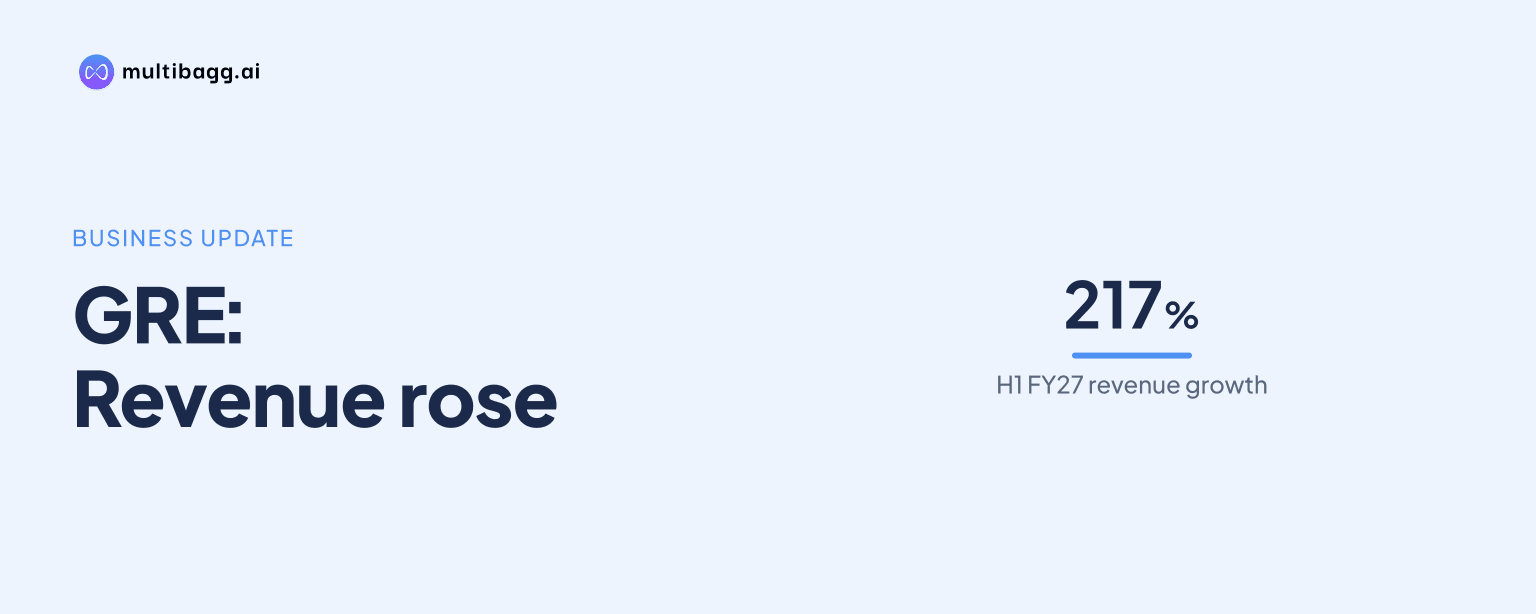
GRE™ reported H1-FY27 revenue from operations of Rs 138.7 crore, up 216.7% year on year, while EBITDA margin fell 349 basis points to 9.52% as a lower-margin 50 megawatt alternating-current solar engineering, procurement and construction project accounted for 48% of first-half revenue.
Know GRE Renew Enertech inside out
Results, valuation, peers and who's buying, in one view.
What drove GRE's H1-FY27 revenue growth?
GRE's H1-FY27 revenue growth was driven by higher engineering, procurement and construction, or EPC, execution, with revenue from operations reaching Rs 138.7 crore against Rs 43.8 crore in H1-FY26. Revenue was also 75.3% above Rs 79.1 crore in H2-FY26, meaning the first-half level exceeded both comparable half-year periods disclosed by the company.
The principal operational factor identified by management was a 50 MW alternating current, or AC, and 65 MW direct current, or DC, back-to-back EPC solar project. The project represented 48% of H1-FY27 revenue, and GRE said it was executed at lower margins to establish execution credibility. This means a substantial portion of the revenue increase came from one large contract rather than being evenly spread across the portfolio.
GRE said it secured significant EPC orders during H1-FY27, including the 50 MW AC and 65 MW DC solar project. Its order book was approximately Rs 220.3 crore as of October 31, 2026. Separately, GRE reported successful execution of a 9.676 MW DC initial-public-offering-funded solar project at Himmatnagar, Gujarat, and an additional 2 MW solar project through its subsidiary.
How did GRE's profitability change in H1-FY27?
GRE's earnings before interest, tax, depreciation and amortisation, or EBITDA, increased 131.6% year on year to Rs 13.2 crore in H1-FY27, but EBITDA margin declined to 9.52% from 13.01% in H1-FY26. Total expenses increased 229.4% to Rs 125.5 crore, faster than the 216.7% rise in revenue, corresponding with the 349-basis-point margin reduction.
The sequential comparison also showed a lower operating margin. H1-FY27 EBITDA of Rs 13.2 crore was 24.5% above Rs 10.6 crore in H2-FY26, while EBITDA margin declined 388 basis points from 13.40%. GRE directly attributed the margin effect to the 50 MW AC project, which it said was undertaken at lower margins to build its execution track record.
Profit after tax, or PAT, rose 127.5% year on year to Rs 9.1 crore from Rs 4 crore. PAT margin fell 257 basis points to 6.56% from 9.13%, while PAT was 5.2% below Rs 9.6 crore in H2-FY26. Diluted earnings per share, or EPS, not annualised, was Rs 6.34 in H1-FY27, up 66.8% from Rs 3.80 a year earlier but down 20.8% from Rs 8 in H2-FY26.
Got a follow-up? Ask IRIS
How does GRE's H1-FY27 margin compare with earlier years?
GRE's H1-FY27 EBITDA margin of 9.52% was below each of the three full-year margins in its historical income statement: 12.74% in FY24, 11.35% in FY25 and 13.10% in FY26. The H1-FY27 margin was 358 basis points below FY26's full-year level, even as first-half revenue of Rs 138.7 crore exceeded FY26 revenue of Rs 122.9 crore.
The same pattern is visible below the operating line. GRE's H1-FY27 PAT margin was 6.56%, compared with 10.96% in FY24, 8.36% in FY25 and 11.07% in FY26. H1-FY27 PAT of Rs 9.1 crore was below FY26 PAT of Rs 13.6 crore, although H1-FY27 revenue had already surpassed the FY26 full-year total.
Other income, depreciation and finance costs also changed between periods. Depreciation increased to Rs 1 crore in H1-FY27 from Rs 30 lakh in H1-FY26, while finance cost increased to Rs 70 lakh from Rs 20 lakh. Other income was Rs 40 lakh, compared with Rs 2.7 crore in H2-FY26, and profit before tax was Rs 11.9 crore, 6.3% below Rs 12.7 crore in the preceding half.
What balance-sheet and execution factors should readers track?
GRE's balance sheet expanded alongside revenue execution. Trade receivables were Rs 80.2 crore at H1-FY27, compared with Rs 9.8 crore at FY26, while trade payables to creditors other than micro enterprises and small enterprises rose to Rs 65.3 crore from Rs 9.2 crore. Cash and cash equivalents declined to Rs 7.6 crore from Rs 30.8 crore over the same period.
Borrowings increased as GRE arranged funding and expanded its asset base. Long-term borrowings rose to Rs 11.9 crore at H1-FY27 from Rs 1.2 crore at FY26, and short-term borrowings rose to Rs 6.6 crore from Rs 60 lakh. GRE disclosed Rs 8.5 crore of unsecured loans, enhancement of its cash-credit facility to Rs 5 crore, and a new Rs 2.58 crore term loan for the Rashtrapati Bhavan project.
On the asset side, property, plant and equipment increased to Rs 51.6 crore at H1-FY27 from Rs 15.1 crore at FY26. Total shareholders' funds reached Rs 88.7 crore from Rs 79.6 crore, while total assets rose to Rs 187.7 crore from Rs 103 crore. The presentation showed working-capital days increasing from 55 in FY24 to 79 in FY25 and 104 in FY26, but did not provide an H1-FY27 working-capital-days figure.
GRE said its cumulative solar project portfolio had expanded to more than 197 MW and that it had entered Rajasthan, Delhi and Maharashtra in addition to Gujarat. Management expects successful commissioning of the 50 MW AC project to strengthen GRE's execution record, allowing it to bid for larger-scale projects and qualify for larger government tenders; this is a stated expectation rather than a reported outcome.
Conclusion
GRE combined rapid H1-FY27 revenue growth with lower profitability per rupee of sales. Revenue rose to Rs 138.7 crore and EBITDA increased to Rs 13.2 crore, but the 48%-of-revenue 50 MW AC project coincided with EBITDA margin falling to 9.52% and PAT margin falling to 6.56%.
The next disclosures should show whether GRE converts its approximately Rs 220.3 crore order book as of October 31, 2026 into revenue while improving the margin mix after the lower-margin project. Readers can also track receivables of Rs 80.2 crore, cash of Rs 7.6 crore, and management's stated plan to use the completed project record to pursue larger government tenders.