










Jenburkt Pharmaceuticals PPE rises Rs 54.34 crore by September 2026
Key highlights
- Jenburkt Pharmaceuticals’ PPE rose Rs 54.34 crore to Rs 65.64 crore at 30 September 2026.
- Capital work-in-progress fell Rs 42.84 crore to Rs 3.28 crore from Rs 46.12 crore at 31 March 2026.
- Combined payments for PPE, CWIP and intangible assets were Rs 11.20 crore in the cash-flow statement column dated 30 September 2026.
- Year-to-date profit after tax declined Rs 1.86 crore to Rs 16.10 crore despite Rs 2.75 crore revenue growth.
powered by IRIS
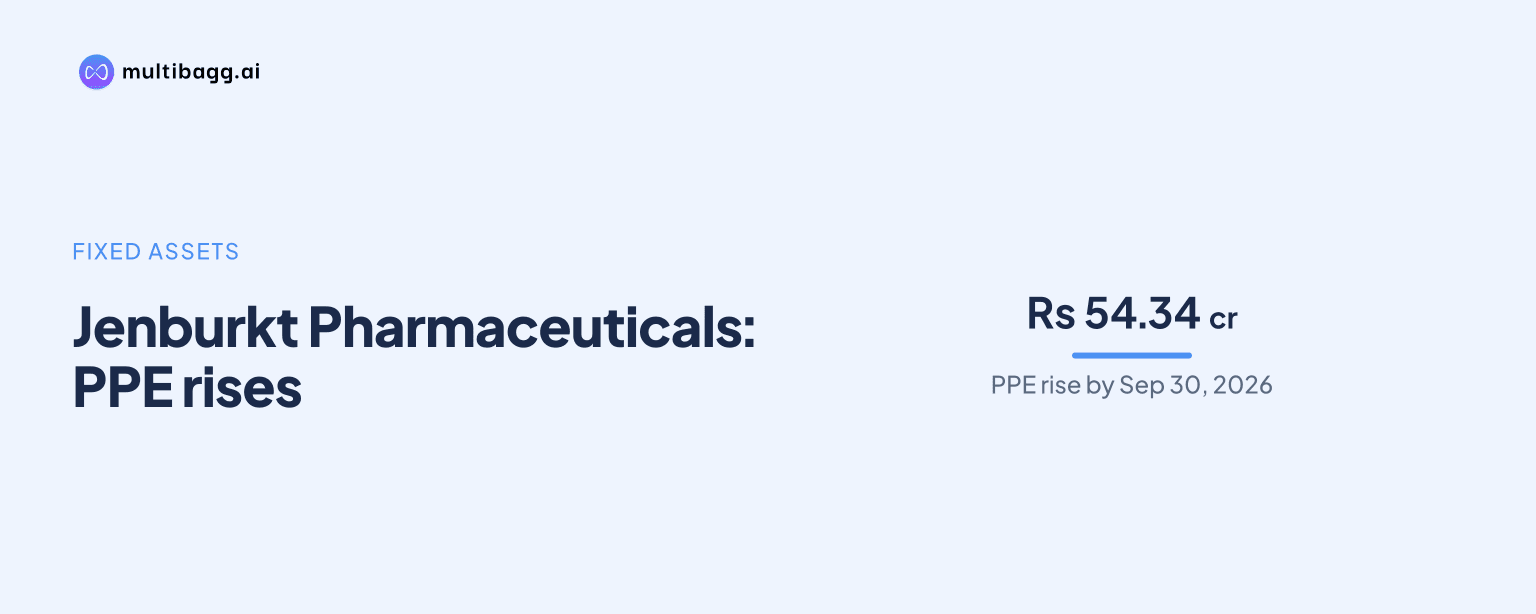
Jenburkt Pharmaceuticals Limited reported property, plant and equipment of Rs 65.64 crore at 30 September 2026, up Rs 54.34 crore from 31 March 2026, while capital work-in-progress fell Rs 42.84 crore to Rs 3.28 crore. The filing records the two balance-sheet movements but does not state an exact transfer amount or identify the underlying project.
Know Jenburkt Pharmaceuticals inside out
Results, valuation, peers and who's buying, in one view.
What changed in Jenburkt Pharmaceuticals’ fixed-asset balances?
Jenburkt Pharmaceuticals’ property, plant and equipment, or PPE, increased to Rs 65.64 crore at 30 September 2026 from Rs 11.30 crore at 31 March 2026. Capital work-in-progress, or CWIP, moved in the opposite direction, falling to Rs 3.28 crore from Rs 46.12 crore over the same six-month balance-sheet comparison.
The reported changes are Rs 54.34 crore for PPE and negative Rs 42.84 crore for CWIP. The simultaneous rise in completed fixed assets and reduction in work under progress is consistent with the recognition of assets that were previously under development, but the disclosure does not provide a detailed movement schedule for either category.
PPE increased by Rs 11.50 crore more than CWIP declined. This difference means the standalone assets-and-liabilities statement cannot establish that all of the PPE increase resulted from a CWIP transfer, or support a precise claim that Rs 43.50 crore was capitalised. Additions, disposals, depreciation and accounting adjustments are not separately reconciled in the filing.
Does Jenburkt Pharmaceuticals identify the project behind the movement?
No, Jenburkt Pharmaceuticals does not identify a plant, product, location or project responsible for the PPE and CWIP movements in its 3 November 2026 announcement. The balance sheet presents aggregate closing balances at 30 September 2026 and 31 March 2026, without a note showing commissioning dates, project costs or asset-class additions.
The company deals exclusively in the pharmaceuticals business segment, according to the notes accompanying its standalone results. As a result, there is no segment-level disclosure that could link the Rs 65.64 crore PPE balance to a particular operating activity, facility or product category.
The cash-flow statement also combines payments for PPE, CWIP, intangible assets and intangible assets in development into one category. Its column dated 30 September 2026 reports payments of Rs 11.20 crore, compared with Rs 13.72 crore in the column dated 31 March 2026. That combined line cannot isolate spending on a project that may have moved from CWIP to PPE.
Jenburkt Pharmaceuticals reported proceeds of Rs 2.50 lakh from disposal of PPE and intangible assets in the 30 September 2026 cash-flow column, against Rs 82,000 in the 31 March 2026 column. These disposals were small compared with the Rs 54.34 crore rise in PPE, but the company has not provided the fixed-asset roll-forward needed to calculate an exact capitalisation figure.
How did the asset movement change Jenburkt Pharmaceuticals’ balance sheet?
Jenburkt Pharmaceuticals’ total assets rose to Rs 234.92 crore at 30 September 2026 from Rs 226.01 crore at 31 March 2026, an increase of Rs 8.90 crore. The PPE gain was therefore largely offset by the lower CWIP balance and changes in financial assets, rather than translating one-for-one into total asset growth.
Non-current investments declined by Rs 7.63 crore to Rs 19.40 crore, while other non-current financial assets declined by Rs 20.27 crore to Rs 14.39 crore. At the same time, current investments stood at Rs 10.62 crore at 30 September 2026, compared with nil at 31 March 2026, showing that financial-asset balances also shifted during the period.
Cash and cash equivalents increased by Rs 44.89 lakh to Rs 6.03 crore, while bank balances other than cash equivalents rose by Rs 17.33 crore to Rs 64.86 crore. Trade receivables fell by Rs 4.53 crore to Rs 19.83 crore, whereas inventories rose by Rs 1.46 crore to Rs 15.10 crore.
Other equity, comprising reserves and surplus, increased to Rs 200.52 crore from Rs 192.63 crore. Total equity and liabilities matched total assets at Rs 234.92 crore on 30 September 2026, while lease liabilities were reported at Rs 1.55 crore as non-current liabilities and Rs 70.59 lakh as current liabilities.
Got a follow-up? Ask IRIS
What do Jenburkt Pharmaceuticals’ half-year results show?
Jenburkt Pharmaceuticals reported revenue from operations of Rs 83.83 crore for the year-to-date period ended 30 September 2026, up from Rs 81.08 crore in the corresponding prior-year period. Profit after tax, however, declined to Rs 16.10 crore from Rs 17.96 crore as total expenses rose faster than revenue.
Total expenses increased by Rs 5.78 crore to Rs 66.49 crore for the six months ended 30 September 2026. Employee benefit expenses rose by Rs 2.25 crore to Rs 27.90 crore, other expenses increased by Rs 2.12 crore to Rs 20.62 crore, and purchases of stock-in-trade were Rs 12.68 crore, up Rs 1.02 crore.
Depreciation and amortisation expense was Rs 1.44 crore in the six months ended 30 September 2026, compared with Rs 1.47 crore a year earlier. The period’s depreciation charge was therefore marginally lower despite the substantially higher PPE closing balance, and the filing does not disclose when the additional assets entered service or their expected depreciation profile.
What does Jenburkt Pharmaceuticals’ cash-flow statement show?
Jenburkt Pharmaceuticals reported net cash from operating activities of Rs 17.19 crore in the cash-flow statement column dated 30 September 2026. Net cash used in investing activities was Rs 6.80 crore and net cash used in financing activities was Rs 9.95 crore, leaving a Rs 44.89 lakh increase in cash and cash equivalents.
The investing outflow included Rs 11.20 crore of combined payments for PPE, CWIP and intangible assets. It also included investment purchases of Rs 18.42 crore, partly offset by Rs 16.68 crore of proceeds from sale or redemption of investments, alongside Rs 1.46 crore of interest received.
Financing activities included Rs 9.27 crore of dividend payments, Rs 43.03 lakh of lease-liability repayments and Rs 24.37 lakh of finance cost. The balance sheet does not list bank borrowings among its financial liabilities at 30 September 2026, although the cash-flow statement’s working-capital movement line for bank borrowings shows no movement in the 30 September 2026 column.
The cash-flow figures demonstrate that the reported balance-sheet reclassification and current-period cash spending are different measures. A movement from CWIP into PPE can change asset classification without necessarily matching cash paid during the same six-month period, which is why the Rs 11.20 crore combined capital-payment line cannot be treated as the amount capitalised.
Conclusion
Jenburkt Pharmaceuticals’ September 2026 balance sheet records a pronounced shift in its fixed-asset mix: PPE rose Rs 54.34 crore and CWIP fell Rs 42.84 crore. The pattern indicates that assets previously recorded as work in progress may have progressed into recognised fixed assets, but the announcement does not disclose the project, commissioning event or exact amount transferred between categories.
The unresolved issue for subsequent disclosures is the composition of the Rs 54.34 crore PPE increase, including the amounts attributable to CWIP capitalisation, new additions, disposals and depreciation. Jenburkt Pharmaceuticals’ 3 November 2026 filing provides no capital-expenditure target, completion schedule or project-specific plan, while the next financial statements could show the depreciation effect of the higher closing PPE base.