










Jenburkt Pharmaceuticals profit edges up to Rs 10.21 crore
Key highlights
- Jenburkt Pharmaceuticals reported September-quarter revenue from operations of Rs 48.32 crore, up 6.06% year on year.
- Jenburkt Pharmaceuticals reported September-quarter profit after tax of Rs 10.21 crore, compared with Rs 10.16 crore a year earlier.
- Jenburkt Pharmaceuticals’ profit after tax rose from Rs 5.89 crore in June 2026 to Rs 10.21 crore in September 2026.
- Jenburkt Pharmaceuticals’ year-to-date profit after tax declined to Rs 16.10 crore from Rs 17.96 crore despite revenue rising to Rs 83.83 crore.
powered by IRIS
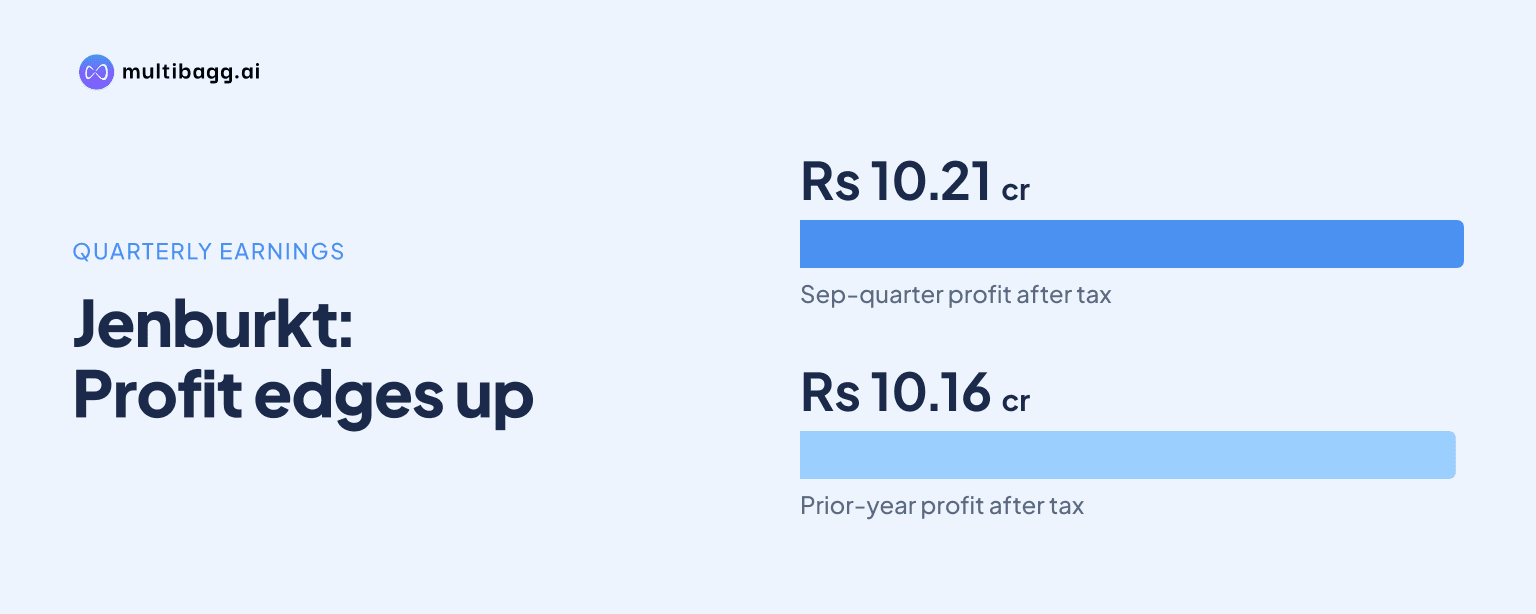
Jenburkt Pharmaceuticals Limited reported standalone profit after tax of Rs 10.21 crore for the quarter ended 30 September 2026, marginally above Rs 10.16 crore a year earlier, as revenue from operations increased 6.06% to Rs 48.32 crore. Profit also rose from Rs 5.89 crore in the preceding June 2026 quarter.
Know Jenburkt Pharmaceuticals inside out
Results, valuation, peers and who's buying, in one view.
How did Jenburkt Pharmaceuticals perform in the September quarter?
Jenburkt Pharmaceuticals increased revenue from operations to Rs 48.32 crore in the September 2026 quarter from Rs 45.56 crore in the September 2025 quarter. Total income, including other income, rose to Rs 50.57 crore from Rs 47.64 crore, while other income increased to Rs 2.25 crore from Rs 2.08 crore. The standalone unaudited results were approved by the board on 3 November 2026.
Profit after tax was Rs 10.21 crore, up Rs 5 lakh from Rs 10.16 crore a year earlier. Profit before tax was Rs 14.34 crore, compared with Rs 14.33 crore, while total expenses increased to Rs 36.23 crore from Rs 33.30 crore. Earnings per share, or EPS, rose to Rs 23.13 from Rs 23.03.
Why did Jenburkt Pharmaceuticals’ profit change only marginally year on year?
Jenburkt Pharmaceuticals’ profit changed only marginally because expenses rose by Rs 2.93 crore, exceeding the Rs 2.76 crore increase in revenue from operations. The resulting profit before tax increased by Rs 75,000 year on year, while the Rs 17.36 lakh rise in other income helped lift total income by Rs 2.93 crore.
Employee benefit expense rose to Rs 14.87 crore from Rs 13.93 crore, and purchases of stock-in-trade increased to Rs 7.20 crore from Rs 6.28 crore. Other expenses rose to Rs 10.48 crore from Rs 10.16 crore, while cost of materials consumed declined to Rs 1.96 crore from Rs 2.19 crore. Tax expense fell to Rs 4.13 crore from Rs 4.17 crore, supporting the Rs 5 lakh increase in post-tax profit.
How did Jenburkt Pharmaceuticals compare with the June quarter?
Jenburkt Pharmaceuticals reported September-quarter profit after tax of Rs 10.21 crore, 73.46% above Rs 5.89 crore in the June 2026 quarter. Revenue from operations increased 36.06% sequentially from Rs 35.51 crore, total income rose from Rs 37.03 crore to Rs 50.57 crore, and profit before tax increased from Rs 6.77 crore to Rs 14.34 crore.
Total expenses increased to Rs 36.23 crore in September from Rs 30.26 crore in June. Employee benefit expense rose by Rs 1.85 crore and stock-in-trade purchases by Rs 1.72 crore, while the inventory-change line moved from a Rs 1.47 crore negative amount in June to a Rs 79.01 lakh expense in September. EPS rose from Rs 13.34 to Rs 23.13, although total comprehensive income was Rs 9.64 crore after a Rs 64.20 lakh other comprehensive income charge before related tax.
Got a follow-up? Ask IRIS
What do Jenburkt Pharmaceuticals’ year-to-date results show?
Jenburkt Pharmaceuticals reported revenue from operations of Rs 83.83 crore for the year-to-date period ended 30 September 2026, compared with Rs 81.08 crore in the comparable prior-year period. Despite the Rs 2.75 crore revenue increase, profit after tax declined to Rs 16.10 crore from Rs 17.96 crore and profit before tax fell to Rs 21.11 crore from Rs 24.51 crore.
Total expenses rose to Rs 66.49 crore from Rs 60.71 crore over the two periods. Employee benefit expense increased to Rs 27.90 crore from Rs 25.65 crore, other expenses rose to Rs 20.62 crore from Rs 18.50 crore, and stock-in-trade purchases reached Rs 12.68 crore from Rs 11.66 crore. Other income declined to Rs 3.77 crore from Rs 4.14 crore.
What changed in Jenburkt Pharmaceuticals’ balance sheet and cash flows?
Jenburkt Pharmaceuticals reported total assets of Rs 234.92 crore at 30 September 2026, compared with Rs 226.01 crore at 31 March 2026. Property, plant and equipment rose to Rs 65.64 crore from Rs 11.30 crore, while capital work in progress declined to Rs 3.28 crore from Rs 46.12 crore. Cash and cash equivalents increased to Rs 6.03 crore from Rs 5.58 crore, and bank balances other than cash equivalents rose to Rs 64.86 crore from Rs 47.54 crore.
The cash-flow annexure’s 30 September 2026 column reports Rs 17.19 crore as net cash used in operating activities, Rs 6.80 crore as net cash used in investing activities and Rs 9.95 crore as net cash used in financing activities. Payments for property, plant and equipment were Rs 11.20 crore, dividend payments were Rs 9.27 crore, and cash and cash equivalents increased by Rs 44.89 lakh. Jenburkt Pharmaceuticals operates only in the pharmaceuticals business, so it did not provide segment-wise reporting.
What did Jenburkt Pharmaceuticals disclose about labour codes and the review?
Jenburkt Pharmaceuticals recorded no exceptional item in either the September 2026 quarter or the year-to-date period ended 30 September 2026. Its year ended 31 March 2026 included a Rs 3.95 crore exceptional item after revised labour codes notified on 21 November 2025 increased gratuity and leave liabilities for past service costs.
The limited review report dated 3 November 2026 stated that nothing had come to the auditor’s attention to suggest the September-quarter standalone results did not disclose the information required under Regulation 33. The report said the review, conducted under Standard on Review Engagements 2410, provides less assurance than an audit and did not express an audit opinion.
Conclusion
Jenburkt Pharmaceuticals delivered 6.06% year-on-year operating-revenue growth in the September quarter, but higher employee, stock-in-trade and other expenses limited the increase in profit after tax to Rs 5 lakh. The quarter improved sharply from June, whereas the year-to-date comparison showed higher revenue alongside lower profit.
What to watch next is clarification of the cash-flow annexure’s period labelling. The covering letter describes the cash-flow statement as covering the half year ended 30 September 2026, while the annexure title refers to the year ended 30 September 2026 and its comparison column is dated 31 March 2026.