








Jhandewalas Foods Limited Publishes FY26 Report, Sets December AGM
MAX Plan at ₹4,999/yr

Find your next multibaggerBe a Pro Investor
Research stocks and track your picks on the go. Download the app.
Key highlights
- Jhandewalas Foods has scheduled its 20th AGM for December 23, 2026 at 9:15 AM through VC/OAVM.
- The November 27, 2026 filing includes the company's FY2025-26 annual report and AGM notice.
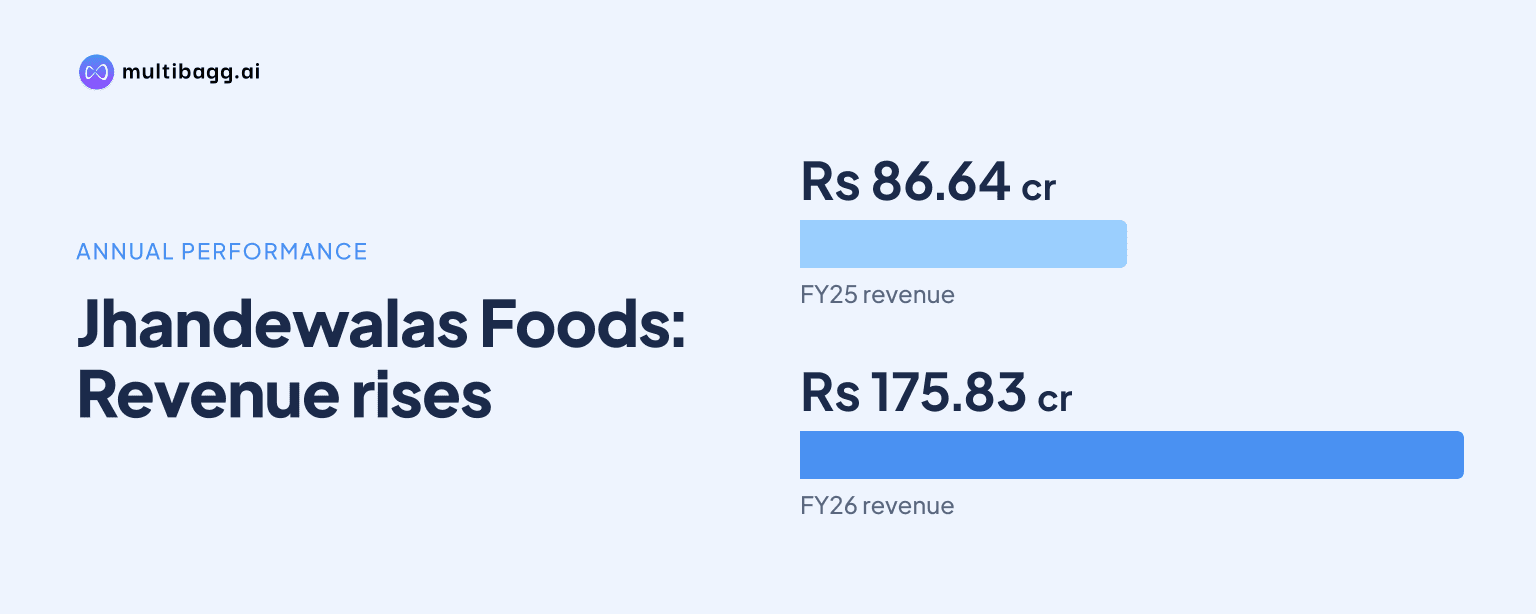
- Jhandewalas Foods reported FY26 revenue of ₹175.83 crore, up 102.94% from ₹86.64 crore in FY25.
- The company reported an H1 FY27 net loss of ₹4.93 crore, compared with H1 FY26 profit of ₹3.13 crore.
powered by IRIS
Jhandewalas Foods Limited has published its FY2025-26 annual report and fixed its 20th Annual General Meeting for December 23, 2026, at 9:15 AM through video conferencing. The filing provides shareholders with the annual-report documentation and the revised schedule for the statutory meeting covering the year ended March 31, 2026.
Know Jhandewalas Foods inside out
Results, valuation, peers and who's buying, in one view.
When is Jhandewalas Foods' 20th AGM scheduled?
Jhandewalas Foods will hold its 20th AGM on December 23, 2026, at 9:15 AM through Video Conferencing or Other Audio Visual Means. The company has issued the FY26 annual report and AGM notice as part of the filing dated November 27, 2026.
The AGM is the formal shareholder meeting for the financial year ended March 31, 2026. It gives members the opportunity to consider items placed in the notice, including matters that require shareholder approval. The supplied filing summary does not list the individual resolutions or voting outcomes.
The meeting date follows an earlier schedule disclosed in June 2026, when the company had planned to hold its 20th AGM on July 15, 2026. The current filing identifies December 23 as the applicable AGM date and 9:15 AM as the meeting time.
Why was the AGM date moved to December 2026?
The AGM could be scheduled in December after Jhandewalas Foods received an extension from the Registrar of Companies, Jaipur, for holding the meeting for FY26. The supplied regulatory context states that the approval letter was dated September 30, 2026 and granted a three-month extension.
Before seeking the extension, the board had considered an application to the Registrar of Companies under Section 96(1) of the Companies Act, 2013. The company had initially circulated an annual report and notice for a July 15 meeting, also through VC/OAVM.
This sequence is relevant because annual general meetings are subject to timelines under the Companies Act. The filing establishes the updated date for shareholders rather than the earlier July schedule shown in prior company disclosures.
What does the FY26 annual report cover?
The FY26 annual report covers Jhandewalas Foods' reporting for the year ended March 31, 2026, alongside the notice convening the 20th AGM. Annual reports generally bring together the board's report, financial statements and statutory disclosures required for shareholders, while the specific contents should be read in the company-issued document.
The company had previously reported audited financial results for FY26 after its board meeting on May 18, 2026. The results were filed with BSE on May 19, 2026 under Regulation 33 of the SEBI Listing Regulations, together with the audit report and statement of assets and liabilities.
Financial highlights supplied with the filing context show FY26 revenue of ₹175.83 crore, compared with ₹86.64 crore in FY25. That represents year-on-year revenue growth of 102.94%. These figures provide a financial reference point for investors reviewing the annual-report publication and AGM notice.
Got a follow-up? Ask IRIS
What financial information should investors assess alongside this filing?
Investors should assess the FY26 annual financial information alongside the more recent half-yearly disclosure for the period ended September 30, 2026. The supplied context reports H1 FY27 revenue from operations of ₹50.54 crore, down 32.56% year-on-year from ₹74.94 crore, and a net loss of ₹4.93 crore compared with a profit of ₹3.13 crore in H1 FY26.
The same H1 FY27 disclosure reported earnings per share of negative ₹3.23, against positive ₹2.36 in the comparable prior-year period. It also stated that the half-yearly results carried auditor qualifications, though the supplied information does not describe the basis or scope of those qualifications.
The contrast between FY26 revenue growth and the H1 FY27 decline is material context, but the annual-report filing itself does not state any future financial target or forecast. No share-price movement or immediate market response is provided in the filing information, so the disclosure should not be treated as evidence of a confirmed market reaction.
How does the filing affect Jhandewalas Foods shareholders?
The filing gives Jhandewalas Foods shareholders the current date, time and online format for the 20th AGM, enabling them to review the FY26 report and follow the procedures in the AGM notice. Shareholders should use the notice for details on eligibility, electronic voting and participation, as these operational terms are not reproduced in the supplied summary.
For investors, the annual report is a formal record of FY26 performance and governance disclosures, while the AGM is the mechanism for shareholder consideration of the stated business. The rescheduling also resolves the uncertainty created by the earlier July 2026 meeting plan and the subsequent extension process.
The filing does not announce a dividend, capital raise, acquisition, management change or business forecast. Its central significance is the publication of the FY26 annual-report material and confirmation of the December 23 AGM schedule.
Conclusion
Jhandewalas Foods has completed an important FY26 disclosure step by publishing its annual report and setting its 20th AGM for December 23, 2026 at 9:15 AM through VC/OAVM. The document is relevant both for statutory shareholder participation and for reviewing FY26 revenue of ₹175.83 crore, which was 102.94% above FY25.
The next disclosed event to watch is the AGM itself, including the resolutions contained in the notice and any shareholder voting disclosures issued after the meeting. Investors may also monitor subsequent company disclosures for further information on the reported H1 FY27 loss, lower revenue and the auditor qualifications referenced in the half-yearly results.

