










Jindal Capital document shows conflicting March 2026 CRAR
Key highlights
- Jindal Capital disclosed March 31, 2026 CRAR of both 0.45% and 44.37% in the same Letter of Offer.
- The Letter of Offer states that Base Layer NBFCs must maintain minimum CRAR of 15.00%.
- Detailed capital data show CRAR declined from 63.54% in March 2025 to 44.37% in March 2026.
- Jindal Capital plans gross rights-issue proceeds of up to Rs 16.2182 crore, including Rs 15.50 crore for capital augmentation and NBFC scale.
powered by IRIS
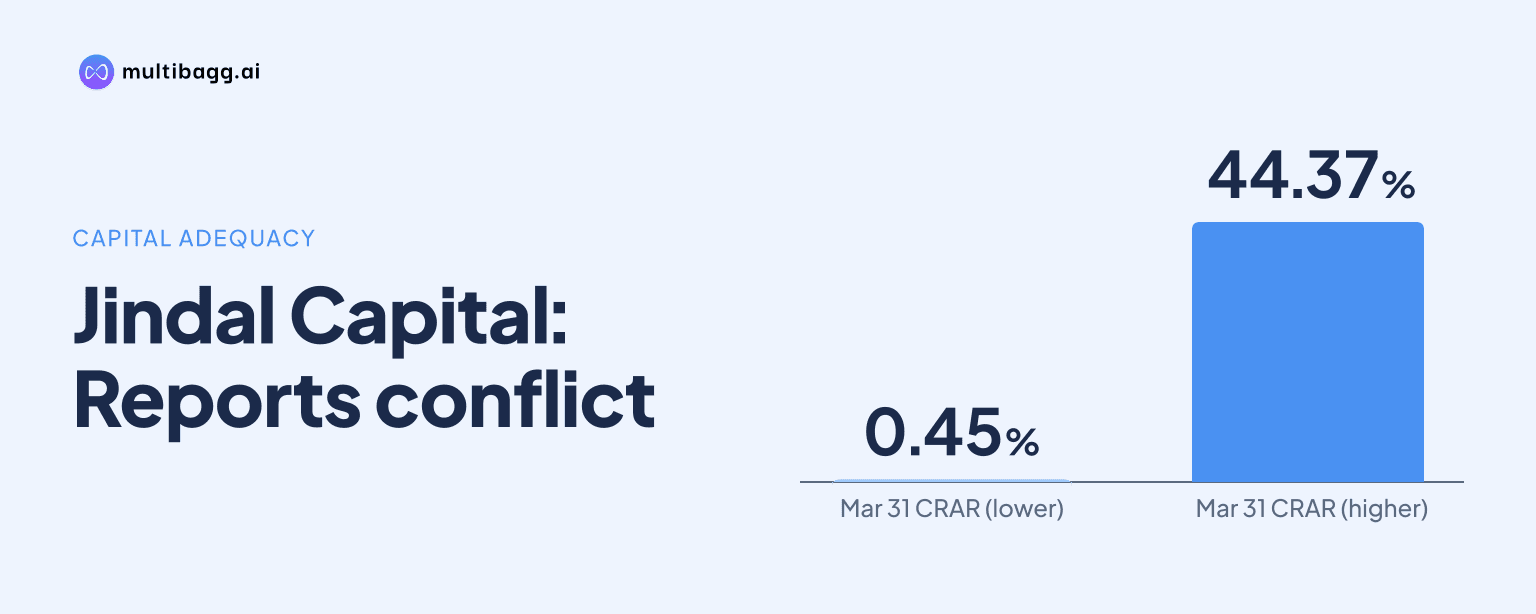
Jindal Capital Limited’s Letter of Offer gives two incompatible capital-to-risk-weighted-assets ratio, or CRAR, figures for March 31, 2026: 0.45% in a risk factor and 44.37% in its detailed capital-adequacy section. The difference is consequential because the document states that Base Layer non-banking financial companies must maintain minimum CRAR of 15%.
Know Jindal Capital inside out
Results, valuation, peers and who's buying, in one view.
What are the two March 2026 CRAR figures disclosed by Jindal Capital?
Jindal Capital reports a capital adequacy ratio of 0.45% as at March 31, 2026 in risk factor 13 on page 27. The passage describes the company as a non-deposit-taking non-banking financial company, or NBFC, under the Reserve Bank of India’s, or RBI’s, Base Layer framework and says it must meet capital adequacy and other prudential requirements.
Jindal Capital separately reports CRAR of 44.37% as at March 31, 2026 in the capital-adequacy disclosure on pages 55 and 56. That table records Tier I capital of Rs 12.1827 crore, nil Tier II capital and total risk-weighted assets and contingents of Rs 27.4567 crore. The Letter of Offer does not reconcile the 0.45% and 44.37% figures or label either disclosure as an error.
Why do Jindal Capital’s two CRAR figures matter?
The two figures imply materially different positions against the 15% minimum stated in the Letter of Offer. A 0.45% ratio is 14.55 percentage points below that threshold, while a 44.37% ratio is 29.37 percentage points above it. The risk-factor disclosure says failure to maintain prescribed levels may result in increased supervisory scrutiny, operating restrictions, monetary penalties or other RBI action.
The detailed capital section presents a different position, stating that Jindal Capital presently maintains CRAR above the regulatory minimum. Its reported March 31, 2026 total capital of Rs 12.1827 crore and risk-weighted assets and contingents of Rs 27.4567 crore correspond to the disclosed 44.37% CRAR. The same section says Tier I capital accounted for all reported capital because Tier II capital was nil.
How did Jindal Capital’s detailed capital position change over three years?
Jindal Capital’s detailed table shows CRAR declining to 44.37% at March 31, 2026 from 63.54% at March 31, 2025 and 66.33% at March 31, 2024. Risk-weighted assets and contingents rose to Rs 27.4567 crore in 2026 from Rs 17.3973 crore in 2025, while total capital increased to Rs 12.1827 crore from Rs 11.054 crore.
Tier II capital fell to nil at March 31, 2026 from Rs 18.34 lakh a year earlier and Rs 40.93 lakh at March 31, 2024. Tier I capital increased from Rs 10.8706 crore in 2025 to Rs 12.1827 crore in 2026, comprising Rs 7.2081 crore of share capital and Rs 5.0169 crore of reserves and surplus, less a deferred-tax-asset deduction of Rs 4.23 lakh.
Got a follow-up? Ask IRIS
What capital raise and regulatory target does Jindal Capital disclose?
Jindal Capital proposes a rights issue of up to 1,08,12,149 equity shares at Rs 15 each, for gross proceeds of up to Rs 16.2182 crore. After estimated issue expenses of Rs 35 lakh, the company expects net proceeds of Rs 15.8682 crore, including Rs 15.50 crore earmarked to augment capital and meet funding requirements for a larger NBFC operating scale.
The Letter of Offer says Base Layer NBFCs must maintain minimum net owned funds, or NOF, of Rs 10 crore by March 31, 2027. Jindal Capital reports NOF of Rs 12.18 crore at March 31, 2026 and says the issue is intended to support onward lending in loan against property, business loans and personal loans. Management estimates post-rights-issue CRAR of 66.12%, using Tier I capital of Rs 28.400925 crore and risk-weighted assets and contingents of Rs 42.9567 crore.
What should readers watch before Jindal Capital’s rights issue closes?
Readers should watch for clarification of the March 31, 2026 CRAR intended to be relied upon, because Jindal Capital’s Letter of Offer contains both 0.45% and 44.37% without an explanation. The issue is scheduled to open on November 17, 2026 and close on December 1, 2026, with allotment expected on or about December 2, 2026.
Readers can also track deployment of the proposed Rs 15.8682 crore of net proceeds during FY 2026-27. Brickwork Ratings India Private Limited has been appointed to monitor use of gross proceeds until they are fully utilised, while Jindal Capital says it will provide quarterly use-of-proceeds disclosures to its audit committee and report material deviations to stock exchanges.
Conclusion
The two March 31, 2026 capital disclosures create incompatible readings of Jindal Capital’s regulatory capital position. The detailed Basel II table shows a decline in CRAR from 63.54% in March 2025 to 44.37% in March 2026 as risk-weighted assets grew faster than total capital, whereas the risk factor reports 0.45% for the same date.
The next disclosed events are the November 17, 2026 opening and December 1, 2026 closing of the rights issue, which targets gross proceeds of up to Rs 16.2182 crore. Jindal Capital plans to direct Rs 15.50 crore to capital augmentation and NBFC scale while continuing to address the stated March 31, 2027 Rs 10 crore NOF requirement.