










Jindal Capital promoters hold 71.34% before rights issue
Key highlights
- Jindal Capital’s promoter group held 51,42,045 shares, or 71.34%, on June 30, 2026.
- Seven promoter-group holders may subscribe to entitlements, additional shares and unsubscribed shares in the rights issue.
- The proposed issue covers up to 1,08,12,149 shares at Rs 15 each, for gross proceeds of up to Rs 16.2182 crore.
- Assuming full allotment, Jindal Capital’s equity share count would rise from 72,08,100 to 1,80,20,249 shares.
powered by IRIS
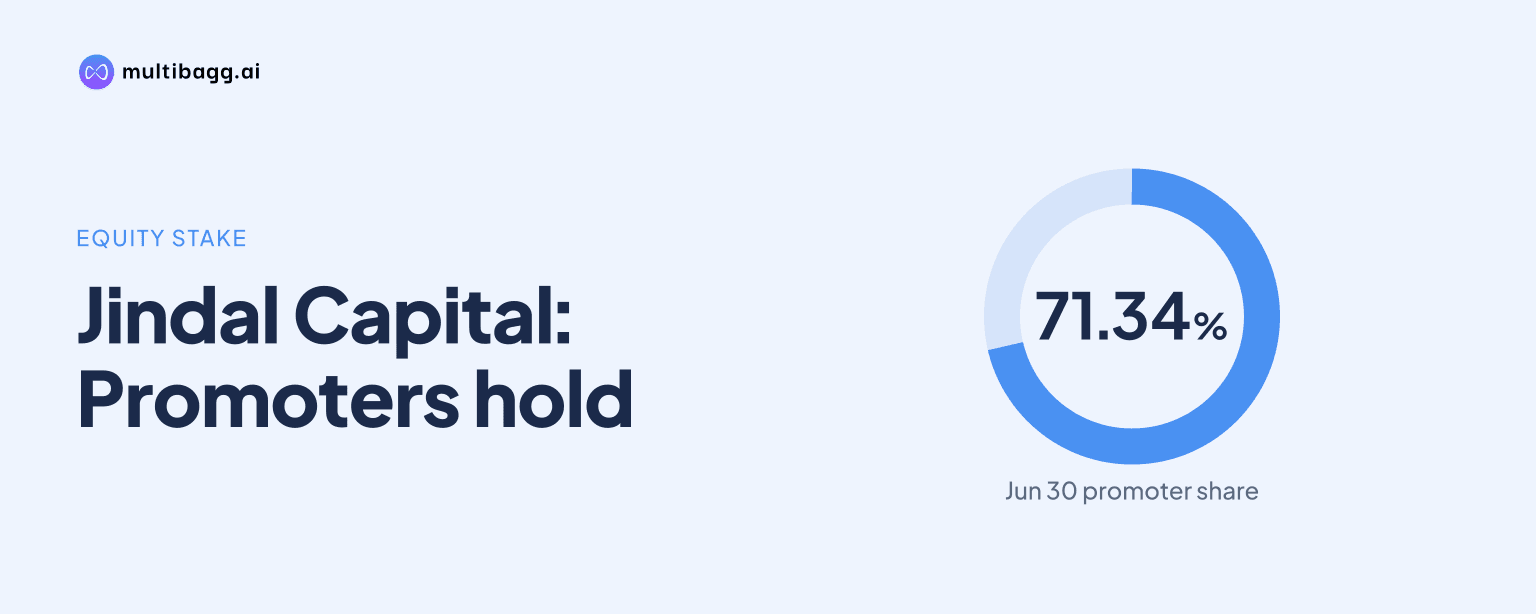
Jindal Capital Limited’s promoter group held 71.34% of equity and voting rights, or 51.42 lakh shares, on June 30, 2026, before a proposed Rs 16.2182 crore rights issue. Its seven holders said they may subscribe to entitlements, additional shares and shares left unsubscribed, subject to applicable law.
Know Jindal Capital inside out
Results, valuation, peers and who's buying, in one view.
What is Jindal Capital’s pre-issue ownership structure?
Jindal Capital’s promoter and promoter group owned 51,42,045 of its 72,08,100 fully paid equity shares on June 30, 2026, representing 71.34% of the company’s shares and voting rights. The public held the remaining 20,66,055 shares, or 28.66%, through 7,313 shareholders, while the promoter category comprised seven holders.
The June 30 disclosure reports the same 71.34% holding on a fully diluted basis because Jindal Capital had no outstanding warrants, options, convertible debentures, convertible loans or other instruments exchangeable for equity shares. All existing shares were fully paid, and the company stated that no shares carried differential or special voting rights. The promoter group’s 51,42,045 shares were all held in dematerialised form.
Which Jindal Capital promoters hold the shares?
Jindal Capital’s six individual promoters held a combined 42,00,116 shares, or 58.27%, while CMV Informatics Private Limited held 9,41,929 shares, or 13.07%. This makes the corporate promoter’s stake smaller than the individuals’ combined position but larger than the stake of any one named individual promoter.
Manjula Aggarwal was the largest individual holder with 9,00,000 shares, or 12.49%, followed by Sadhu Ram Aggarwal, Rahul Agarwal and Udit Aggarwal with 7,00,116, 7,00,000 and 7,00,000 shares respectively. Each of those three holdings was disclosed at 9.71%, while Divya Aggarwal and Ridhima Aggarwal each held 6,00,000 shares, or 8.32%. The filing records no acquisition by promoters or the promoter group in the year immediately before the Letter of Offer.
Jindal Capital also stated that, as of the Letter of Offer date, no shares held by promoters or promoter-group members were locked in, pledged or otherwise encumbered. That statement is subject to verification against the latest shareholding pattern, disclosures under Securities and Exchange Board of India (SEBI) takeover regulations, depository records and promoter declarations.
How could the Jindal Capital rights issue affect ownership?
Jindal Capital proposes to issue up to 1,08,12,149 rights equity shares at Rs 15 each, comprising a Rs 10 face value and a Rs 5 premium. Assuming full subscription and allotment, total issued, subscribed and paid-up shares would rise from 72,08,100 before the issue to up to 1,80,20,249 after it, while face-value share capital would increase from Rs 7.2081 crore to Rs 18.0203 crore.
The promoters, named as Sadhu Ram Aggarwal, Manjula Aggarwal, Rahul Agarwal, Udit Aggarwal, Divya Aggarwal, Ridhima Aggarwal and CMV Informatics Private Limited, confirmed in letters dated August 27, 2026 that they intend to participate. They may take all or part of their rights entitlements, apply for additional shares and subscribe to shares remaining unsubscribed, although they may also renounce entitlements in whole or part. Therefore, the filing does not establish a final post-issue ownership percentage.
Jindal Capital says promoter and promoter-group acquisitions in the issue will not result in a change in control and must comply with minimum public-shareholding rules. The issue is not underwritten, and the company says the regulatory minimum-subscription requirement applies; if minimum subscription is not received, application money must be refunded no later than four days after the rights issue closes.
Got a follow-up? Ask IRIS
How does Jindal Capital’s public holding compare with promoter ownership?
Jindal Capital’s public holding of 28.66% was 42.68 percentage points below the promoter group’s 71.34% as of June 30, 2026. The contrast is also visible in holder numbers: 7,313 public shareholders held 20,66,055 shares, compared with seven promoter-group holders holding 51,42,045 shares.
Resident individuals holding nominal share capital of up to Rs 2 lakh formed the largest public segment, with 16,36,434 shares or 22.70% of the company. Resident individuals above that threshold held 3,34,886 shares or 4.65%, and non-resident Indians held 15,886 shares or 0.22%. The filing shows no institutional, domestic institutional, foreign institutional, government or foreign-company holdings.
Within the smaller public categories, bodies corporate held 12,954 shares, or 0.18%, while trusts, limited liability partnerships and Hindu undivided families together appeared under other holdings. Sunil Sharma was listed with 75,823 shares, or 1.05%, within the resident-individual category above Rs 2 lakh. Of the public’s 20,66,055 shares, 17,63,315 were held in dematerialised form.
When will Jindal Capital’s rights issue be decided?
Jindal Capital set November 6, 2026 as the record date under a board resolution dated November 2, 2026, while its disclosed ownership snapshot is for the quarter ended June 30, 2026. The board had earlier authorised the issue on August 27, 2026, and approved its price, size and rights-entitlement ratio on November 2, 2026, although the ratio itself is not stated in the supplied filing extract.
The subscription period is scheduled to open on November 17, 2026 and close on December 1, 2026, with finalisation of allotment planned for December 2. Credit of shares is scheduled on or about December 3 and listing or commencement of trading on or about December 4. Jindal Capital describes the timetable as indicative and says its board may extend the issue period, subject to a minimum of seven days and a maximum of 30 days from the opening date.
Conclusion
Jindal Capital’s proposed issue is larger than its existing equity base, with up to 1,08,12,149 new shares offered against 72,08,100 shares outstanding before the issue. The 71.34% promoter-group holding, held by six individuals and one corporate entity, means the final split between promoter and public ownership will depend on subscription, renunciation and applications for any unsubscribed shares.
The next disclosed milestones are the November 17, 2026 opening, December 1 closing and expected December 2 allotment. The filing leaves the final post-issue promoter percentage unresolved because the promoters may subscribe to additional or unsubscribed shares, while any acquisition remains subject to applicable law and minimum public-shareholding requirements.