










JK Tyre says debt rise reflects inventory, volumes and capex
Key highlights
- JK Tyre’s consolidated net debt rose Rs 751 crore sequentially to Rs 5,696 crore at September 30, 2026.
- JK Tyre’s consolidated revenue reached a record Rs 4,850 crore in Q2 FY27, up 20% year on year.
- Consolidated EBITDA increased 28% sequentially to Rs 343 crore, lifting the margin to 7.1% from 6.8%.
- JK Tyre expects raw-material costs to rise another 4% to 5% in Q3 FY27 after a 30% increase over the prior six months.
powered by IRIS
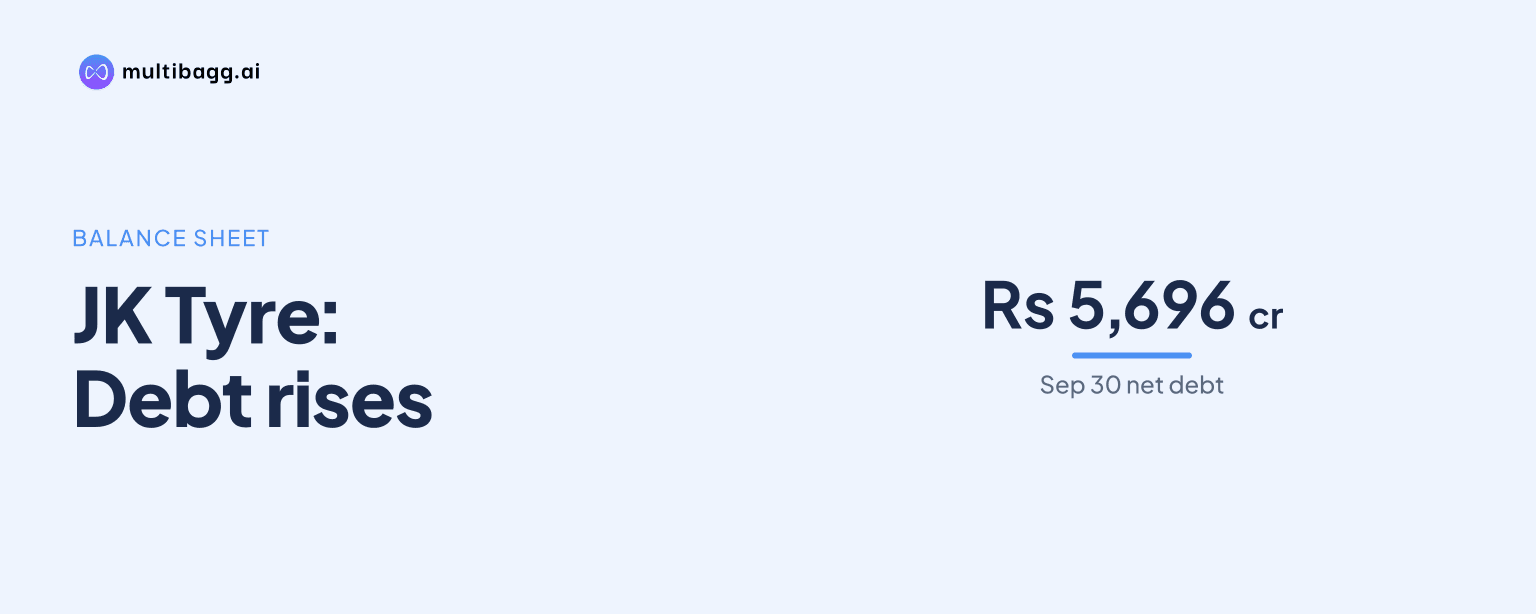
JK Tyre reported consolidated net debt of Rs 5,696 crore at September 30, 2026, up Rs 751 crore sequentially, as raw-material inflation, higher sales volumes and expansion borrowing increased funding needs. Management said its raw-material basket had risen 30% in six months and disclosed Rs 1,130 crore of expansions under way, followed by phased capex of around Rs 5,000 crore.
Know JK Tyre & Industries inside out
Results, valuation, peers and who's buying, in one view.
Why did JK Tyre’s net debt increase in Q2 FY27?
JK Tyre said its net debt increased because working-capital needs rose alongside long-term borrowing for capacity projects. Consolidated net debt reached Rs 5,696 crore on September 30, 2026, compared with Rs 4,945 crore in the preceding quarter, an increase of Rs 751 crore. Management cited higher raw-material prices, higher volumes and expansion projects in truck and bus radial, or TBR, and passenger-car radial, or PCR, tyres.
The main near-term pressure was the higher value of inventory, according to management. An investor cited inventory of Rs 743 crore, and management said it had risen because raw-material prices increased about 30% in the six months since the West Asia crisis began, tyre volumes grew, and JK Tyre held some strategic raw-material inventory. Management expects operating efficiencies to improve working-capital management, but did not provide a debt-reduction target or timetable.
What capital expenditure is JK Tyre planning?
JK Tyre said it is taking up expansions worth Rs 1,130 crore immediately and plans further capex in phases of around Rs 5,000 crore. Management said it expects roughly 1 to 1.1 times asset turnover from this capex, indicating that future turnover could be added at that multiple when the new assets are used. The call did not disclose commissioning dates, plant locations or capacity additions for these phases.
The programme follows projects worth Rs 1,400 crore that management said had recently been completed. For the balance of FY27, management guided to about Rs 500 crore of capex after an analyst said Rs 800 crore had already been spent. That would imply Rs 1,300 crore of FY27 capex if both figures are completed, above the earlier full-year indication of around Rs 1,200 crore cited by the analyst.
How are raw-material prices affecting JK Tyre’s working capital?
JK Tyre said its raw-material basket rose 9% sequentially in Q2 FY27 after increasing 22% in Q1 FY27, taking the six-month increase to about 30%. Management said crude-linked materials make up about 65% to 70% of the basket, including carbon black, synthetic rubber, butyl rubber and steel cord. It reported no current availability shortage despite supply-chain constraints.
For Q3 FY27, management expects a further 4% to 5% increase in the raw-material basket. JK Tyre said it raised net selling realisation, or NSR, by 7% sequentially in Q2 after a 4% to 5% increase in Q1, or 11% to 12% over six months, and plans another 4% to 5% increase in Q3. Management said original-equipment manufacturer price changes are index-led and can lag costs, while replacement-market pricing must remain competitive.
Got a follow-up? Ask IRIS
Did JK Tyre’s operating performance improve as debt rose?
JK Tyre reported higher operating earnings in Q2 FY27 while net debt increased. Consolidated revenue reached a record Rs 4,850 crore, up 20% year on year from Rs 4,026 crore. Consolidated earnings before interest, tax, depreciation and amortisation, or EBITDA, rose 28% sequentially to Rs 343 crore from Rs 268 crore, and the EBITDA margin increased to 7.1% from 6.8%.
Cash profit before depreciation and tax rose 39% sequentially to Rs 234 crore from Rs 169 crore, while profit after tax increased 40% sequentially to Rs 60 crore. Consolidated earnings per share were Rs 2.29 in Q2 FY27 versus Rs 1.55 in Q1 FY27. These gains occurred as Indian capacity utilisation remained above 90% across key TBR, passenger light radial, two-wheeler and three-wheeler segments.
How did volumes and demand develop for JK Tyre?
JK Tyre said domestic-market volume grew 22% year on year in Q2 FY27, with original-equipment sales up 25% and replacement-market sales up 20%. Export volume increased 7% sequentially, while exports from India rose 14% sequentially. Management said domestic quarter-on-quarter growth was about 13%, split equally between volume growth and higher NSR.
Management said demand remained steady entering Q3 FY27 and expected demand in Q4 as it marks year-end for most original-equipment manufacturers. On a standalone basis, replacement represented 60% of revenue, original equipment 30% and exports 10%. JK Tyre also said certain TBR products made in India are sent to its Mexican subsidiary, which then sells them into Mexican and Latin American markets under arm’s-length transfer-pricing formulas.
Conclusion
JK Tyre’s Rs 751 crore sequential net-debt increase reflects more than capacity spending. Management attributed it to the combined effect of 30% raw-material inflation over six months, greater inventory value, higher volumes and borrowing for TBR and PCR expansion. At the same time, Q2 FY27 revenue reached Rs 4,850 crore and consolidated EBITDA rose to Rs 343 crore.
The next disclosures to watch are whether the planned 4% to 5% Q3 FY27 NSR increase offsets another expected 4% to 5% increase in raw-material costs, and whether operating efficiencies reduce working-capital pressure. Management’s stated milestones also include about Rs 500 crore of capex for the balance of FY27, Rs 1,130 crore of expansions under way and later phases of around Rs 5,000 crore.