










JK Tyre forecasts 4%-5% Q3 raw-material cost increase after 30% rise
Key highlights
- JK Tyre’s raw-material basket increased 30% in the six months through Q2FY27, after rising 22% in Q1FY27 and 9% sequentially in Q2FY27.
- Management expects raw-material costs to rise another 4%-5% in Q3FY27 and plans a matching 4%-5% increase in net selling realisation.
- Consolidated Q2FY27 revenue reached a record Rs 4,850 crore, up 20% year-on-year, while EBITDA margin improved to 7.1% from 6.8% in Q1FY27.
- Consolidated net debt rose Rs 751 crore quarter-on-quarter to Rs 5,696 crore as of September 30, 2026, partly because of higher working-capital needs and expansion borrowings.
powered by IRIS
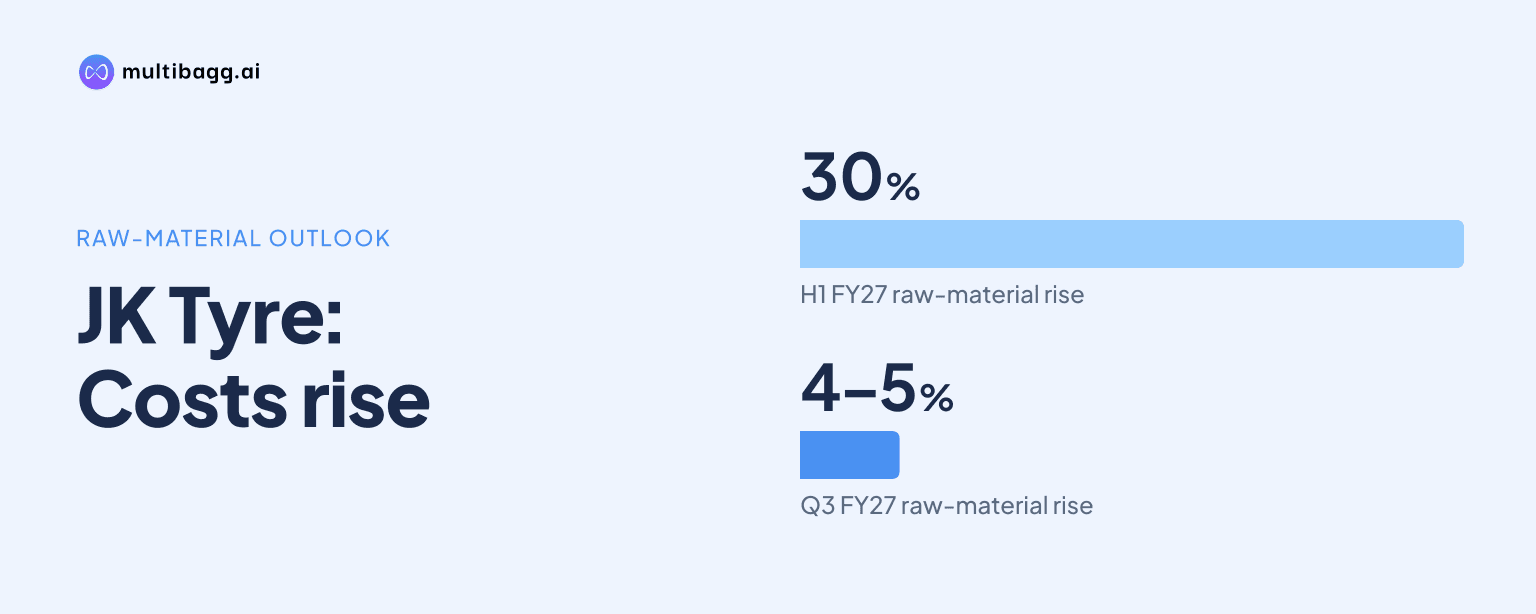
JK Tyre reported that its raw-material basket rose 30% in the six months through the second quarter of financial year 2027 (Q2FY27), following a 22% increase in Q1FY27 and a 9% sequential rise in Q2FY27. Management expects a further 4%-5% increase in Q3FY27 and plans a matching increase in net selling realisation.
Know JK Tyre & Industries inside out
Results, valuation, peers and who's buying, in one view.
Why did JK Tyre's raw-material costs rise 30%?
JK Tyre attributed the 30% six-month increase in its raw-material basket to inflationary pressure and supply-chain constraints linked to the West Asia crisis. The company reported a 22% increase in the first quarter of FY27 (Q1FY27), followed by a 9% quarter-on-quarter increase in Q2FY27. Management said the escalation affected profitability in the near term, despite Q2FY27 consolidated revenue reaching a record Rs 4,850 crore, up 20% from Rs 4,026 crore a year earlier.
Crude oil-based inputs account for about 65%-70% of JK Tyre's raw-material requirements, management said. Carbon black, synthetic rubber, butyl rubber and steel cord had all risen both year-on-year and quarter-on-quarter. Management said these inputs would soften if crude oil prices ease, but used a conservative assumption of a further 4%-5% basket increase for Q3FY27. It also said there was no current scarcity or availability issue for the materials.
The reported movements show that the six-month input-cost increase was larger than the forecast increase for the next quarter.
How much of the cost increase has JK Tyre passed through in prices?
JK Tyre said net selling realisation (NSR) rose 7% quarter-on-quarter in Q2FY27 after a 4%-5% increase in Q1FY27, taking the six-month increase to 11%-12%. Management plans a further 4%-5% NSR increase in Q3FY27. The stated price increases remain below the reported 30% increase in the raw-material basket during the first six months of FY27.
Management said pass-through differs between original equipment manufacturers (OEMs) and the replacement market. OEM pricing is index-led, with some Q2FY27 benefit and some adjustment expected in Q3FY27, but management said there is a lag effect. In replacement tyres, management said full pass-through is constrained by the need to remain competitive. It described an unabsorbed cost gap between rising materials costs and its ability to recover them through selling prices.
The effect was visible in consolidated earnings before interest, tax, depreciation and amortisation (EBITDA) margin, which was 7.1% in Q2FY27 compared with 6.8% in Q1FY27. Consolidated EBITDA nevertheless rose 28% sequentially to Rs 343 crore from Rs 268 crore, while profit after tax increased 40% sequentially to Rs 60 crore. Management said product mix, calibrated pricing and internal efficiency measures were being used to manage the pressure, and it expects some margin improvement in Q3FY27.
Got a follow-up? Ask IRIS
How did the increase affect JK Tyre's working capital and debt?
JK Tyre said higher raw-material prices increased the value of raw-material and finished-goods inventory, raising working-capital needs alongside higher volumes. Consolidated net debt stood at Rs 5,696 crore on September 30, 2026, up Rs 751 crore quarter-on-quarter. Management identified capital-expenditure-led long-term borrowings and the working capital required for higher material costs and volumes as the main reasons for the increase.
An analyst cited inventory of Rs 743 crore for the quarter. Management said inventory had risen for two reasons: the 30% increase in raw-material prices since the West Asia crisis began and volume growth. It added that JK Tyre had retained some strategic raw-material inventory. Management expects operating efficiencies to help manage working capital better, but it did not give a debt-reduction target.
Expansion spending is also part of the funding picture. JK Tyre said it had recently completed projects worth Rs 1,400 crore and was undertaking truck and bus radial and passenger car radial expansion projects. For the balance of FY27, management indicated capital expenditure of roughly Rs 500 crore, after an analyst referred to Rs 800 crore already spent and earlier full-year guidance of about Rs 1,200 crore.
What is JK Tyre expecting for Q3FY27 demand and costs?
JK Tyre expects demand to remain steady in Q3FY27 while its raw-material basket rises another 4%-5%, according to management. It said Q2FY27 demand was supported by goods and services tax reforms, the festive season, infrastructure activity and freight movement. Management also expects demand in Q4FY27 as OEMs approach their financial year-end, but presented this as an outlook rather than a quantified volume forecast.
JK Tyre entered Q3FY27 after reporting 22% year-on-year domestic volume growth in Q2FY27, including 25% growth in OEM volumes and 20% growth in replacement volumes. Exports from India rose 14% sequentially, while capacity utilisation in India exceeded 90% across key segments, including truck and bus radial tyres and two- and three-wheeler tyres. Management said higher volumes increase working-capital requirements when raw-material prices are elevated.
Category performance differed in Q2FY27. Truck and bus radial OEM volumes grew 76% year-on-year, while passenger light radial volumes rose 14% overall, led by 35% OEM growth. Farm replacement volumes increased 16%, and two- and three-wheeler replacement volumes more than doubled. Management said rainfall deficits in some agricultural areas could put pressure on the farm season, although it also cited improving rural income and its supply relationships with OEMs.
Conclusion
JK Tyre's pricing actions recovered part, but not all, of the raw-material inflation reported through Q2FY27. A 30% six-month rise in the material basket compares with an 11%-12% increase in NSR, while Q2FY27 EBITDA margin improved by 0.3 percentage points sequentially to 7.1%. Higher input values and volumes also contributed to net debt rising Rs 751 crore quarter-on-quarter to Rs 5,696 crore.
The immediate point to watch is whether the 4%-5% Q3FY27 material-cost increase estimated by management is matched by its planned 4%-5% NSR increase, particularly as OEM pricing adjustments can lag. Management said it hopes the forecast price range remains in Q4FY27, but also said it could not comment much beyond Q3FY27. The roughly Rs 500 crore of remaining FY27 capital expenditure and working-capital management will also affect the balance-sheet outcome.