










JM Financial to Resume Borrowing as Private-Market Cash Falls
Key highlights
- JM Financial private-markets cash fell from Rs 3,077 crore in June 2026 to Rs 1,691 crore in September 2026.
- JM Financial private-markets disbursements doubled sequentially to Rs 977 crore in Q2 FY27.
- JM Financial private-markets standard loans rose 22% year on year to Rs 4,748 crore.
- JM Financial said private-markets debt-equity was 0.8x, against a permitted limit of up to 4x.
powered by IRIS
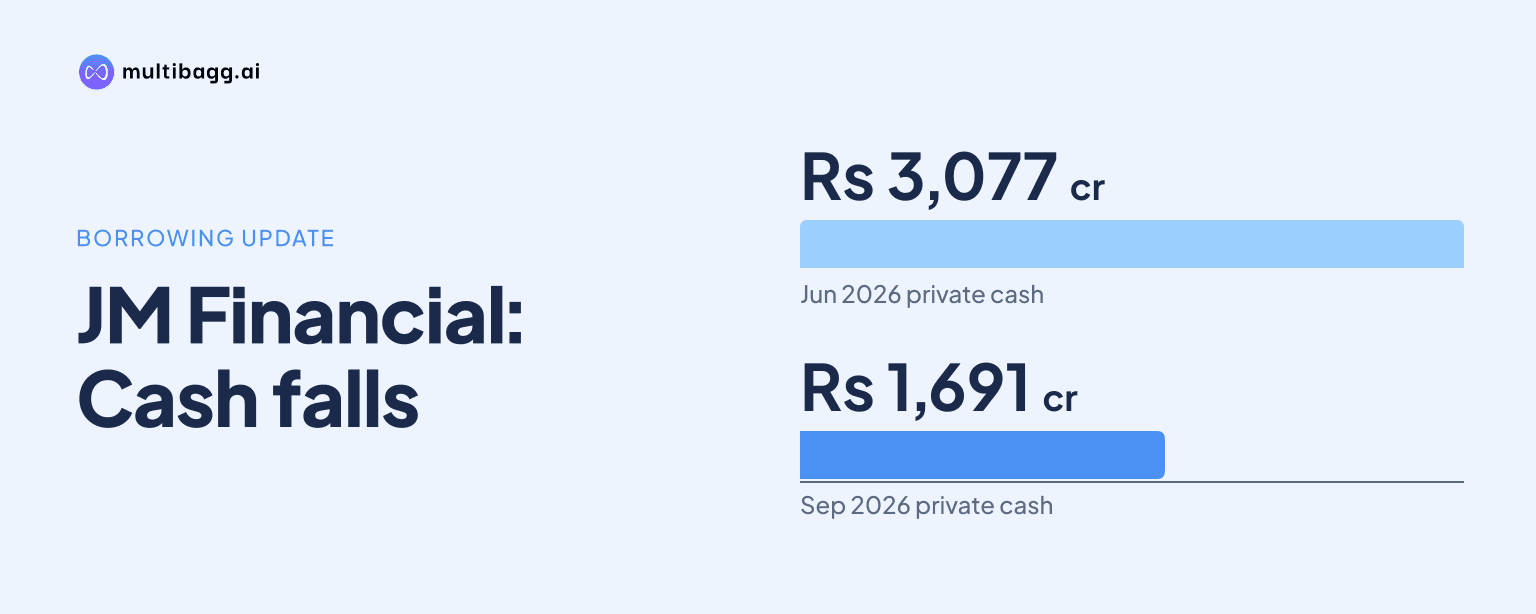
JM Financial Limited plans to resume borrowing for private markets from the next quarter after Q2 FY27 disbursements reduced segment cash and cash equivalents to Rs 1,691 crore in September 2026 from Rs 3,077 crore in June, while the segment’s debt-equity ratio reached 0.8x.
Know JM Financial inside out
Results, valuation, peers and who's buying, in one view.
Why is JM Financial resuming private-markets borrowing?
JM Financial is resuming borrowing because private-markets disbursements have consumed much of the cash it had been using to fund loan growth without material new debt. The private-markets business disbursed Rs 977 crore in Q2 FY27, double the preceding quarter’s level, principally in bespoke credit. Management said it expects to preserve at least Rs 1,000 crore as pure cash for asset-liability management and lending and investment opportunities.
The decline in liquidity was substantial over one quarter. Cash and cash equivalents in private markets fell by Rs 1,386 crore, or about 45%, from Rs 3,077 crore in June 2026 to Rs 1,691 crore in September 2026. Management said planned disbursements in the current quarter would mean it “probably” needs to begin borrowing in the next quarter, while also allowing for wholesale-loan prepayments.
The planned borrowing marks a shift from the previous low-leverage phase, rather than a disclosed change in lending criteria. Management said it had reached the bottom of the segment’s debt-equity level at 0.8x and has limits to take debt-equity as high as 4x. It said additional borrowing would be used to grow private markets across asset classes offering what it considers the best risk-adjusted return.
How fast did JM Financial’s private-markets loan book grow?
JM Financial’s private-markets standard loan book grew 22% year on year to Rs 4,748 crore at September 2026, supported by Rs 977 crore of Q2 FY27 disbursements. The company had earlier guided to approximately 20% year-on-year growth and said it had effectively reached that pace in the first half after a sharp September-quarter expansion.
Bespoke loans drove the increase. Management said the bespoke book rose to Rs 3,800 crore from Rs 3,000 crore during the quarter, with a significant portion of the Rs 800 crore increase carrying two- to three-year maturities. It distinguished these corporate and promoter loans from loan against securities and margin-trade finance, which it said sit within wealth management rather than private markets.
Real-estate credit remained stable despite management identifying opportunities because it did not accept pricing comparable to corporate credit. Management said real-estate lending needs pricing 200 to 300 basis points above corporate lending for the business to participate. It also described typical real-estate loan maturities as three to four years, compared with 18 to 36 months for security-receipt structures.
Management did not project even quarter-by-quarter loan growth. It said private credit would remain lumpy because it will add assets only when terms meet its risk-return requirements and when it can syndicate exposure if necessary. Its stated longer-term endeavour remains around 20% year-on-year loan-book growth, but it cautioned that some quarters may have fewer transactions.
Got a follow-up? Ask IRIS
What did private markets contribute to JM Financial’s earnings?
JM Financial’s private-markets segment reported Q2 FY27 net revenue of Rs 120 crore and profit after tax after non-controlling interests of Rs 77 crore, while first-half net revenue rose 63% year on year to Rs 582 crore and profit reached Rs 305 crore. The half-year outcome was higher than the Rs 357 crore of net revenue reported for H1 FY26.
The contrast between quarterly and half-year figures illustrates why management asked investors to consider a broader period. Q2 FY27 net revenue of Rs 120 crore was below Rs 124 crore in Q2 FY26, even though the loan book had expanded and management said yields had improved. It attributed the difference partly to fair-value movements in asset reconstruction company, or ARC, investments, prior-period recovery-related interest income, and lower liquidity this year.
ARC recoveries and investment marks remain sources of variability. Management said a large account received final National Company Law Tribunal approval in October and could provide nearly Rs 330 crore to Rs 340 crore of liquidity before the quarter closes. It also said security-receipt investments had declined to about Rs 2,825 crore, with a further Rs 350 crore of cash resolution to JM Financial, for total resolutions of nearly Rs 800 crore in the quarter.
What could make JM Financial’s private-markets earnings volatile?
JM Financial said ARC resolutions and quarterly mark-to-market changes in equity and alternative investments can make private-markets earnings uneven, even as the loan book expands. One cited example was an ARC asset merged into Gokaldas Exports, whose quarterly valuation was affected by US tariffs because the United States is a significant market for that company.
Management expects the variation to lessen over time if the standard loan book grows and the ARC adds more retail granular assets. It said the loan book produces less volatility than the investment book, while security receipts can generate irregular resolution gains. After the latest large resolution, management said ARC would still hold more than Rs 2,000 crore in security-receipt investments targeted for cash recovery over the next 18 months to two years, with modeled returns of 16% to 18%.
The company also reaffirmed an impairment-writeback target of Rs 250 crore for the financial year and said it was on track, subject to closing by March 31. In comparing periods, management said H1 FY26 included a Rs 231 crore writeback while H1 FY27 had only Rs 15 crore so far. That difference means reported profit-before-tax comparisons can reflect recovery timing as well as underlying lending income.
Private markets are one part of a larger group whose results vary by segment. Consolidated gross leverage stood at 1x in Q2 FY27, distinct from the 0.8x debt-equity measure management cited for private markets. Group standard loans across private markets, wealth and affordable home loans rose 23% year on year to Rs 10,270 crore, while Q2 consolidated net revenue was Rs 712 crore and profit after tax after non-controlling interests was Rs 240 crore.
Conclusion
JM Financial has moved from deploying surplus cash to preparing for debt-funded private-markets growth. The immediate evidence is the Rs 1,386 crore quarterly reduction in segment cash, Rs 977 crore of Q2 disbursements and the 22% year-on-year increase in standard loans to Rs 4,748 crore. The funding decision also comes with acknowledged earnings variability from ARC recoveries and investment valuation movements.
Next, investors should watch whether management begins borrowing in the next quarter while maintaining its stated Rs 1,000 crore minimum cash buffer. Other disclosed milestones include potential Rs 330 crore to Rs 340 crore of liquidity from the October-approved resolution, the Rs 250 crore impairment-writeback target by March 31, and progress toward management’s approximately 20% private-markets loan-book growth objective.