










John Cockerill India revenue doubles as EBITDA turns negative
Key highlights
- JIL’s standalone 9M CY26 revenue rose 104.9% year on year to Rs 523.64 crore.
- JIL’s standalone 9M CY26 EBITDA was a Rs 3.95 crore loss, versus a Rs 12.81 crore profit a year earlier.
- JIL’s 9M CY26 material-margin rate declined to 40.0% from 49.9%.
- JIL reported a standalone order book of about Rs 2,328 crore as of Oct-26.
powered by IRIS
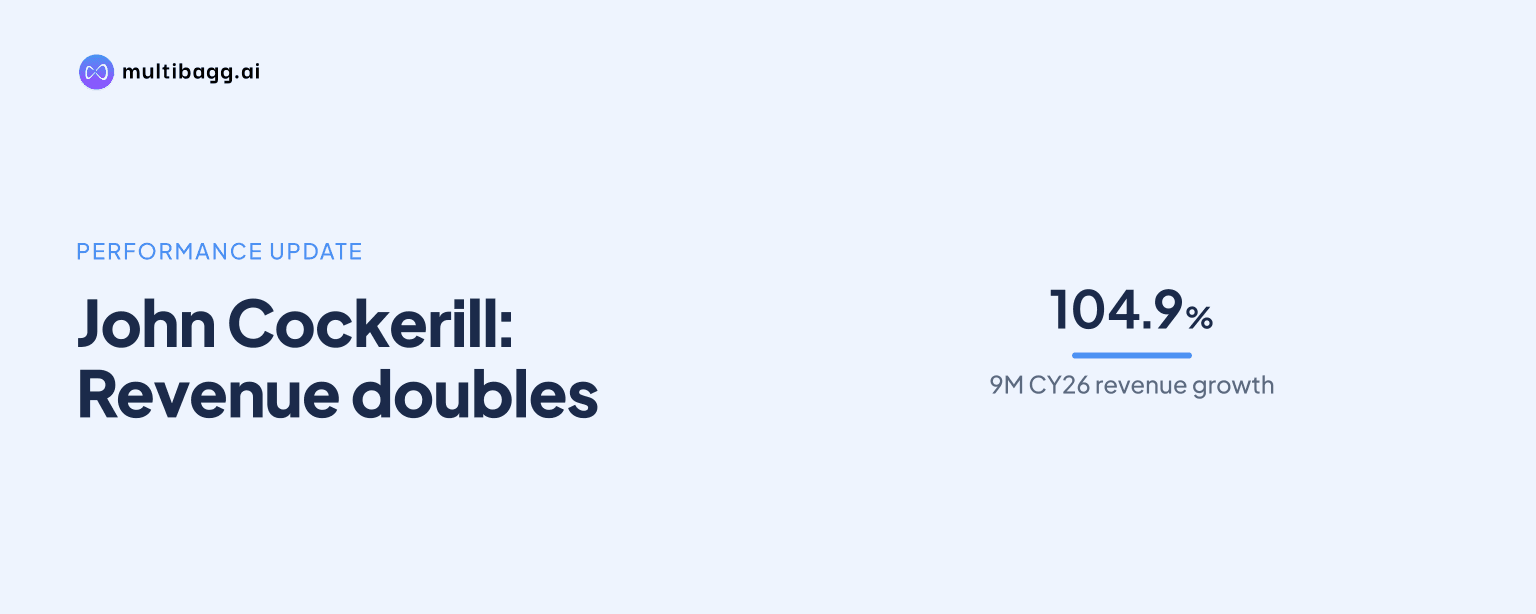
John Cockerill India Limited reported standalone revenue of Rs 523.64 crore for 9M CY26, up 104.9% year on year, but EBITDA turned to a Rs 3.95 crore loss from a Rs 12.81 crore profit as material margin fell to 40.0% and project-execution costs increased.
Know John Cockerill India inside out
Results, valuation, peers and who's buying, in one view.
How fast did JIL’s standalone revenue grow in 9M CY26?
JIL’s standalone revenue more than doubled in 9M CY26, rising 104.9% year on year to Rs 523.64 crore from Rs 255.53 crore in 9M CY25. The increase followed Q3 CY26 revenue of Rs 174.42 crore, up 79.9% from Rs 96.98 crore a year earlier. The presentation attributed the revenue momentum to strengthening underlying demand and order wins during the quarter.
The growth in revenue did not translate into an equivalent increase in material margin in Q3 CY26. Q3 material margin rose 5.6% to Rs 53.41 crore while revenue increased 79.9%. Over nine months, material margin increased 64.0% to Rs 209.23 crore, slower than the 104.9% revenue increase, as raw-material cost rose to Rs 314.41 crore from Rs 127.92 crore.
Why did JIL’s EBITDA turn negative despite revenue growth?
JIL’s earnings before interest, tax, depreciation and amortisation, or EBITDA, turned negative because material-margin rates declined and operating costs rose during project execution. In Q3 CY26, EBITDA was a loss of Rs 11.97 crore, compared with a profit of Rs 11.31 crore in Q3 CY25. The EBITDA margin consequently moved to negative 6.9% from positive 11.7%.
The material-margin rate was 30.6% in Q3 CY26, down from 52.2% in Q3 CY25, a decline of 2,150 basis points. For 9M CY26, the rate declined 1,000 basis points to 40.0% from 49.9%. JIL said profitability was affected by multiple project-related costs incurred during initial execution stages, while corresponding margin contribution is expected as projects move into subsequent stages.
Employee cost increased to Rs 21.57 crore in Q3 CY26 from Rs 12.29 crore a year earlier, while other expenses rose to Rs 43.81 crore from Rs 26.99 crore. Across 9M CY26, employee cost reached Rs 68.68 crore versus Rs 49.72 crore, and other expenses were Rs 144.50 crore versus Rs 65.08 crore. The combined increases in these costs exceeded the quarter’s Rs 2.82 crore increase in material margin.
How did JIL report higher profit after tax while core operations lost money?
JIL reported profit after tax, or PAT, of Rs 34.61 crore in 9M CY26 because a one-time property-sale gain offset its operating loss and finance costs. Reported PAT increased from Rs 9.90 crore in 9M CY25, while Q3 PAT rose to Rs 32.16 crore from Rs 8.91 crore. The adjusted profit figures show that reported PAT did not reflect an improvement in underlying operating profitability.
The presentation recorded exceptional income of Rs 55.97 crore for 9M CY26 and Rs 53.58 crore for Q3 CY26, identifying it as a one-time gain on sale of property. Before this item, 9M EBITDA was negative Rs 3.95 crore, earnings before interest and tax were negative Rs 2.56 crore, and finance cost increased to Rs 13.35 crore from Rs 1.36 crore. Reported profit before tax was Rs 40.06 crore, compared with Rs 13.22 crore in the previous nine-month period.
JIL’s adjusted PAT, which deducts the exceptional item net of income tax, was a loss of Rs 12.46 crore in 9M CY26 against a Rs 9.90 crore profit in 9M CY25. Q3 adjusted PAT was a loss of Rs 14.91 crore, compared with a Rs 8.91 crore profit a year before. This comparison indicates that the increase in statutory PAT was driven by the property-sale gain rather than operating performance.
Got a follow-up? Ask IRIS
What does JIL’s order book indicate about future execution?
JIL reported a standalone order book of about Rs 2,328 crore as of Oct-26, which it said provides visibility for the coming years. This order book is more than four times the Rs 523.64 crore of standalone revenue recognised in 9M CY26, although the presentation did not provide order-book conversion timing, project-level margins or a revenue forecast.
Management linked current margin pressure to the early stages of several projects and said the corresponding margin contribution would materialise as projects advance into subsequent stages. Q3 CY26 raw-material cost was Rs 121.01 crore, compared with Rs 46.39 crore in Q3 CY25, while the material-margin rate fell to 30.6% from 52.2%. The timing of future margin contribution therefore depends on project execution progressing through those later stages.
JIL is also adding execution capacity. The chairman said that, since September 2025, more than 100 employees had been added in India and more than 30 in China, with a further plan to hire about 50 people across both operations by year-end. These additions are intended to strengthen engineering, project-execution and operational capabilities, but the presentation does not quantify their expected cost or revenue effect.
How did JIL’s consolidated results compare with standalone performance?
JIL’s consolidated revenue grew more slowly than its standalone revenue, while consolidated EBITDA remained negative. Consolidated revenue was Rs 958.66 crore in 9M CY26, up 30.7% from Rs 733.61 crore, compared with standalone revenue growth of 104.9%. Consolidated EBITDA was a loss of Rs 54.51 crore, wider than the Rs 19.00 crore loss in 9M CY25.
On the consolidated basis, the material-margin rate declined to 45.3% in 9M CY26 from 52.1%, while the EBITDA margin declined to negative 5.7% from negative 2.6%. Consolidated PAT improved to a loss of Rs 12.89 crore from a loss of Rs 20.25 crore, assisted by the same Rs 55.97 crore exceptional income. Consolidated adjusted PAT was a Rs 59.96 crore loss, versus a Rs 20.25 crore loss in the prior-year period.
The presentation says Chinese, German and Belgian entities were merged under JIL with effect from January 1, 2026. It also reported a consolidated order book of about Rs 4,600 crore as of Jun-26, although this date differs from the Oct-26 standalone order-book date. The different reporting scopes and dates mean the two order-book figures are not directly comparable.
Conclusion
JIL’s 9M CY26 results show a large expansion in standalone revenue, with Rs 523.64 crore recognised versus Rs 255.53 crore a year earlier, but this growth coincided with a move from Rs 12.81 crore of EBITDA profit to a Rs 3.95 crore loss. Lower material-margin rates, higher employee costs and higher other expenses explain the operational reversal, while the Rs 55.97 crore one-time property-sale gain supported reported PAT of Rs 34.61 crore.
The next reported period will indicate whether projects in JIL’s Rs 2,328 crore standalone order book reach stages that generate the margin contribution management expects. Investors can also watch for the Q4 CY26 financial impact of Project Vulcan, after regulatory approvals and the allotment of 35,185 compulsorily convertible preference shares to John Cockerill SA, as disclosed by the chairman.