










JPT Securities Q2 FY27 Loss Narrows to ₹4.60 Lakh
Key highlights
- JPT Securities reported a Q2 FY27 standalone net loss of ₹4.60 lakh.
- The Q2 FY27 loss compared with a ₹656 lakh loss in the corresponding prior-year quarter.
- JPT Securities filed its Q2 FY27 results with BSE on November 14, 2026.
- JPT Securities' 32nd AGM is scheduled for December 10, 2026.
powered by IRIS
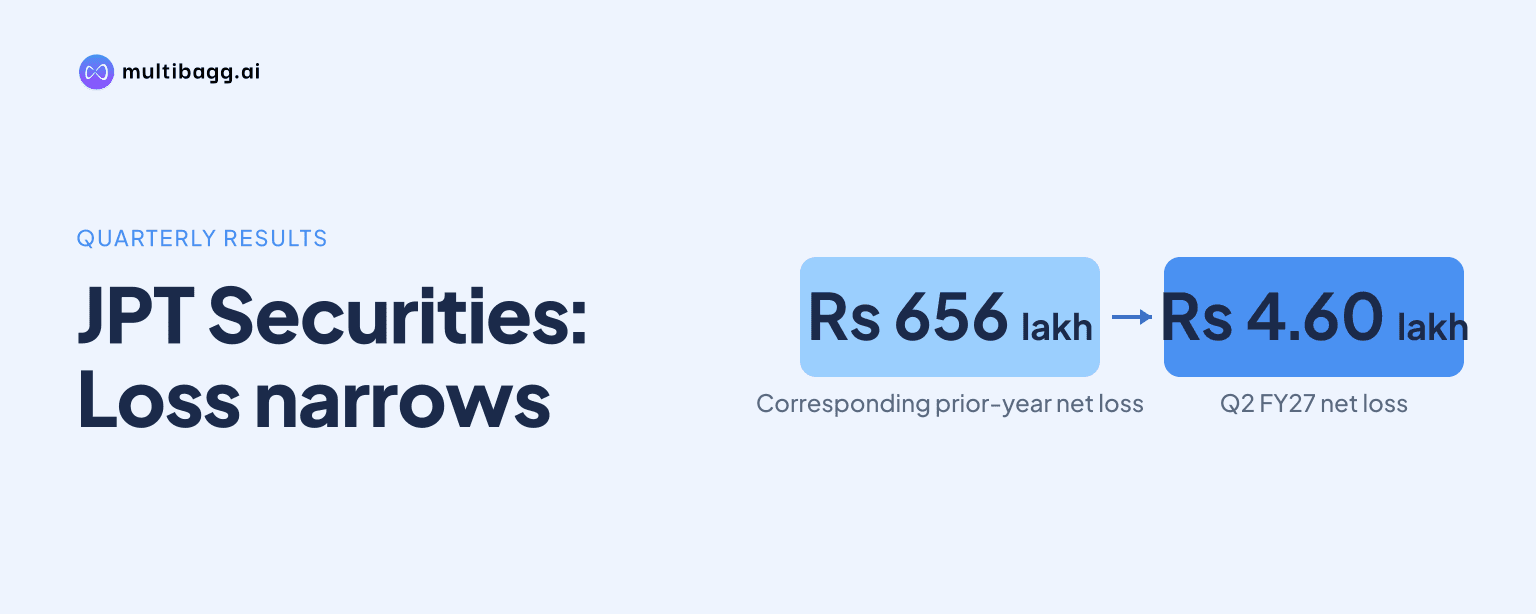
JPT Securities Limited reported a standalone net loss of ₹4.60 lakh for Q2 FY27, versus a loss of ₹656 lakh a year earlier, according to its filing with BSE on November 14, 2026. The result marks a substantial year-on-year reduction in the reported loss, while disclosures around liquidity, negative equity and statutory liabilities remain relevant for investors.
Know JPT Securities inside out
Results, valuation, peers and who's buying, in one view.
What did JPT Securities report for Q2 FY27?
JPT Securities reported an unaudited standalone net loss of ₹4.60 lakh for the quarter ended in Q2 FY27. The latest filing, made on BSE at 5:10 PM IST on November 14, 2026, compares this with a standalone loss of ₹656 lakh in the corresponding quarter a year earlier.
The filing also said that the board re-appointed Chintan Chheda as Whole-Time Director. The available information does not provide a detailed revenue break-up, expense composition, balance sheet figures or cash-flow data for the latest quarter. Therefore, the reported reduction in loss should be assessed alongside the full financial statements and auditor observations.
The company had initially scheduled its board meeting for November 12, 2026, before rescheduling it to November 14. The revised meeting considered and approved the unaudited Q2 FY27 financial results.
Why was the board meeting rescheduled?
JPT Securities had first announced a board meeting for November 12, 2026, to consider Q2 FY27 results and later moved the meeting to November 14, 2026. The company subsequently filed the approved unaudited results with BSE after the rescheduled meeting.
A change in a results-meeting date does not by itself establish a financial issue. However, the timing of corporate disclosures can matter to shareholders because listed companies are required to communicate material information and financial results under the applicable listing framework.
The company had previously approved its FY26 audited standalone and consolidated financial results at a board meeting held on May 28, 2026. It also disclosed a board meeting on August 13, 2026, for consideration of Q1 FY27 results. These filings show that the November disclosure followed earlier FY26 and FY27 reporting actions.
What financial and compliance concerns have been disclosed?
Available corporate-filing summaries state that the auditor flagged liquidity concerns, large negative equity and continuing statutory and tax liabilities in connection with JPT Securities' unaudited Q2 FY27 financials. The supplied information does not quantify these items, so their scale cannot be independently assessed from the disclosed summary.
Negative equity generally means that a company's accumulated obligations exceed the carrying value of its reported assets. Liquidity concerns relate to a company's ability to meet obligations as they fall due. Both matters can be material for a financial-services company because they may affect operating flexibility, funding access and stakeholder confidence.
Separate filing information also notes that the Registrar of Companies granted JPT Securities a one-month extension for its FY26 annual general meeting. The company's 32nd AGM is scheduled for December 10, 2026, with agenda materials including the AGM notice, board's report, management discussion and analysis disclosures, book closure and e-voting arrangements.
Got a follow-up? Ask IRIS
How does the result compare with earlier JPT Securities data?
The Q2 FY27 reported loss of ₹4.60 lakh is materially lower than the ₹656 lakh loss cited for the corresponding prior-year quarter. This comparison is the clearest financial change available in the latest filing summary, although the source does not explain the drivers behind the movement.
Separately, JPT Securities last reported results for the quarter ended March 2026 with sales of ₹0 crore and a net loss of ₹9 lakh. That disclosure relates to a different reporting period and should not be treated as a direct measure of Q2 FY27 operating performance.
The company reported no dividend payout for FY26. For investors, this means recent disclosures point to a focus on financial reporting, governance actions and operating continuity rather than shareholder distributions.
What does the filing mean for shareholders and operations?
The sharp reduction in the quarterly loss is a positive comparison against the prior-year figure, but it does not remove the need to examine JPT Securities' liquidity position and negative equity disclosures. Investors typically need the detailed quarterly financial statements, notes to accounts and audit-related observations to understand whether a lower loss reflects recurring operating improvement or other factors.
The AGM on December 10, 2026, is the next disclosed corporate event. Its notice, board's report and management discussion and analysis may provide further context on the company's financial condition, compliance matters and business operations. No share-price movement or market reaction is provided in the supplied information.
For customers, creditors and other stakeholders, the reported statutory and tax liabilities are relevant because they concern the company's obligations. The available material does not state any change in customer services, business operations or settlement arrangements.
Conclusion
JPT Securities Limited's Q2 FY27 standalone loss narrowed to ₹4.60 lakh from ₹656 lakh a year earlier, based on the November 14 BSE filing. The board also re-appointed a Whole-Time Director, while filing summaries continued to flag liquidity concerns, negative equity and statutory and tax liabilities.
The next disclosed event to watch is JPT Securities' 32nd AGM on December 10, 2026. Investors should review the AGM documents and detailed financial statements for quantified information on liquidity, liabilities, equity and the factors behind the year-on-year loss movement.