










Indian Metals & Ferro Alloys Limited Targets 100,000-Tonne Q3 Output
Key highlights
- IMFA expects to exceed 100,000 tonnes of quarterly ferrochrome output for the first time in Q3 FY27.
- KNR-1's second furnace is expected to achieve hot-metal tapping around November 15, 2026.
- KNR-2 reached an annualised run rate of about 84,000 tonnes in October and targets 100,000 tonnes by December 2026.
- IMFA's installed ferrochrome capacity is expected to reach about 534,000 tonnes per annum after KNR-1 is fully commissioned.
powered by IRIS
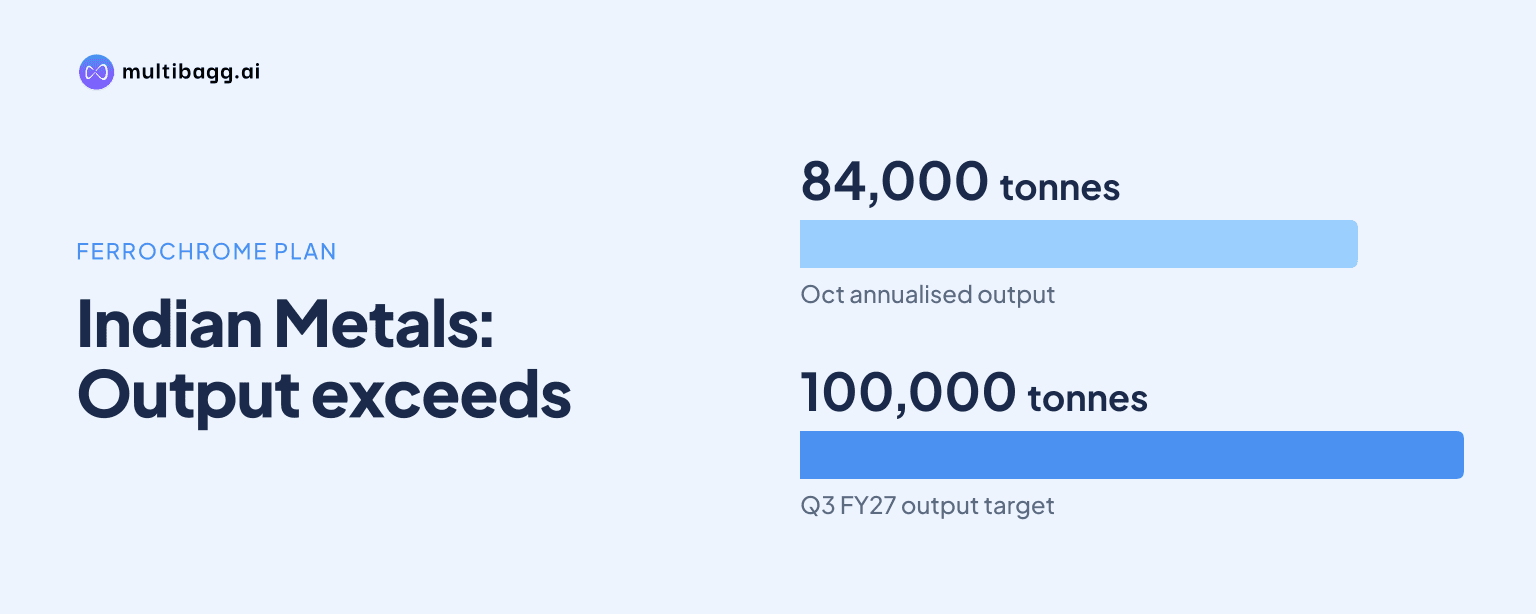
Indian Metals & Ferro Alloys Limited expects to exceed 100,000 tonnes of ferrochrome output for the first time in Q3 FY27, supported by the planned mid-November 2026 start-up of KNR-1's second furnace and transformer upgrades at KNR-2. The milestone would follow the August 25, 2026 first hot-metal tapping at KNR-1.
Know Indian Metals & Ferro Alloys inside out
Results, valuation, peers and who's buying, in one view.
Why is IMFA targeting more than 100,000 tonnes in Q3 FY27?
IMFA is targeting more than 100,000 tonnes of quarterly output because both its Kalinganagar units are moving closer to their intended operating levels during the December 2026 quarter. Management said on its November 4 earnings call that the second furnace at the KNR-1 greenfield project was in pre-commissioning and was expected to achieve hot-metal tapping around November 15, subject to a variation of a few days.
The timing is important because KNR-1's first furnace only began production late in Q2 FY27. It achieved its first hot-metal tapping on August 25, 2026, leaving limited time to contribute to the September quarter. A second furnace operating for part of Q3 FY27 is therefore expected to materially increase production availability compared with Q2.
The company is also increasing output at KNR-2, the unit acquired from Tata Steel. KNR-2 reached a production run rate of about 84,000 tonnes per annum in October. IMFA expects the plant to reach its rated capacity of about 100,000 tonnes per annum by December after transformer replacements are completed.
What is changing at KNR-1 and KNR-2?
KNR-1 is adding its second furnace while KNR-2 is completing electrical upgrades needed to run its four furnaces at rated capacity. These two workstreams are central to IMFA's plan to lift ferrochrome volumes through FY27 and FY28.
KNR-1 is a greenfield ferrochrome facility at Kalinganagar, Odisha, built at a reported cost of ₹800 crore. The project covers 124.26 acres and includes two 33 MVA submerged arc furnaces. Construction began on May 22, 2025, and the first furnace entered production roughly 15 months later, with the first tapping on August 25, 2026.
At KNR-2, IMFA began operating the Tata Steel-acquired unit in March 2026. Management said the facility produced about 35,000 tonnes in H1 FY27. While all four furnaces are operational, transformer replacements are required for the unit to operate at its full rated capacity.
IMFA has also indicated that a partially built 33 MVA furnace at KNR-2 is targeted to become operational around July 2027. That timeline remains dependent on environmental clearances. The company has said that it will provide a formal update once the process advances.
What capacity and production targets has IMFA disclosed?
IMFA has stated that full commissioning of KNR-1 will lift its total installed ferrochrome production capacity to about 534,000 tonnes per annum. The company has maintained FY27 volume guidance of 380,000 tonnes, while its FY28 guidance is approximately 475,000 tonnes.
Management described the FY27 guidance as slightly reduced because KNR-1 production was lower during the initial ramp-up and KNR-2's transformer work was delayed slightly. The company has separately stated an ambition to reach annual ferrochrome output of 500,000 tonnes by FY28, reflecting the benefit of the Kalinganagar additions and higher utilisation.
Got a follow-up? Ask IRIS
How does the expansion affect IMFA's operations and investors?
The Kalinganagar ramp-up gives IMFA a larger production base at a time when ferrochrome pricing and input costs remain relevant to margins. The company has highlighted softer ferrochrome prices and higher coke costs as factors that could pressure profitability, even as volumes rise. Higher output does not by itself determine financial performance because realised prices, raw-material costs and operating efficiency will also matter.
For investors, Q3 FY27 will provide the first quarter in which the first KNR-1 furnace can contribute for the full period and the second furnace is expected to begin operations. KNR-2's progress toward its 100,000-tonne annual rated capacity will also be a key operational measure, particularly after its October run rate of about 84,000 tonnes per annum.
The expansion also increases the company's ability to serve domestic and export markets. IMFA had previously discussed moving toward a 60:40 export-to-domestic mix after new capacity comes online, compared with an earlier 90:10 mix. The company has not provided a confirmed date for reaching that mix, and the transition depends on capacity ramp-up and market demand.
Why does Kalinganagar matter to India's ferrochrome industry?
Kalinganagar is an established industrial area in Odisha, a state with substantial mineral and metal-processing activity. IMFA's additional furnace capacity adds to the domestic ferrochrome production base, which supplies stainless-steel and alloy-steel value chains. The company has described the fully commissioned expansion as strengthening its position in the Indian ferrochrome industry.
The project was formally inaugurated by Odisha Chief Minister Mohan Charan Majhi on October 14, according to company-related disclosures. The inauguration followed the first furnace's operational start and occurred while commissioning work on the second furnace continued.
The sequence of commissioning is relevant because capacity additions typically do not translate immediately into steady-state production. IMFA has said volumes at the first furnace would be increased gradually after initial tapping. The company's disclosed Q3 target therefore reflects both new equipment availability and the operational ramp-up needed to convert installed capacity into saleable ferrochrome output.
Conclusion
IMFA's expected move above 100,000 tonnes of quarterly ferrochrome output in Q3 FY27 is tied directly to the phased commissioning of KNR-1 and the transformer upgrade programme at KNR-2. The first KNR-1 furnace began tapping in August, while the second furnace is expected to start around November 15, making the December quarter meaningfully different from the preceding quarter.
The next operational markers are the actual hot-metal tapping date for KNR-1's second furnace, KNR-2 reaching its expected 100,000-tonne annual rated capacity by December, and progress toward the partially built KNR-2 furnace targeted around July 2027, subject to environmental clearances.