










IMFA expects Chinese cuts to offset South African restart
Key highlights
- IMFA expects Chinese ferrochrome production reductions to broadly offset South Africa’s output recovery.
- IMFA guides for 380,000 tons of ferrochrome output in FY27 and about 475,000 tons in FY28.
- KNR-2 reached an annualised production pace of about 84,000 tons in October 2026, with 100,000 tons targeted by December 2026.
- IMFA expects to exceed 100,000 tons of quarterly ferrochrome output for the first time in Q3 FY27.
powered by IRIS
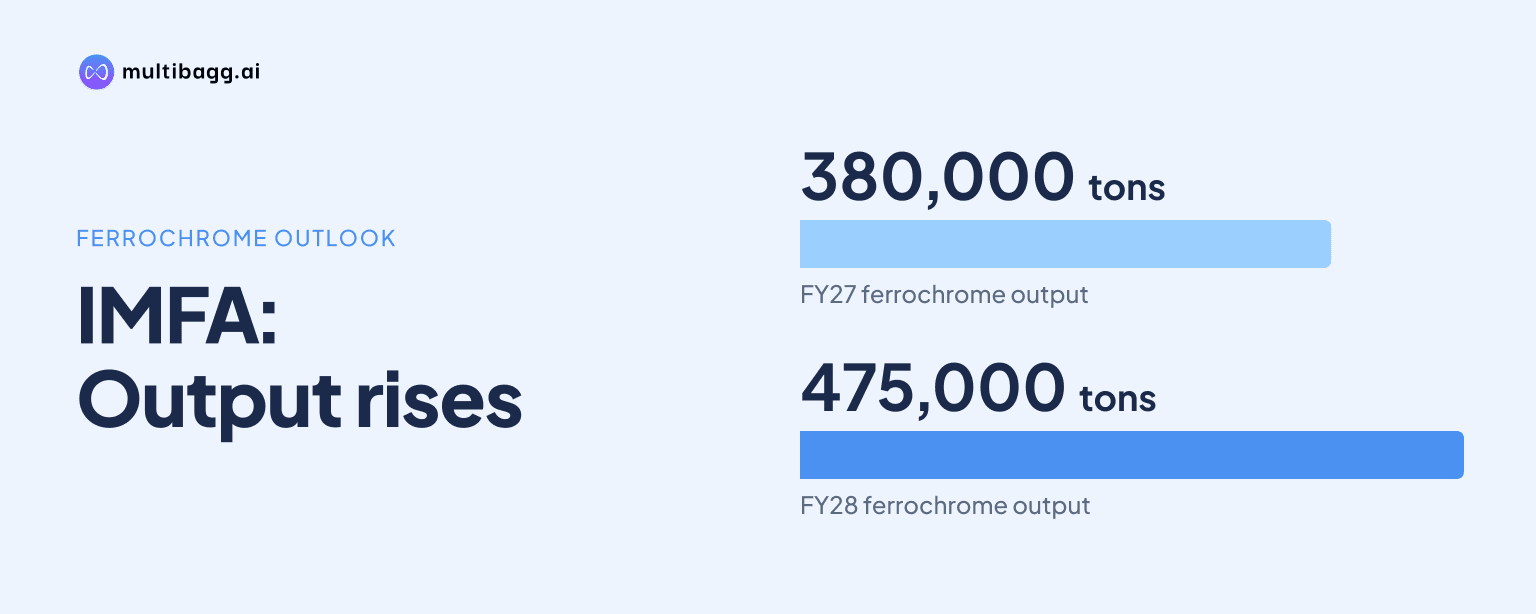
Indian Metals & Ferro Alloys Limited expects Chinese ferrochrome production reductions to broadly offset South Africa’s output recovery, limiting a lasting global surplus. IMFA’s management said the adjustment may involve short-term turbulence, but it remains confident about FY27, when it guides for 380,000 tons of ferrochrome output.
Know Indian Metals & Ferro Alloys inside out
Results, valuation, peers and who's buying, in one view.
Will South Africa’s ferrochrome restart create a global surplus?
IMFA’s answer is no: management expects South Africa’s rising output to be followed shortly by lower ferrochrome production, mainly in China, leaving the market broadly balanced. Management said South African ferrochrome output had fallen drastically in 2025 and was recovering after special tariffs were approved.
Some South African peers have increased production by 20% to 30% quarter on quarter, according to the analyst’s question cited on the call. IMFA said the market may be unsettled temporarily because South African production cannot rise at exactly the same time as Chinese capacity reduces.
Management said South African producers also have reason to avoid surplus ferrochrome, because excess supply would reduce both ferrochrome and chrome ore prices. It added that its assessment is guided in part by Glencore’s comments on maintaining parity in chrome units, while acknowledging that stainless-steel demand remains a separate market variable.
What demand support does IMFA see outside China?
IMFA sees India becoming an additional demand source as domestic stainless-steel capacity rises, although it said Asian growth remains centred primarily on China. Management put Indian stainless-steel consumption at about 3.5 kilograms per capita and said greater use could follow as buyers consider life-cycle cost rather than only the initial cost against carbon steel.
IMFA’s sales plan reflects that shift. At FY26 output of 160,000 tons, exports accounted for 90% of its sales and domestic customers 10%; by 2028, management targets a 60:40 export-domestic mix from about 500,000 tons of production.
That 2028 target implies roughly 300,000 tons of exports and 200,000 tons of domestic sales, subject to market conditions. IMFA said significant volumes are sold through long-term contracts, while many spot sales are to repeat customers, and it supplies practically all medium-sized and large stainless-steel producers in India.
How will higher volume offset IMFA’s price and cost pressure?
IMFA expects higher second-half FY27 volumes to more than offset modest price moderation and rising input costs. Management said Q2 FY27 average realisation was about Rs 1.165 lakh and expected a slight reduction in Q3 FY27, alongside higher metallurgical coke costs.
The volume plan relies on Kalinganagar operations. KNR-2, the Tata Steel-acquired unit, reached an annualised production pace of about 84,000 tons in October 2026, and IMFA expects its four existing furnaces to reach 100,000 tons a year by December 2026 after transformer replacements.
At KNR-1, the first furnace achieved hot-metal tapping on August 25, 2026, while the second furnace was expected to tap hot metal around November 15, 2026. On that schedule, IMFA expects quarterly ferrochrome output to exceed 100,000 tons for the first time in Q3 FY27.
Got a follow-up? Ask IRIS
What costs could affect IMFA’s FY27 margins?
IMFA expects a tighter cost environment in FY27 because metallurgical coke, underground ore mix, startup and shipping costs have increased. Management cited coke pricing at around 375 to 380, without specifying a currency or unit, and said it saw further upward momentum from currency movements, trade costs and other factors.
Chrome ore costs have increased modestly because more material is coming from underground operations rather than open-cast mining, management said. It also cited royalty effects and startup inefficiencies as KNR-1 and KNR-2 move from commissioning and recovery into steadier operations.
IMFA is also paying for a General Network Access renewable-energy corridor before it receives the related renewable power. Management expected the first 70-megawatt branch from JSW Energy by the end of October 2026 and said operational inefficiencies from scaling the two sites should be largely ironed out by December 2026.
How will ore expansion support IMFA’s next growth phase?
IMFA maintains a FY27 ore-raising target of 1 million tons despite a lower Q2 mining result during an extended monsoon. Management said open-cast ore output is seasonally lower in Q2, with heavy rainfall disrupting mining activity, and that the target is needed to support its 380,000-ton ferrochrome guidance.
The board approved about Rs 375 crore of capital expenditure to increase Mahagiri underground ore-raising capacity from 600,000 tons to 750,000 tons annually and to add low-carbon ferrochrome production. Management said Mahagiri additions would come in 50,000-ton annual increments beginning in 2029.
IMFA’s short-term goal is 1.2 million tons of ore raising, split between 600,000 tons each from Sukinda and Mahagiri. The Mahagiri expansion should first accelerate that target and then lift ore availability above 1.2 million tons, creating scope for more smelting; a partly built KNR-2 furnace is targeted for around July 2027, subject to permissions.
Conclusion
IMFA’s outlook depends on a supply response rather than on South Africa remaining offline. Management expects Chinese production reductions to counter South Africa’s recovery, while a planned rise in domestic sales from 10% in FY26 to 40% by 2028 could provide another outlet for higher ferrochrome volumes.
The next disclosures to watch are Q3 FY27 output above 100,000 tons, KNR-2 reaching 100,000 tons of annual capacity by December 2026, and the start of the 70-megawatt JSW Energy supply. Management’s FY28 output target of about 475,000 tons also depends on the commissioning and permissions timetable for the additional KNR-2 furnace.