










IKS plans TruBridge profit lift from second-half Q3 actions
Key highlights
- IKS reported EBITDA of Rs 442 crore at a nearly 28% combined margin in the quarter.
- Nearly two-thirds of the TruBridge book is in the financial-health customer base targeted for delivery changes.
- The reported quarter included Rs 25 crore of one-time TruBridge integration expenses.
- IKS reported net debt of Rs 5,280 crore and net leverage below three times EBITDA.
powered by IRIS
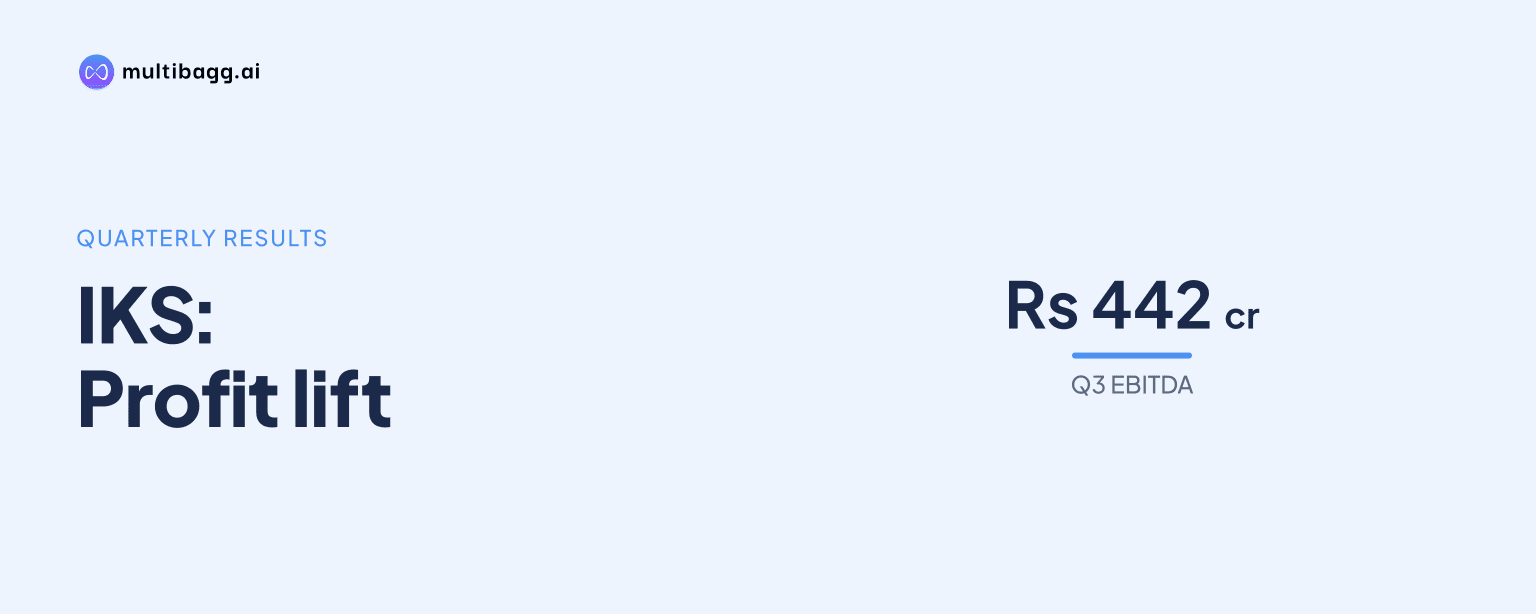
Inventurus Knowledge Solutions Limited said on November 6, 2026, that it plans to improve TruBridge profitability through delivery-model changes, technology-spend optimisation and overhead consolidation, after the combined business reported EBITDA of Rs 442 crore and a nearly 28% margin in the quarter. Management said most acquisition synergies remain unrealised and should begin to contribute from the second half of Q3.
Know Inventurus Knowledge Solutions inside out
Results, valuation, peers and who's buying, in one view.
How will IKS improve TruBridge profitability?
IKS plans to improve TruBridge profitability by applying a technology-first, human-in-the-loop operating model, optimising technology deployment and consolidating selling, general and administrative expenses, or SG&A. Management said its early review found scope to exceed its original acquisition-synergy expectations, although it did not disclose a revised savings target. TruBridge contributed for 82 days in the reported quarter, when the combined entity generated Rs 442 crore of EBITDA.
The principal delivery change will focus on TruBridge’s financial-health customer base, which management said represents nearly two-thirds of the TruBridge book. IKS intends to use global execution and technology interventions across traditional back-office revenue-cycle management and medical coding. Management identified incomplete use of a global delivery model and technology interventions at TruBridge as the largest operating opportunity in these two service areas.
Which operating costs will IKS target at TruBridge?
IKS identified global delivery and technology deployment as the two main operating-cost levers in the financial-health business. Management said TruBridge had not fully optimised either its global model or technology interventions before the acquisition. The plan is therefore to alter the execution model for revenue-cycle management and medical coding, rather than describe the initiative as a broad reduction in customer-service capacity.
Technology expenditure is also under review, but IKS said it does not intend simply to cut technology investment. TruBridge has a significant technology footprint, and management plans to right-size and right-locate that investment to obtain more value from spending. The stated mechanism is to optimise where and how technology is deployed while retaining investment needed for the technology-first delivery model.
IKS also expects SG&A savings as it integrates the two organisations. Public-company costs have already been removed, according to management, and further overlaps are being reviewed across administrative functions. Management cited leadership consolidation as one example: three of TruBridge’s five top executive leaders joined the integrated organisation, while redundancies at several SG&A levels are also being addressed.
When will IKS realise TruBridge synergies?
IKS said most TruBridge synergies had not been realised during the initial 82 days of consolidation because management chose not to make major changes in the first three months after taking control. Apart from public-company costs already reflected in TruBridge’s cited annual EBITDA run rate, management described any early savings from staff attrition or lower adviser costs as non-material.
Management expects three synergy vectors to start contributing from the second half of Q3. These are restructuring the financial-health revenue-cycle-management model around global execution and technology interventions, making similar changes in medical coding, and integrating the two general-and-administrative organisations. This is a management plan, not formal earnings guidance, and its contribution depends on implementation.
The reported quarter also included Rs 25 crore of one-time integration expenses within EBITDA, which management said should be adjusted when assessing the period. IKS said its underlying legacy business maintained a margin of about 34.5% to 35%, compared with the combined entity’s nearly 28% margin. Management has reiterated its expectation of returning to its traditional early-to-mid-30% margin range after the acquisition, without providing a timetable.
Got a follow-up? Ask IRIS
How has TruBridge changed IKS’s reported margins and cash flow?
TruBridge lowered the combined reported EBITDA margin relative to IKS’s underlying legacy margin while adding acquisition-integration costs. The combined business reported Rs 442 crore of EBITDA at nearly 28%, while management put the underlying IKS margin at about 34.5% to 35%. The Rs 25 crore one-time integration expense is a further factor in comparing the reported combined margin with the legacy business.
Adjusted operating cash flow was Rs 393 crore, which management said represented up to 90% conversion of EBITDA. Reported operating cash flow was Rs 96 crore lower because of a TruBridge acquisition payment made after the consolidation cutoff. Management said acquired cash covered that payment and that the item was non-recurring.
Free cash flow was also affected by about Rs 30 crore of additional tax paid in the quarter. Management characterised this as a timing issue resulting from a conservative tax view at the time of the TruBridge acquisition, saying it should be consumed against tax owed in the remaining two quarters of the year. On that adjusted basis, management said cash conversion remained at 90%.
What does IKS expect from TruBridge growth during integration?
IKS does not expect significant net growth in the TruBridge book during the current fiscal year, which management described as a period of integration and consolidation. That means the initial margin plan relies primarily on changes to delivery, technology deployment and SG&A rather than on revenue-led operating leverage. Management separately said the legacy IKS book had delivered a little more than 13% year-on-year organic growth in the reported quarter.
For FY 2028, management expects early growth from its system of action within the TruBridge customer base. It referred to three features being rolled out first into the TruBridge base and integrated into the electronic health record, or EHR. Management also sees remaining scope for traditional revenue-cycle-management offerings within the EHR install base, but described these as ambitions rather than guidance.
Management said the EHR system-of-record business is intended to remain relatively flat through FY 2028 and FY 2029, because it provides the installed base for cross-selling the system of action. It sees possible moderate EHR growth only from FY 2029 onward, after the planned launch of Project Endeavor, an integrated operating system for rural and community healthcare markets. This sequence leaves the nearer-term TruBridge profit case tied to execution of the Q3 cost actions.
Conclusion
IKS has identified three specific routes to improve TruBridge profitability: global, technology-enabled delivery in financial-health revenue-cycle management and coding; better allocation of technology spending; and SG&A consolidation. The nearly 28% combined margin on Rs 442 crore of EBITDA remains below the 34.5% to 35% margin management cited for the underlying IKS business, while Rs 25 crore of integration costs and the initial three-month pause on major changes explain why management says the larger synergy opportunity lies ahead.
The next disclosed milestone is the second half of Q3, when management expects delivery restructuring, coding interventions and administrative integration to begin contributing. Investors can also monitor adjusted cash conversion after the Rs 96 crore acquisition-payment effect and Rs 30 crore tax-timing effect, net debt of Rs 5,280 crore, and management’s FY 2030 ambition of bringing leverage near zero while reaching Rs 3,000 crore of EBITDA.