










IKS finds 3.5-4 times more TruBridge records than expected
Key highlights
- IKS said TruBridge patient-record access is 3.5-4 times its original estimate of about 5 million records.
- TruBridge has more than 600 EHR hospitals, while probably no more than 200 use its financial health offering.
- IKS has launched 2 extensive assessments with legacy TruBridge customers for its full system-of-action platform.
- IKS targets Q1 FY2028 to release denial prevention, coding and clinical-productivity features in the legacy TruBridge EHR.
powered by IRIS
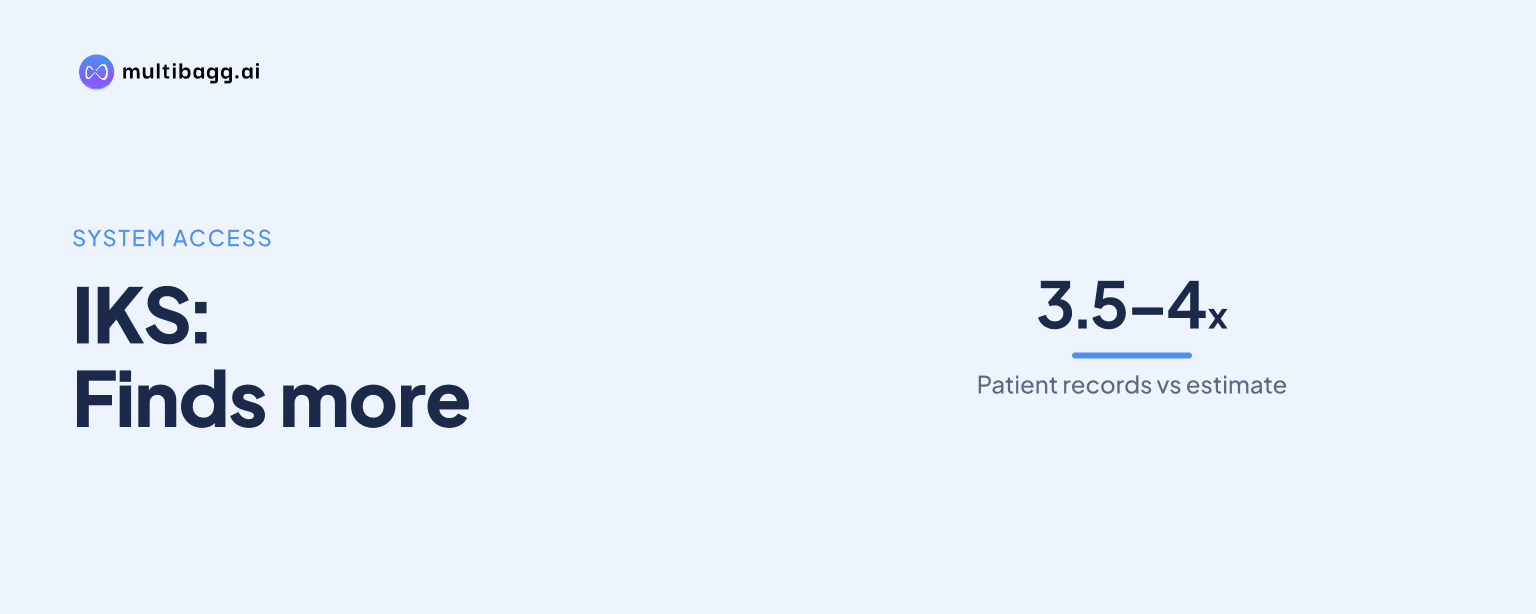
Inventurus Knowledge Solutions Limited said on November 6, 2026 that TruBridge gives IKS access to 3.5-4 times the 5 million patient records it expected before the acquisition, expanding data for model training and exposing a cross-sell opportunity among more than 600 hospitals using TruBridge’s electronic health record platform.
Know Inventurus Knowledge Solutions inside out
Results, valuation, peers and who's buying, in one view.
How much larger is IKS's TruBridge data opportunity?
IKS said the TruBridge patient-record opportunity is 3.5-4 times its pre-acquisition assumption of about 5 million records. Based on that range, access would be roughly 17.5 million to 20 million patient records rather than the original estimate of about 5 million records.
Management described the additional records as a strategic benefit because they can be converted into a context layer for artificial intelligence, or AI, model training. IKS said this system of intelligence is intended to organise otherwise transactional electronic health record, or EHR, data with semantic interoperability, knowledge graphs and ontologies before using it for predictive insights.
IKS also said the context layer is being designed to accept data from EHRs beyond TruBridge. TruBridge records are expected to be a major input, while data obtained through IKS’s existing care-enablement work across other EHRs can also feed the same system of intelligence.
What cross-sell headroom does TruBridge's EHR base provide?
IKS said TruBridge has more than 600 hospitals using its EHR, while probably no more than 200 of those hospitals use its financial health offering. That difference indicates more than 400 hospitals could represent cross-sell headroom for revenue cycle management, or RCM, and IKS’s broader system-of-action platform.
The cross-sell case rests on the combination of TruBridge’s system of record and IKS’s workflow platform. IKS said its system of action covers workflow optimisation, automation and orchestration, with humans retained in the loop for oversight, complex transactions and cases where AI cannot process outcomes autonomously.
Management said it had met more than 50 TruBridge customers in the roughly three months after closing the acquisition. In those discussions, customers were said to be asking IKS both to modernise the EHR and to integrate the system of action, while two legacy TruBridge customers had already begun extensive assessments for taking the full platform.
The immediate product priorities are denial prediction and prevention, coding, and clinical-productivity tools, including clinical documentation and a virtual care assistant. Management said these three categories were selected after customer surveys because they had the highest demand and return-on-investment potential in the TruBridge customer base.
Got a follow-up? Ask IRIS
Why does the larger data set matter to IKS's integration plan?
IKS said the larger record base enhances its ability to train its own models and develop what management called a proprietary AI moat. The mechanism is not simply putting EHR records into large language models, because management said the underlying records are transactional and disconnected and must first be transformed into a contextual intelligence layer.
For IKS’s established large physician-group market, the company plans to keep the system of intelligence agnostic to the underlying EHR. The system of record could be TruBridge or another EHR, while the intelligence layer would supply AI-driven capabilities to IKS’s existing system of action, which management said has been built over 20 years.
For rural and community customers gained through TruBridge, IKS plans a more tightly integrated architecture. Management said it intends to combine the system of record and system of intelligence into an AI-native substrate, enabling data flows without middleware interfaces and supporting real-time clinical and financial automation within native workflows.
That architecture creates two routes to market rather than a single conversion programme. The EHR-agnostic approach is intended to extend across the legacy IKS customer base, while the integrated operating-system approach is intended for the rural and community market served by TruBridge.
When will IKS bring new capabilities to TruBridge customers?
IKS’s stated objective is to have the three prioritised features available in the legacy, COBOL-based TruBridge EHR by the first quarter of fiscal 2028. Those features are denial prediction and prevention, coding, and clinical-productivity functions such as documentation and the virtual care assistant.
Management said the work will proceed through the system-of-intelligence layer, which it likened to a smelting process. The initial release timetable is therefore tied to integration of selected capabilities into the current EHR, rather than to immediate replacement of the legacy platform used by more than 600 hospitals.
In parallel, IKS said it will launch Project Endeavor, its effort to build an AI-native operating system from the ground up for rural and community care. Management framed that project as part of a plan to stabilise churn in TruBridge’s financial health customer base while building future growth engines for fiscal 2028 and beyond.
The acquisition review has also changed management’s view of potential operational gains. IKS said its initial review identified more synergy opportunity in the TruBridge financial health business than it had seen from outside the company, while stating that it aimed to pursue those gains without compromising customer-satisfaction needs.
Conclusion
The TruBridge acquisition gives IKS two larger-than-expected strategic inputs: access to 3.5-4 times the originally expected 5 million patient records, and more than 400 EHR hospitals that do not currently have the financial health offering. Management’s strategy is to use the records to build a reusable intelligence layer and use the EHR installed base to distribute selected workflow and RCM capabilities.
The next disclosed milestone is the target of making denial prevention, coding and clinical-productivity features available in the legacy TruBridge EHR by Q1 FY2028. Investors will also need to watch whether the two customer assessments convert into deployments, how the financial health customer base stabilises, and whether Project Endeavor advances alongside the EHR integration.