










IKS targets Q1 FY28 tool rollout on legacy TruBridge EHR platform
Key highlights
- IKS targets Q1 FY28 to make three capabilities available for release on the legacy TruBridge EHR.
- The first IKS tools are denial prevention, coding, clinical documentation and virtual-care-assistant capabilities.
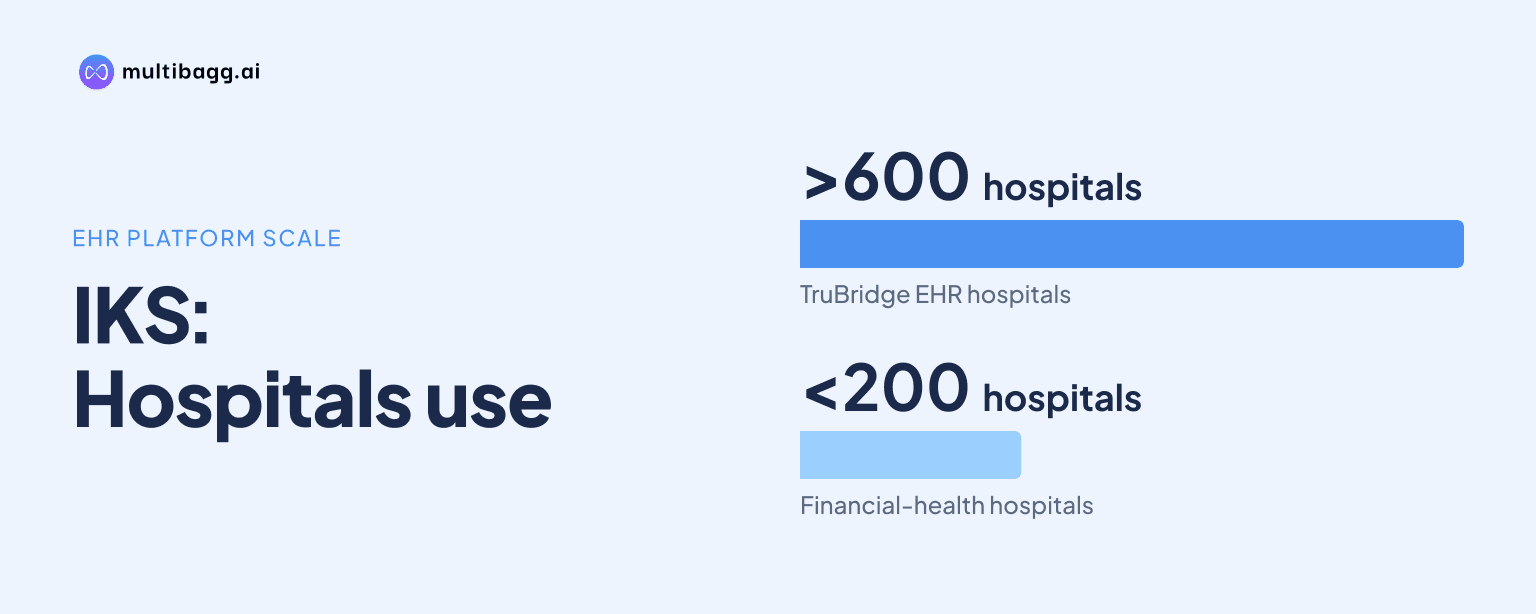
- More than 600 hospitals use the TruBridge EHR, while probably no more than 200 use its financial-health offering.
- IKS said accessible patient records are 3.5 to 4 times its original assumption of about 50 lakh records.
powered by IRIS
Inventurus Knowledge Solutions Limited targets Q1 FY28 to integrate denial prediction and prevention, coding, and clinical-productivity tools into the legacy TruBridge electronic health record, or EHR, for release to its customer base. Management selected the three capabilities after surveys and more than 50 customer discussions identified the highest demand and expected return on investment.
Know Inventurus Knowledge Solutions inside out
Results, valuation, peers and who's buying, in one view.
What will IKS release on the legacy TruBridge EHR?
IKS plans to make three system-of-action capabilities available for release through the COBOL-based legacy TruBridge EHR in Q1 FY28: denial prediction and prevention, coding, and clinical-productivity tools. The productivity category includes clinical documentation and a virtual care assistant, which management said are intended to return time to providers.
The Q1 FY28 objective is integration into the legacy EHR and availability for release to TruBridge customers, not a stated commitment that every customer will be live by that date. IKS said the work will use a “smelting process” that first develops a system-of-intelligence layer and then connects the three selected capabilities to the existing EHR workflows.
IKS is initially limiting the integration to functions that management said have immediate appeal in TruBridge’s rural and community-care market. The company described the three tools as having the maximum demand and return on investment among the offerings assessed after it met more than 50 TruBridge customers in the roughly three months following the acquisition close.
The target applies to an installed base of more than 600 hospitals using the TruBridge EHR. Management estimated that probably no more than 200 of those hospitals use TruBridge’s financial-health offering, which includes revenue cycle management, or RCM, creating a cross-sell opportunity for IKS’s wider system-of-action platform.
Why did IKS choose denial prevention, coding and productivity?
IKS chose denial prevention, coding and clinical productivity because management said these three offerings showed the highest demand and expected return on investment in the TruBridge customer base. The selection puts revenue-cycle and provider-workflow functions ahead of a full replacement of the legacy EHR, which remains the system of record for the initial Q1 FY28 release.
Denial prediction and prevention is intended to address claims before they are rejected, while coding is a core part of the revenue-cycle workflow. Clinical documentation and the virtual care assistant are the named elements of the productivity offering, with management framing them as ways to reduce the time providers spend on administrative and clinical tasks.
The three-tool release is also narrower than IKS’s overall platform. Management said the ambulatory platform has about 16 features, while the acute-care system-of-action platform has five features that are expected to expand as IKS identifies additional hospital tasks that providers and administrators should not have to perform.
IKS has already begun two extensive customer assessments among legacy TruBridge customers that indicated interest in taking its full system-of-action platform. Management did not name those customers, disclose contract values or provide deployment dates, so the assessments do not establish a quantified revenue contribution from the Q1 FY28 product target.
How will IKS integrate the tools with TruBridge data?
IKS plans to use a system-of-intelligence layer to convert transactional EHR information into contextual data before it feeds the system of action. Management said an EHR is the longitudinal system of record and single source of truth, but the data can be disconnected and insufficiently organised for artificial intelligence, or AI, models to reason across it directly.
The proposed intelligence layer is intended to create semantic interoperability through knowledge graphs and ontologies. Management said this context layer can support predictive insights using AI, machine learning and cognitive computing, while the system of action manages workflow optimisation, automation and orchestration with humans retained for oversight, safety and complex transactions.
The TruBridge acquisition has increased the records available for this work. IKS had assumed access to about 50 lakh patient records, but management said the accessible total appears to be 3.5 to 4 times that estimate, a larger dataset it expects to use in training its proprietary models and building the system-of-intelligence layer.
IKS said the intelligence layer is being built to accept data from EHRs other than TruBridge. For its established market of large physician groups, the company intends to retain the customer’s existing EHR, whether TruBridge or another system, while linking it to IKS’s intelligence and action layers. That design means the work on the three TruBridge capabilities could be applicable beyond the acquired customer base.
Got a follow-up? Ask IRIS
What is Project Endeavor and when could it affect growth?
Project Endeavor is IKS’s planned effort to build an AI-native healthcare operating system from the ground up for the rural and community-care market. Management said it expects to launch the project in parallel with the Q1 FY28 integration of denial prevention, coding and clinical-productivity tools into the legacy TruBridge EHR.
Unlike the targeted integration with the current EHR, Project Endeavor is intended to combine the system of record and system of intelligence into an AI-native substrate. Management said this architecture could remove middleware interfaces, create zero-latency data flows and enable real-time clinical and financial automation, but these are product-design objectives rather than disclosed operating outcomes.
IKS described two parallel paths: an EHR-agnostic system of intelligence and system of action for its traditional large physician-group market, and a natively integrated record, intelligence and action platform for the TruBridge rural and community market. The first path supports the Q1 FY28 release; the second depends on the longer Project Endeavor build.
Management said it aims to keep the TruBridge system-of-record business relatively flat in FY28 and FY29. It said Project Endeavor could support moderate growth in the EHR business from FY29 onward, while the TruBridge system-of-action business could begin showing growth in late FY28 and early FY29. Management explicitly described these comments as aspirations, not guidance.
How does the roadmap support TruBridge stabilisation?
IKS is treating the current fiscal year as a period of TruBridge integration, customer stabilisation and work to stem churn in the financial-health customer base. Management said investors should not model significant growth in TruBridge during FY27, making the Q1 FY28 release the first dated product milestone in its stated transition from stabilisation to growth.
Management said the legacy TruBridge business had an annualised run rate of about 75 crore US dollars after excluding operations it did not intend to retain, but did not provide a rupee conversion for that figure. Rather than forecasting near-term sales from the EHR integrations, it pointed to more than 600 hospitals using the EHR and the smaller estimated base of no more than 200 financial-health users as the available cross-sell opportunity.
IKS’s plan separates the EHR’s data role from the growth role of the system of action. Management called the system-of-record business a source of data to train the intelligence layer and a route to cross-sell workflow capabilities, while its stated ambition is for the system-of-action component to approach the industry’s 10% to 12% growth rate in late FY28 and early FY29.
The product roadmap therefore depends on execution across several disclosed steps: stabilising financial-health churn during FY27, releasing the three selected functions in Q1 FY28, and beginning Project Endeavor in parallel. Management did not give a customer-adoption target, an implementation count or a revenue target for the initial release, leaving uptake in the installed base as the central unresolved measure.
Conclusion
IKS has set a specific first integration milestone for TruBridge: denial prevention, coding and clinical-productivity tools are targeted for availability on the legacy EHR in Q1 FY28. The plan combines customer feedback from more than 50 discussions, an EHR base of more than 600 hospitals and a patient-record pool estimated at 3.5 to 4 times the original 50 lakh-record assumption.
Next, investors can watch whether IKS releases the three functions on the stated Q1 FY28 timetable, whether the two customer assessments develop into deployments, and whether financial-health churn stabilises during FY27. Management also plans to launch Project Endeavor in parallel, while placing potential moderate EHR growth from FY29 onward within aspirations rather than formal guidance.