










IMFA’s Kalinganagar mix could add Rs 1,500-2,000 EBITDA a tonne
Key highlights
- IMFA said a 500,000-tonne output mix could add Rs 1,500 to Rs 2,000 a tonne to EBITDA realisation.
- Efficient-site output is expected to rise from 160,000 tonnes at a 260,000-tonne configuration to 400,000 tonnes at 500,000 tonnes.
- Therubali’s 100,000 tonnes of output costs Rs 6,000 to Rs 6,500 a tonne more than Choudwar, according to management.
- IMFA maintained FY27 ferrochrome production guidance of 380,000 tonnes.
powered by IRIS
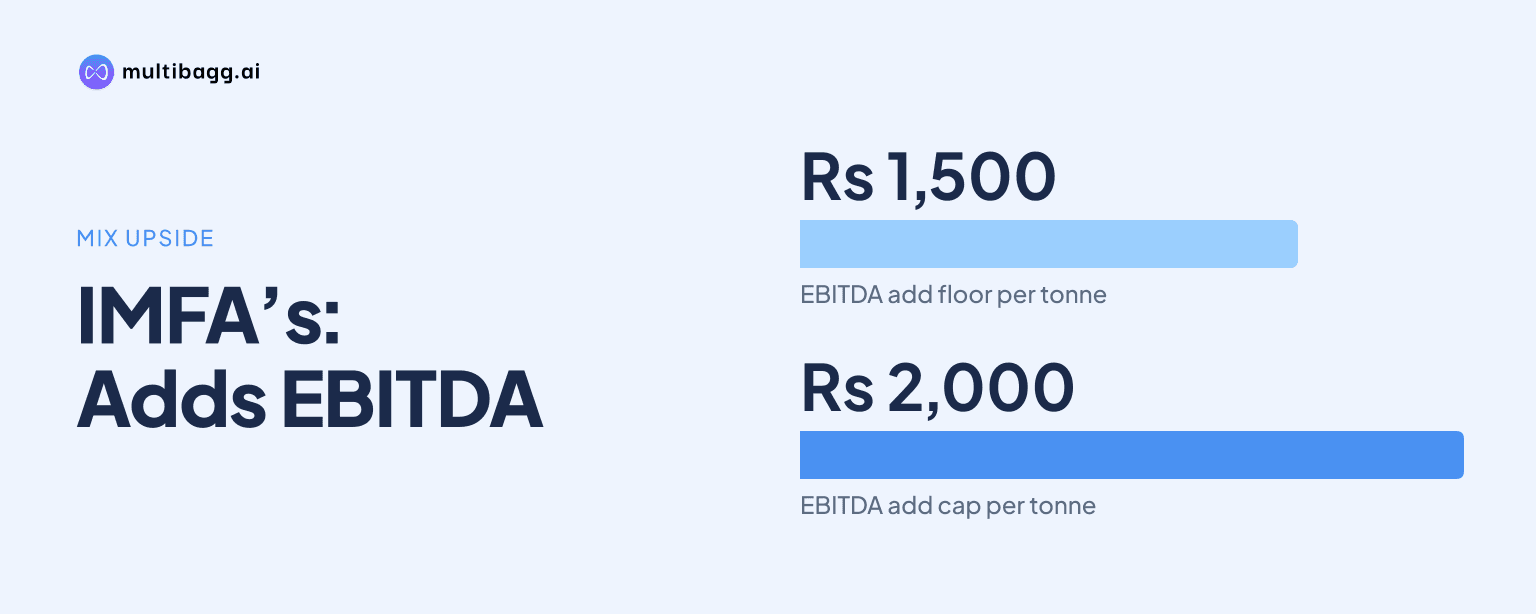
Indian Metals and Ferro Alloys Limited said a 500,000-tonne ferrochrome production mix could improve EBITDA realisation by Rs 1,500 to Rs 2,000 a tonne, as 400,000 tonnes would come from its more efficient Choudwar and Kalinganagar sites. That compares with 160,000 efficient tonnes in the 260,000-tonne production configuration management described.
Know Indian Metals & Ferro Alloys inside out
Results, valuation, peers and who's buying, in one view.
How could IMFA add Rs 1,500 to Rs 2,000 a tonne to EBITDA?
IMFA said the Rs 1,500 to Rs 2,000-a-tonne EBITDA realisation improvement would come from Kalinganagar becoming its largest ferrochrome site and increasing the share of output from efficient facilities. Management presented this as a production-mix benefit, not as a forecast for ferrochrome prices or a specific future cost line.
At a 260,000-tonne production level, 160,000 tonnes came from efficient operations, according to management. At 500,000 tonnes of output, IMFA expects 400,000 tonnes to be produced at efficient sites, with close to 250,000 tonnes from Kalinganagar and about 150,000 to 160,000 tonnes from Choudwar.
The planned mix shifts the efficient share of production from about 62% at the 260,000-tonne configuration to 80% at 500,000 tonnes. IMFA said this greater weight of Kalinganagar and Choudwar output would expand EBITDA margins, while not specifying when the 500,000-tonne production level would be reached.
Why does Kalinganagar alter IMFA’s cost mix?
Kalinganagar alters IMFA’s cost mix because its ferrochrome output is expected to cost about the same as Choudwar, and may be marginally better on certain counts, management said. The site is expected to produce close to 250,000 tonnes while IMFA retains production at Therubali in the next year or two.
Therubali produces 100,000 tonnes of ferrochrome and costs Rs 6,000 to Rs 6,500 a tonne more than Choudwar, according to management. IMFA said it is not looking to scale back Therubali in the next one to two years, but expects to do so eventually as Kalinganagar becomes the company’s largest ferrochrome location.
Management linked the production advantage to IMFA’s integrated model of captive chrome ore, captive power and ferrochrome production. It said a broader ore base also supports niche grades, including 10,000 to 12,000 tonnes a year of low-phosphorus ferrochrome with a maximum phosphorus content of 0.15%.
IMFA said low-phosphorus material earns a 15% to 20% premium and that it had concluded a 2027 long-term contract with a Japanese customer for about 70% of this output. This product mix is separate from the Kalinganagar site-efficiency benefit, but management identified both as outcomes of its integrated ferrochrome operations.
What costs could affect IMFA before the mix benefit is realised?
IMFA identified a slight upward trajectory in met coke prices, greater underground ore consumption than open-cast ore in the quarter, and higher royalty outgoes from elevated domestic chrome ore prices. Management did not give a per-tonne cost forecast for the next two or three quarters.
Furnace startup costs are another factor because grid electricity is charged at a high rate until power usage crosses a 60% threshold, management said. The rate falls further after usage reaches an 80% or 90% threshold, so a furnace in its initial ramp-up stage carries an operating inefficiency before stabilising at higher load.
Management expects renewable energy to begin flowing from late November, with the associated benefit expected from the following quarter after operations settle. It also expected the second KNR 1 furnace to make its first hot-metal tapping around November 15, after which the new capacity can progress towards its intended load.
Fuel and power expense in the quarter was higher because coal prices had increased and consumption volumes had risen, IMFA said. The company also reported a Rs 8 crore notional mark-to-market loss in other expenses at September-end, when the US dollar was at Rs 95.98 compared with Rs 94.60 at June-end.
Got a follow-up? Ask IRIS
When should IMFA’s higher-volume output become visible?
IMFA expects output to exceed 100,000 tonnes in Q3 of FY27 and rise further in Q4, while retaining FY27 production guidance of 380,000 tonnes. Management said sales volume should broadly match production, although its formal guidance is for output rather than sales.
KNR 1 was expected to be fully operational during Q3, but only from the middle of the quarter because of the planned November 15 tapping for its second furnace. Q4 is expected to be the first full quarter in which all furnaces are operating at optimal load, according to management.
IMFA reported EBITDA of about Rs 28,000 a tonne in the quarter discussed on the call, after an EBITDA margin close to 30% in the first quarter of FY27. Management said prices had eased somewhat and costs had risen, but that higher volumes from Q3 onward could offset a near-term margin contraction in absolute EBITDA terms.
Management did not provide guidance for selling prices, costs or quarterly margins. It said a tighter operating environment could last for a quarter or so, while describing the first-quarter FY27 margin as exceptional and the subsequent moderation as reflecting lower prices and higher costs.
How does IMFA describe its position against overseas producers?
IMFA’s management described the company as being in the lower decile of global ferrochrome producers by cost, without providing a comparable cost-curve dataset or a numerical ranking. It attributed that position principally to captive chrome ore and captive power.
Management said Chinese ferrochrome producers rely entirely on imported ore, while China has advantages from domestic met coke production and lower logistics costs to local stainless-steel customers. IMFA said the chrome ore advantage is significant despite those Chinese cost benefits.
IMFA is targeting about 40% of its output for the domestic market, a share that management said could rise if warranted. The company cited Indian stainless-steel consumption of about 3.5 kilograms per capita, compared with more than 8 kilograms in China at its peak, as part of its demand rationale.
Management also said South African ferrochrome output had collapsed in 2025 because of power and inland logistics costs, although preferential electricity tariffs had enabled two producers to increase output. It warned of possible turbulence during that ramp-up until an offsetting reduction occurs elsewhere, while noting that excess supply would also hurt South African producers.
Conclusion
IMFA’s stated Rs 1,500 to Rs 2,000-a-tonne EBITDA opportunity depends on a shift from 160,000 efficient tonnes in a 260,000-tonne configuration to 400,000 efficient tonnes at 500,000 tonnes of production. Kalinganagar is central to that change because its planned output of close to 250,000 tonnes is expected to have a cost profile comparable with Choudwar, unlike Therubali’s output that costs Rs 6,000 to Rs 6,500 a tonne more than Choudwar.
The next points to watch are the expected November 15 first hot-metal tapping at KNR 1’s second furnace, renewable-energy inflows from late November and optimal furnace loading through Q4. IMFA has maintained FY27 production guidance of 380,000 tonnes, while management has not provided a forecast for coke costs, ferrochrome prices or quarterly margins.