










Muthoot Microfin Limited expands loans through existing branches
Key highlights
- Muthoot Microfin disbursed around Rs 453 crore of gold loans in Q2 FY27 through its Muthoot Fincorp partnership.
- Muthoot Microfin’s JLG-to-non-JLG mix moved to 69:31 in Q2 FY27 from about 83:17 at March-end.
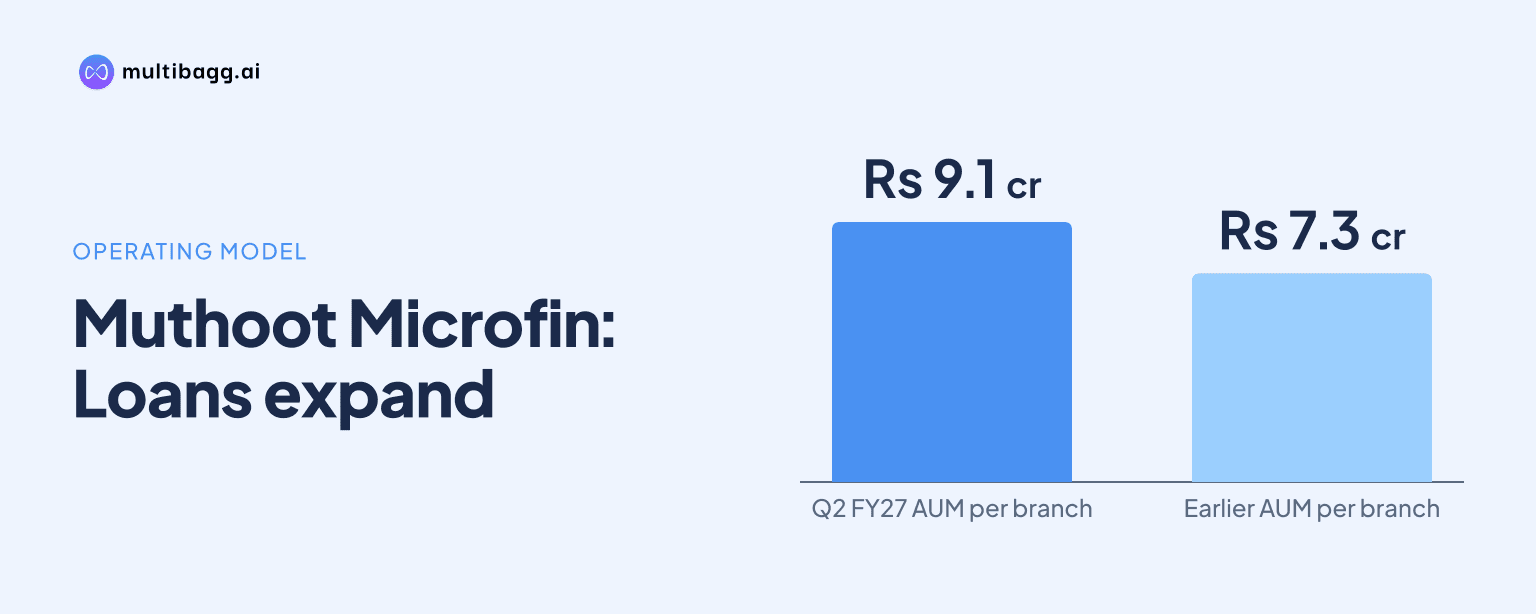
- AUM per branch rose to about Rs 9.1 crore from Rs 7.3 crore earlier, while OPEX-to-GLP fell to 6.1% from 7.0%.
- Muthoot Microfin said Micro LAP AUM crossed Rs 100 crore in October 2026.
powered by IRIS
Muthoot Microfin Limited expanded secured lending through existing operations in Q2 FY27, disbursing Rs 453 crore of gold loans as its joint liability group share fell to 69% from about 83% at March-end. Muthoot Microfin said individual loans use existing branches and centralised underwriting, while Muthoot Fincorp branches service gold loans.
Know Muthoot Microfin inside out
Results, valuation, peers and who's buying, in one view.
How is Muthoot Microfin changing its loan mix?
Muthoot Microfin is reducing the portfolio weight of joint liability group, or JLG, loans by growing individual lending, gold loans and Micro loan against property, or Micro LAP. Its JLG-to-non-JLG mix was 69:31 in Q2 FY27, compared with about 83:17 at the end of March. Total assets under management, or AUM, reached Rs 15,323 crore, increasing 22% year on year.
The shift exceeded management’s full-year target of a 70:30 JLG-to-non-JLG mix. Muthoot Microfin reported Q2 disbursements of Rs 2,900 crore, up 28% year on year and 10% from the prior quarter, while first-half disbursements totalled Rs 5,545 crore. Management said the new-product mix is intended to diversify lending rather than replace group loans immediately.
Individual lending has been the largest contributor to the non-JLG portfolio. The Muthoot small and growing business held AUM of Rs 4,164 crore, or 27% of total AUM, in Q2 FY27. Management said its 90-plus-days delinquency ratio was 0.02%, although it also said the portfolio, which is close to two years old, needs additional seasoning.
Which customers does Muthoot Microfin move into individual loans?
Muthoot Microfin mainly moves existing JLG customers with established repayment records into individual loans. From a base of 32 lakh customers, it had graduated 2.7 lakh borrowers with long-standing relationships, credit scores of 700 or above, and what management described as strong repayment histories. This approach uses prior customer performance as an underwriting input for a larger loan product.
Muthoot Microfin had approximately 32.7 lakh active customers in Q2 FY27. About 50% were unique to the lender, while another 31% had Muthoot Microfin and one additional lending relationship, a group management called “us plus one.” Management said this combined 81% share supports its aim to retain performing borrowers and increase its share of their borrowing.
For gold loans, management said underwriting considers known customer income and repayment capacity alongside the value of pledged collateral. It said the company uses a conservative loan-to-value, or LTV, approach and had not seen an asset-quality challenge in gold lending. Gold-loan disbursements of Rs 453 crore in Q2 FY27 were made under a co-lending partnership with Muthoot Fincorp.
How is Muthoot Microfin adding secured products without new infrastructure?
Muthoot Microfin is using existing branches for individual loans and Muthoot Fincorp branches for gold loans, rather than building a separate network for those products. Centralised underwriting supports individual lending, while the parent-company branch network services gold loans. Management said this model keeps incremental infrastructure costs under control as secured lending grows.
Micro LAP is the other secured product being developed through this operating structure. Management said Micro LAP AUM crossed Rs 100 crore in October 2026, after about 18 months of seasoning, and that delinquency was near zero. The call did not provide a separate portfolio-level Micro LAP delinquency ratio or a quarterly Micro LAP disbursement figure.
Muthoot Microfin had 1,675 branches in Q2 FY27 and said it was deepening its South India presence while expanding selectively in Assam, Andhra Pradesh and Telangana. It also said it would enter Jammu and Kashmir soon. These network actions are aimed at acquiring customers in selected markets, whereas individual and gold products are being offered through the current operating base.
Got a follow-up? Ask IRIS
What operating leverage has Muthoot Microfin reported?
Muthoot Microfin reported higher business volume per branch and lower operating expenses relative to its loan book in Q2 FY27. AUM per branch increased to about Rs 9.1 crore from Rs 7.3 crore earlier. AUM per loan officer reached about Rs 1.8 crore, based on an errata correction made during the call.
Operating expenses, or OPEX, as a share of gross loan portfolio, or GLP, declined to 6.1% in Q2 FY27 from 7.0% in the same period a year earlier. The standalone cost-to-income ratio was 48.1%, below management’s stated target of less than 50%. Management linked the movement to branch productivity, centralised underwriting and product growth without additional new-product infrastructure.
Muthoot Microfin also identified 80 branches through a profitability module that assessed revenue, operating cost and credit cost. It said it had started merging, rationalising or redeploying resources at those locations, but did not quantify branch closures. Digital collections accounted for 47% of monthly collections, supported by electronic Know Your Customer processes, electronic signatures and electronic National Automated Clearing House repayment mandates.
What financial results support Muthoot Microfin’s expansion plan?
Muthoot Microfin reported total income of Rs 733 crore in Q2 FY27, up 27% year on year, and pre-provision operating profit of Rs 249 crore, up 67%. Standalone profit after tax was Rs 110.8 crore. Its net interest margin increased to 12.5% from 12%, while average borrowing cost declined to 9.93% from 10.13%.
Asset-quality measures also improved during the quarter. Collection efficiency was 98.1%, an improvement of 477 basis points year on year, and October collection efficiency reached 99.2%. Gross non-performing assets, or GNPA, were 3.38%, down 32 basis points from the preceding quarter, while net NPA was 1.05% and credit cost was 2.6%.
Management retained FY27 guidance for 20% AUM growth and said it expected credit cost to be better than its guided 2.5% to 3.0% range. It also said it expected net interest margin and return on assets to be at the upper end of guidance. These are management expectations, with collection performance and the execution of newer products remaining relevant to the outcome.
What targets will test Muthoot Microfin’s branch-led model?
Muthoot Microfin’s operating targets are AUM per branch of Rs 12 crore to Rs 13 crore and OPEX-to-AUM of 5.5% to 5.75%, compared with Rs 9.1 crore and OPEX-to-GLP of 6.1% in Q2 FY27. Management also expects digital collections to reach 75% earlier than its prior 2030 objective, from 47% of monthly collections currently.
The lender reiterated its target of Rs 30,000 crore of AUM by 2030 and reported a capital adequacy ratio of 25.5% in Q2 FY27. Management said current profitability and portfolio performance should support growth without further capital raising at present. That statement reflects management’s assessment at the time of the November 6, 2026 call.
Conclusion
Muthoot Microfin’s diversification is being built around customers and infrastructure it already has. The 69:31 JLG-to-non-JLG mix in Q2 FY27, Rs 453 crore of quarterly gold-loan disbursements and Micro LAP AUM above Rs 100 crore in October show the secured and individual products gaining a larger role alongside the Rs 15,323 crore loan book.
The next milestones are management’s Rs 12 crore to Rs 13 crore AUM-per-branch target, its 5.5% to 5.75% OPEX-to-AUM range and the planned increase in digital collections to 75%. Entry into Jammu and Kashmir and management’s FY27 target of 20% AUM growth will show whether the model can scale while maintaining the reported 2.6% credit cost.