










Linc Q2 Margin Falls 393 Basis Points on Costs and Promotions
Key highlights
- Linc’s Q2 FY27 EBITDA margin was 7.3%, down 393 basis points year on year from 11.3%.
- Management attributed about 190 basis points of the margin decline to raw materials and 200 basis points to sales promotions.
- Q2 FY27 operating income rose 10.8% year on year to Rs 154.12 crore, while EBITDA was Rs 11.31 crore.
- Linc said it expects raw-material trends from December to support improvement in Q4 FY27 if prices remain stable.
powered by IRIS
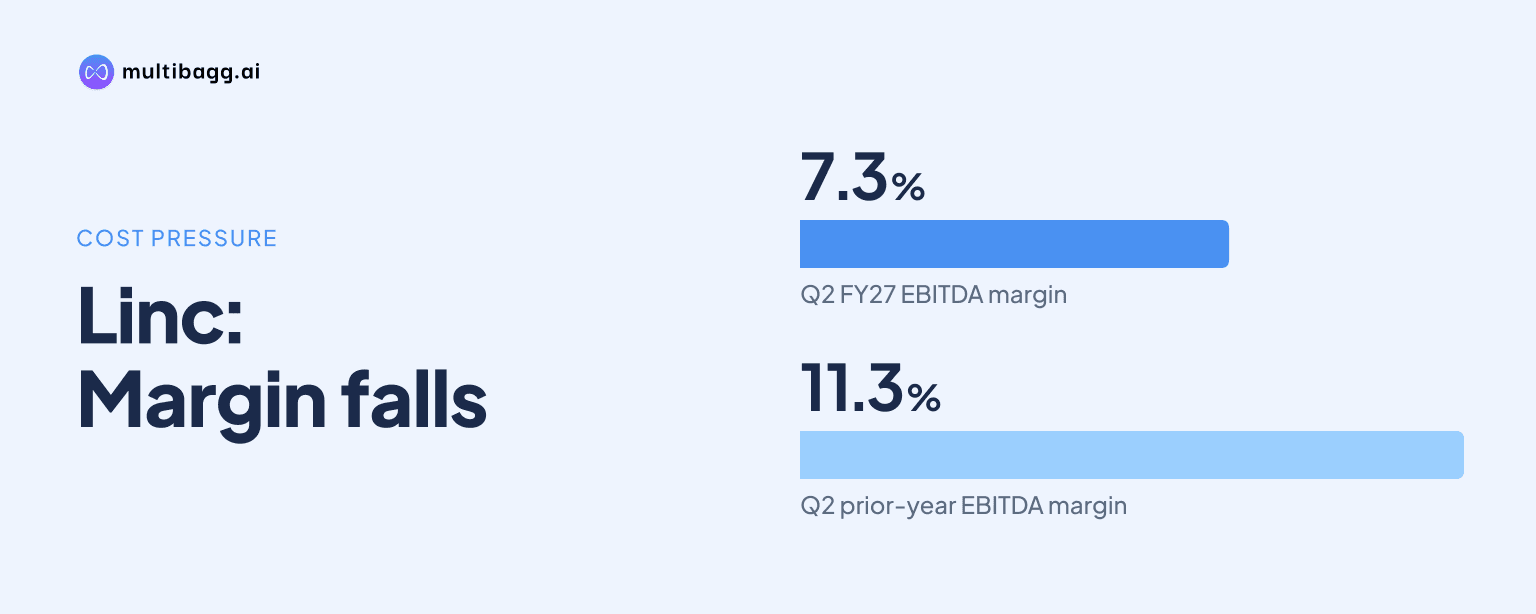
Linc Limited reported a 393-basis-point year-on-year decline in operating earnings before interest, tax, depreciation and amortisation (EBITDA) margin to 7.3% in the second quarter of fiscal 2027 (Q2 FY27), with management attributing roughly 190 basis points to higher raw-material costs and 200 basis points to additional sales-promotion spending.
Know Linc inside out
Results, valuation, peers and who's buying, in one view.
Why did Linc’s Q2 FY27 EBITDA margin decline?
Linc’s EBITDA margin declined because higher input costs and increased demand-generation spending each accounted for about half of the 393-basis-point year-on-year contraction. Management said geopolitical uncertainty had raised prices for certain raw materials, although the degree of inflation varied by material. Its revised raw-material mix limited the aggregate impact, but did not prevent input-cost pressure from reducing the Q2 FY27 margin.
Sales promotions were the other stated cause. Linc increased promotional activity while retaining its underlying pricing structure, aiming to stimulate demand and support sales growth. Management quantified this expenditure as contributing approximately 200 basis points to the margin decline, compared with roughly 190 basis points from raw materials. The two cited components total about 390 basis points, with management describing both figures as approximate components of the reported 393-basis-point fall.
The margin outcome came despite higher operating income. Linc reported operating income of Rs 154.12 crore in Q2 FY27, up 10.8% year on year and 10.9% sequentially. Management linked that double-digit growth to sales promotions and growth in categories beyond writing instruments, meaning the quarter combined improved revenue momentum with higher input and selling costs.
How did Linc’s Q2 FY27 profitability compare with prior periods?
Linc’s 7.3% EBITDA margin in Q2 FY27 was lower than both the 11.3% reported in the second quarter of the prior year and the 8.7% reported in the first quarter of fiscal 2027. The comparison shows that year-on-year margin pressure was greater than the sequential decline, even as operating income increased on both bases. Management did not provide a numerical gross-margin figure or a full-year profitability target during the call.
Operating EBITDA was Rs 11.31 crore in Q2 FY27, while profit after tax (PAT) was Rs 4.19 crore, equal to a 2.7% PAT margin. These reported amounts followed the higher raw-material and sales-promotion expenditure described by management. Linc’s finance director also reported fixed-asset turnover of 3.74 times and a cash-conversion cycle of 70 days.
The Q2 FY27 comparison identifies the trade-off management made: operating income grew 10.8% year on year, but EBITDA margin fell 393 basis points. Management said the promotion programme was intended to gain market share and establish sustained sales momentum, rather than alter underlying pricing. The transcript does not quantify the sales benefit generated by the spending.
When does Linc expect margin pressure to ease?
Linc management said it saw an improving raw-material trend from December and expected improvement in the fourth quarter, provided raw-material prices remain stable. Whole-time Director Rohit Jalan described the current raw-material situation as temporary, but did not provide an exact EBITDA-margin percentage for Q4 FY27 or the following financial year because conditions remained volatile.
In response to a question about the next four to six quarters, management said it expected Linc to return to its margins, subject to input-price stability. It said that by the end of the financial year, over the next two quarters, there should be greater clarity to offer more informed profitability guidance for the following financial year. This was management’s outlook, not a numerical forecast.
The company’s immediate internal levers are its raw-material mix and a greater emphasis on premium-priced products. Management said the mix developed over the past one to one-and-a-half years had seen smaller cost increases than normal grades including styrene acrylonitrile, acrylonitrile butadiene styrene, polypropylene and polycarbonate. It also said premium-price products carry higher margins than products at the Rs 10 price point.
Got a follow-up? Ask IRIS
Which growth initiatives could affect Linc’s mix and profitability?
Linc is broadening its portfolio through introductions under Pentonic and linked product portfolios, alongside lifestyle drinkware sold as Tri-Tonic, a Tritan-based bottle range. Management said the drinkware category covers everyday use, active lifestyles and children, using Linc’s polymer expertise and existing brand and distribution capabilities. Its Stackoo experience centres in Kolkata and Mumbai bring writing instruments, stationery and allied products together in a retail setting.
The company also cited international operations as part of its growth plan. Uni-Linc, Linc’s joint venture with Mitsubishi Pencil Company, Japan, was operationally stable, with exports contributing more than 50% of its revenue in the first half. The venture had launched one ball pen with a maximum retail price of Rs 20, which management said was gaining distribution and volumes; two more products were in the pipeline, with three products expected over the next three to four quarters.
The West Bengal manufacturing facility is another operational milestone. Management initially described the facility as expected to be operational in the third quarter, while the question-and-answer discussion specified that facilities should be ready by end-December and commercial production should begin in late December or early January, placing production in Q4 FY27. Management said the site primarily shifts the old facility into modern infrastructure, with operational-efficiency potential and room for future capacity expansion rather than a substantial immediate increase in operations.
Linc also said its Turkey joint venture was progressing steadily, its Kenya subsidiary’s sales momentum was improving, and Linc On was growing at a healthy rate. For the Morris of Korea subsidiary, management linked business traction and export-volume support to commissioning of the West Bengal facility. The transcript does not quantify revenue, margin or investment for these businesses, so their financial effect on Q2 FY27 cannot be measured from the disclosed discussion.
Conclusion
Linc’s Q2 FY27 result shows that sales growth and profitability moved in opposite directions: operating income rose 10.8% year on year to Rs 154.12 crore, while EBITDA margin fell to 7.3%. Management separated the margin impact into approximately 190 basis points from raw materials and 200 basis points from promotions, providing a specific explanation for the decline.
The next issues to watch are whether the raw-material improvement management said it saw from December supports a Q4 FY27 margin recovery, and whether promotional spending moderates without slowing sales momentum. Investors can also monitor the West Bengal facility’s commercial-production start around late December or early January and the planned Uni-Linc product additions over the next three to four quarters.