










Linc premium writing instruments made 61.5% of H1 category sales
Key highlights
- Premium own-brand writing instruments generated Rs 157.48 crore and 61.5% of Linc’s H1 FY27 disclosed category revenue.
- Mass own-brand writing-instruments revenue fell 26.3% year on year to Rs 28.79 crore in H1 FY27.
- Licensed writing instruments grew 12.3% to Rs 48.57 crore in H1 FY27.
- Linc’s Q2 FY27 EBITDA margin was 7.3%, compared with 11.3% in Q2 FY26.
powered by IRIS
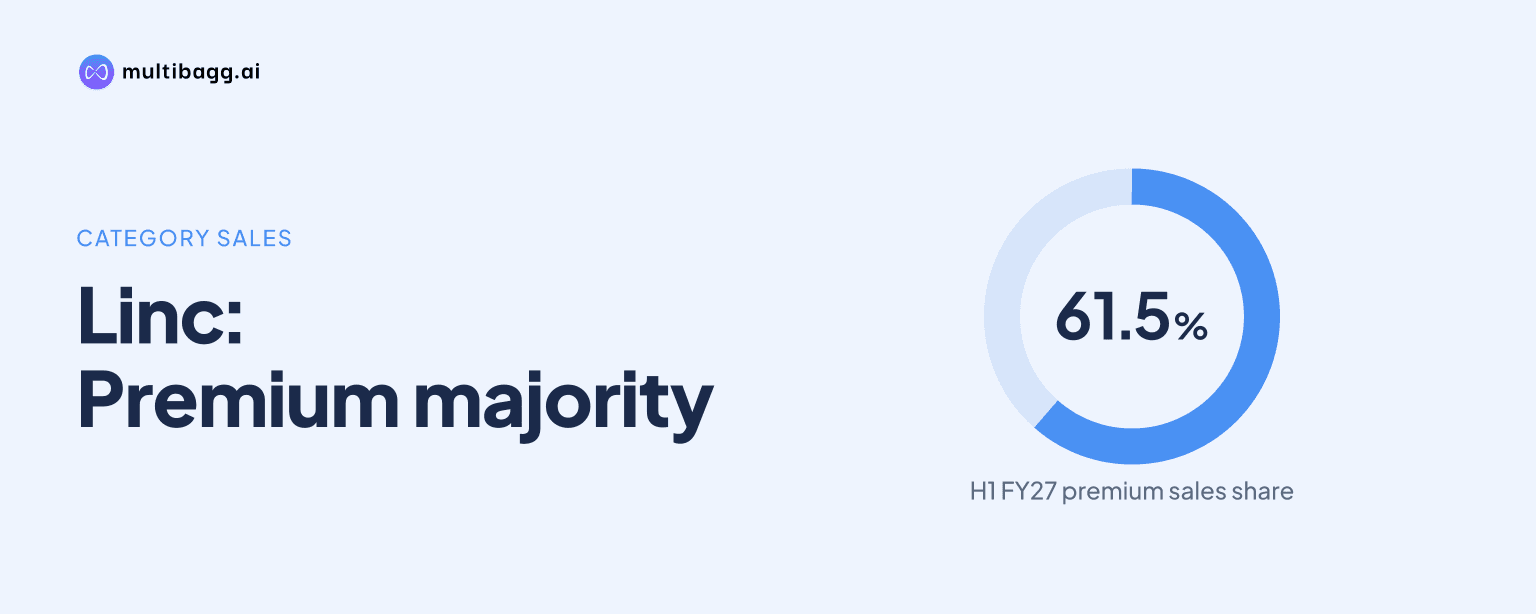
In H1 FY27, Linc Limited’s premium own-brand writing instruments generated Rs 157.48 crore, or 61.5% of disclosed standalone category revenue, while mass own-brand writing-instruments sales fell 26.3% year on year. Premium revenue grew 8.2%, and its contribution increased by 2.6 percentage points from H1 FY26.
Know Linc inside out
Results, valuation, peers and who's buying, in one view.
What drove Linc’s H1 FY27 revenue mix?
Linc’s premium own-brand writing-instruments category drove the H1 FY27 mix because its Rs 157.48 crore of revenue was the largest of the five disclosed categories. It accounted for 61.5% of the Rs 255.95 crore combined category revenue, compared with Rs 145.52 crore and a 58.9% contribution in H1 FY26. The category added Rs 11.96 crore year on year even as Linc’s mass own-brand line contracted.
The disclosed category revenue basis is narrower than Linc’s reported operating income. The operational split excludes resale of raw material and export incentive and is based on standalone revenue, while reported H1 FY27 operating income was Rs 293.07 crore. The 61.5% premium share therefore describes the defined standalone category pool rather than all operating income reported for the half year.
The shift was not solely between Linc’s two own-brand writing-instruments tiers. Premium’s share rose by 2.6 percentage points, from 58.9% to 61.5%, while mass fell by 4.6 percentage points, from 15.8% to 11.2%. Licensed writing instruments also gained share, rising from 17.5% to 19.0% on Rs 48.57 crore of H1 FY27 revenue.
Which Linc categories grew and which declined?
Linc reported growth in four of the five H1 FY27 categories, with mass own-brand writing instruments the only declining segment. Premium own-brand writing instruments increased 8.2%, licensed writing instruments rose 12.3%, own-brand other products gained 11.5%, and licensed other products grew 9.4%. Mass own-brand writing instruments declined to Rs 28.79 crore from Rs 39.06 crore, a reduction of Rs 10.27 crore.
Licensed writing instruments generated Rs 48.57 crore in H1 FY27, making them Linc’s second-largest disclosed category and contributing 19.0% of the category pool. Other products were smaller at a combined Rs 21.11 crore, or 8.3% of the total, but both own-brand and licensed other products recorded year-on-year revenue growth.
Linc does not disclose a separate revenue number or revenue share for Pentonic in the supplied H1 FY27 category table. It identifies premium own-brand writing instruments as a category and displays Pentonic Clipz, Pentonic Oops, Pentonic Squad and Pentonic Gumstick among recent launches. The figures support an assessment of premium own-brand category mix, but not a conclusion about Pentonic’s individual revenue share.
Got a follow-up? Ask IRIS
Did Linc’s quarterly mix show the same direction?
Linc’s Q2 FY27 mix showed the same premium-led direction as the half-year figures. Premium own-brand writing instruments rose 14.8% year on year to Rs 78.41 crore and represented 59.9% of disclosed Q2 category revenue, up from 55.1% in Q2 FY26. Mass own-brand writing instruments fell 24.5% to Rs 16.78 crore, reducing its contribution from 18.0% to 12.8%.
Licensed writing instruments increased 7.2% in Q2 FY27 to Rs 24.52 crore and maintained a similar sales contribution of 18.7%, versus 18.5% a year earlier. Licensed other products delivered the fastest percentage growth among the Q2 categories, rising 30.5% to Rs 7.04 crore, although its 5.4% contribution remained below premium writing instruments’ 59.9% share.
The category trends occurred alongside 10.8% year-on-year growth in reported Q2 FY27 operating income to Rs 154.12 crore. Operating earnings before interest, tax, depreciation and amortisation (EBITDA) were Rs 11.31 crore, down 27.8% year on year, and the EBITDA margin was 7.3% against 11.3% in Q2 FY26. Management attributed about 190 basis points of the 393-basis-point contraction to raw-material costs and about 200 basis points to increased sales expenditure.
What actions is Linc taking to support sales?
Linc says it increased sales-promotion activities in Q2 FY27 to stimulate demand while maintaining its underlying pricing structure. Management said the higher sales expenditure supported double-digit quarterly sales growth but weighed on near-term margins. Advertisement expenditure was 1.9% of revenue in H1 FY27, compared with 1.5% for FY26, while Linc said it had spent more than Rs 50 crore on brands over the last five years.
Product activity includes Pentonic Clipz, a 0.6 millimetre gel pen using Japanese ink, and Pentonic Oops, an erasable gel pen. The presentation also lists Quill, Pink Aura, Cupid, Dots and Monocat as Pentonic 0.7 millimetre ball-pen printed foils. It additionally displays Linc Starline 2.0, a 0.7 millimetre ball pen priced at rupees 5, and Linc Gelite, a gel pen with a 0.7 millimetre tip.
Management’s stated priority is to sustain sales growth while improving the balance between growth investments and profitability. It plans to monitor raw-material costs, evaluate promotional spending, pursue product launches and strategic partnerships, and build categories beyond writing instruments. These include Tritonic, Linc’s Tritan-based bottle brand, and Stackoo experience centres in Kolkata and Mumbai.
Conclusion
Linc’s H1 FY27 disclosures show a change in the composition of its defined standalone category revenue: premium own-brand writing instruments rose to Rs 157.48 crore and 61.5% of the pool, while mass own-brand writing instruments fell to Rs 28.79 crore and 11.2%. Growth in licensed writing instruments and both other-product segments broadened the sources of expansion, but the mass-line decline remained material.
The next indicators to watch are whether Linc’s promotion-led sales activity supports further category growth and whether raw-material and sales costs moderate. Management reported a Q2 FY27 EBITDA margin of 7.3% and plans to assess promotional expenditure while advancing launches, partnerships, Tritonic and Stackoo, but the presentation provides no specific financial target or timetable for those initiatives.