










Novelis normalises Oswego output, targets Q1 FY28 shipments
Key highlights
- Novelis said Oswego hot-mill production had normalised by Q2 FY27.
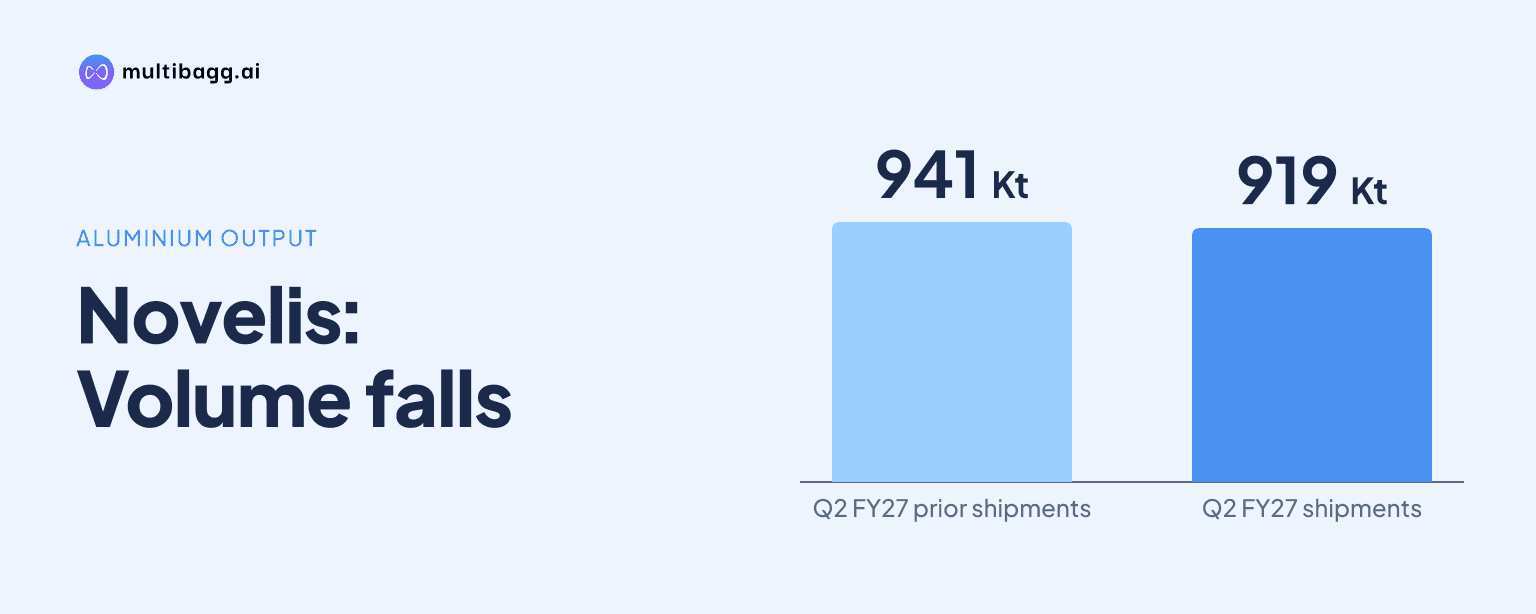
- Novelis shipped 919 Kt in Q2 FY27, down 2% year on year from 941 Kt.
- The 600 Kt Bay Minette facility produced its first cold-rolled coil in September and targets Q1 FY28 commercial shipments.
- Consolidated net-debt-to-EBITDA declined to 1.80 times in September 2026 from 1.95 times in June 2026.
powered by IRIS
Novelis said Oswego hot-mill production had normalised by Q2 FY27, while the 600 Kt Bay Minette facility produced its first cold-rolled coil in September and is scheduled to start commercial shipments in Q1 FY28. The presentation also links positive free cash flow to management’s aim of beginning deleveraging by the FY27 exit.
Know Hindalco Industries inside out
Results, valuation, peers and who's buying, in one view.
Has Novelis restored Oswego production?
Yes. Novelis said production at its Oswego hot mill had normalised by Q2 FY27, marking the operational status disclosed in its September 2026 update. The company separately recorded 919 Kt of total shipments in Q2 FY27, compared with 916 Kt in Q1 FY27, showing that group shipments increased 3 Kt sequentially during the quarter in which it reported normalised Oswego output.
The Oswego disruption had created Rs 51.34 crore of excess costs to fulfil customer contracts, including associated tariffs, and Rs 1.43 crore of repairs, operational downtime and other recovery costs. In the consolidated debt waterfall for the six months to September 2026, property-insurance recoveries of Rs 14.51 crore and tariff and freight-cost recoveries of Rs 18.11 crore partly offset those costs.
The resulting net Oswego impact was Rs 20.15 crore in the debt waterfall through September 2026. That figure should not be read as a fresh operating expense for Q2 FY27: it is the presentation’s net recovery-and-cost measure, whereas Novelis described the hot mill’s production status separately as normalised.
Novelis also said its Q2 FY27 adjusted earnings before interest, tax, depreciation and amortisation, or adjusted EBITDA, benefited from Oswego insurance recoveries. The presentation attributes the year-on-year improvement in adjusted EBITDA to those recoveries, better scrap spreads and higher recycling, rather than attributing it solely to a recovery in shipment volume.
How did Novelis’ shipments and earnings change in Q2 FY27?
Novelis’ Q2 FY27 shipments declined 2% year on year to 919 Kt from 941 Kt, even as adjusted EBITDA increased 20% and adjusted EBITDA per tonne increased 23%. Management said higher beverage-packaging and aerospace shipments were offset by lower automotive and specialty-products shipments.
The first-half comparison followed the same pattern: shipments fell 4% to 1,835 Kt in H1 FY27 from 1,904 Kt in H1 FY26, while adjusted EBITDA rose 22%. The divergence means the reported earnings improvement came despite lower total volume, with the stated support coming from insurance recoveries, scrap spreads and recycling.
Sequentially, shipments rose from 916 Kt in Q1 FY27 to 919 Kt in Q2 FY27. However, adjusted EBITDA per tonne fell to 553 in Q2 FY27 from 563 in Q1 FY27, while remaining above 448 in Q2 FY26; this shows a modest quarter-on-quarter reduction in the unit measure alongside a year-on-year improvement.
Net income rose 29% year on year in Q2 FY27 under United States generally accepted accounting principles, or US GAAP, according to the presentation. The document identifies adjusted EBITDA and net income as separate measures, so the percentage changes should not be treated as interchangeable measures of profitability.
Got a follow-up? Ask IRIS
When will Novelis begin Bay Minette commercial shipments?
Novelis expects commercial shipments from the 600 Kt Bay Minette facility to begin in Q1 FY28. The plant produced its first cold-rolled coil in September, an initial manufacturing milestone that the presentation distinguishes from the scheduled commercial-shipment start.
The 600 Kt capacity figure is the principal capacity-expansion detail in the Novelis update. Management did not disclose a quarterly sales target, utilisation rate or earnings contribution for Bay Minette, so Q1 FY28 is a target for commercial shipments rather than a forecast of the project’s financial output.
Bay Minette’s ramp-up follows the Oswego recovery but represents a different operating event. Oswego was an existing hot mill whose output had normalised by Q2 FY27, while Bay Minette is new capacity that had produced a first cold-rolled coil in September and is moving toward commercial shipments in Q1 FY28.
The project is presented alongside Novelis’ 2030 3X3 plan. That plan calls for 75% average recycled content across products and emissions of less than 3 tonnes of carbon-dioxide equivalent per tonne of flat-rolled product shipped, while identifying profitability growth as the means to continue funding first-mover investments.
What is Novelis’ path to deleveraging?
Management said Novelis’ business fundamentals are expected to generate positive free cash flow and begin deleveraging by the FY27 exit. It also said production at Oswego had normalised and Bay Minette commercial shipments are due in Q1 FY28, making execution at existing and new facilities relevant to that stated timing.
At the consolidated level, net debt rose to Rs 804.35 crore at September 30, 2026 from Rs 648.41 crore at March 31, 2026. The debt waterfall shows Rs 207.19 crore of capital expenditure, Rs 20.15 crore of net Oswego impact and Rs 30.91 crore of other items, partly offset by Rs 102.31 crore of net inflow from operations.
Cash flow from operations was Rs 233.19 crore for the six months to September 2026, up 57% year on year, while net cash inflow from operations was Rs 102.31 crore, up 14%. The presentation said higher working capital, resulting from the rate impact of higher metal prices, affected net cash inflow despite the increase in operating cash flow.
Capital expenditure of Rs 207.19 crore was 83% higher year on year and was directed toward strategic growth projects. The consolidated net-debt-to-EBITDA ratio was 1.80 times in September 2026, below 1.95 times in June 2026 but above 1.23 times in September 2025, showing a sequential reduction after a period of increased investment.
Conclusion
Novelis’ update combines restoration at Oswego with a defined expansion milestone at Bay Minette. Normalised hot-mill production by Q2 FY27, the Rs 20.15 crore net Oswego impact through September 2026, and a 600 Kt project approaching commercial shipments indicate that recovery and capacity build-out are occurring at the same time, although Q2 shipments remained 2% below the prior-year quarter.
The next disclosed points to watch are Bay Minette’s planned Q1 FY28 commercial shipments and management’s expectation that positive free cash flow will start deleveraging by the FY27 exit. Investors can also track whether the consolidated net-debt-to-EBITDA ratio, at 1.80 times in September 2026, continues to decline while capital expenditure remains elevated.