










Hindalco estimates Indian aluminium demand at 1,735 Kt
Key highlights
- Hindalco estimates Indian aluminium demand at 1,735 Kt in Q2 FY27 E, up 6% from Q2 FY26.
- Domestic primary aluminium is estimated at 735 Kt in Q2 FY27 E, versus 669 Kt a year earlier.
- LME aluminium was $3,227 per tonne in Q2 FY27, down from $3,576 in Q1 FY27.
- Hindalco says the global aluminium deficit could widen to about 0.8 million tonnes in CY26.
powered by IRIS
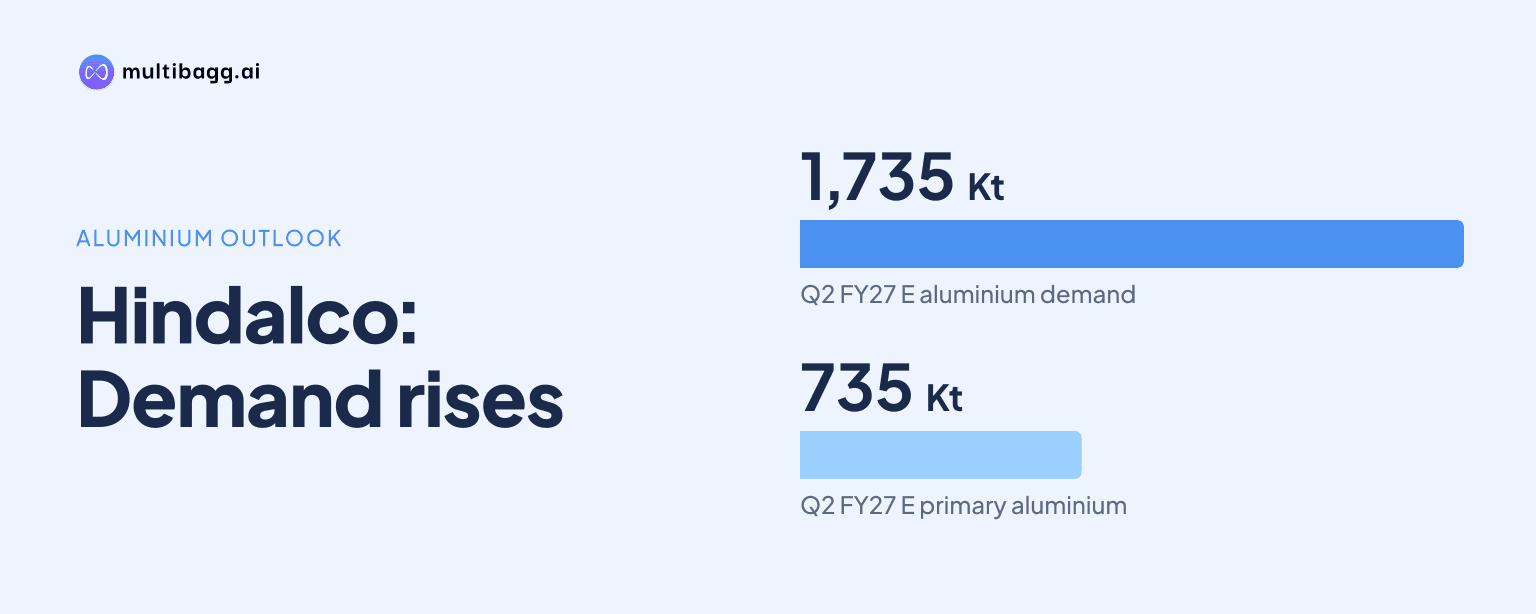
Hindalco Industries Ltd (Hindalco) estimates Indian aluminium demand will reach 1,735 Kt in Q2 FY27, 6% above 1,643 Kt in Q2 FY26, led primarily by automotive and electrical demand. The presentation also shows London Metal Exchange aluminium at $3,227 per tonne in Q2 FY27, below $3,576 in Q1 FY27.
Know Hindalco Industries inside out
Results, valuation, peers and who's buying, in one view.
What is Hindalco’s Indian aluminium demand estimate for Q2 FY27?
Hindalco estimates total Indian aluminium demand at 1,735 Kt in Q2 FY27 E, compared with 1,643 Kt in Q2 FY26 and 1,427 Kt in Q1 FY27. The presentation attributes the 6% year-on-year increase primarily to strong demand from automotive and electrical applications. The “E” label means the Q2 FY27 number is an estimate rather than a reported completed-period market total.
The Q2 FY27 estimate is 308 Kt above Q1 FY27 and exceeds all four preceding quarterly figures displayed. Total demand was 1,555 Kt in Q3 FY26, 1,457 Kt in Q4 FY26 and 1,427 Kt in Q1 FY27, after 1,643 Kt in Q2 FY26. The comparison indicates that the market estimate recovered sequentially after declining through the first quarter of FY27.
What were the sources of Indian aluminium supply in Q2 FY27?
Hindalco estimates domestic primary aluminium at 735 Kt, scrap imports at 556 Kt and other imports at 444 Kt in Q2 FY27 E. These three categories add to the 1,735 Kt market total. Domestic primary aluminium was the largest individual supply category, while imported scrap and other imports together accounted for 1,000 Kt.
Domestic primary aluminium increased by 66 Kt from 669 Kt in Q2 FY26 and by 104 Kt from 631 Kt in Q1 FY27. Scrap imports rose by 29 Kt year on year and by 76 Kt sequentially, reaching 556 Kt. Other imports were 3 Kt below the Q2 FY26 level of 447 Kt but 128 Kt above the Q1 FY27 figure of 316 Kt.
These categories describe Indian market demand and supply, not Hindalco’s own shipments or sales mix. The presentation does not identify the share of Hindalco aluminium sold domestically, its export volumes, or its exposure to automotive and electrical end markets. As a result, the 735 Kt domestic-primary figure cannot be treated as a Hindalco domestic-sales measure.
Did Hindalco disclose upstream EBITDA per tonne or a domestic-sales mix?
No, Hindalco does not disclose aluminium upstream earnings before interest, tax, depreciation and amortisation, or EBITDA, per tonne, a 52% upstream EBITDA margin, or a 79% domestic-sales mix in the supplied presentation. The aluminium-market pages provide LME pricing, global production and consumption trends, and Indian demand-and-supply estimates for Q2 FY27.
The supplied material also does not provide aluminium upstream EBITDA, upstream production or shipment tonnage, realised aluminium prices, or a domestic-versus-export sales split. Without both a defined upstream earnings figure and a corresponding tonnes denominator, an upstream EBITDA-per-tonne figure cannot be calculated from these pages.
Hindalco’s Q2 FY27 financial snapshot reports India-business segment EBITDA of Rs 9,011 crore, compared with Rs 5,419 crore in Q2 FY26. However, that measure covers the India businesses rather than a separately reported aluminium upstream operation. The snapshot provides no aluminium-tonnage denominator and therefore does not validate a company-specific upstream EBITDA-per-tonne calculation.
Got a follow-up? Ask IRIS
How did LME aluminium prices change in Q2 FY27?
Hindalco reports LME aluminium at $3,227 per tonne in Q2 FY27, down $349 per tonne from $3,576 in Q1 FY27. Even after that quarterly decline, the Q2 FY27 level was above the FY26 yearly average of $2,772 per tonne and the FY25 yearly average of $2,526 per tonne.
The Q3 FY27 figure was $3,071 per tonne “till date”, or $156 per tonne below the Q2 FY27 value. Hindalco does not state the cut-off date for that figure or provide a Q3 FY27 average. It therefore shows a quoted level below Q2 FY27, but does not support a completed-quarter comparison.
What global aluminium conditions does Hindalco identify?
Hindalco says global aluminium production declined 1% in Q2 FY27 versus Q2 FY26, while global consumption increased 1%. In China, higher production in Yunnan was offset by Shandong closures. In the rest of the world, increases in Indonesia, India and Europe were partly offset by lower output in the Middle East and Africa.
On the demand side, Hindalco identifies softness in Chinese building and construction and solar markets, offset by growth in new-energy vehicles. Outside China, recovery in packaging and electrical applications was offset by weakness in transport. These trends are separate from the Indian market estimate, where Hindalco identifies automotive and electrical demand as Q2 FY27 growth drivers.
Hindalco says the global aluminium deficit is likely to widen to about 0.8 million tonnes in calendar year 2026, compared with a pre-conflict deficit of 0.3 million tonnes. At the same time, the presentation says supply is expected to increase during FY27 in Indonesia and Vietnam, alongside restoration of Middle East production. It does not quantify the expected production additions or their timing within FY27.
Conclusion
Hindalco’s presentation supports a market-demand finding rather than the company-specific operating claims in the topic. Indian aluminium demand is estimated at 1,735 Kt in Q2 FY27, up 6% from 1,643 Kt a year earlier, with domestic primary supply rising to 735 Kt. LME aluminium fell sequentially to $3,227 per tonne from $3,576 in Q1 FY27, while remaining above the FY26 yearly average of $2,772.
The next disclosed factors to watch are Hindalco’s expectation of a global aluminium deficit of about 0.8 million tonnes in CY26 and anticipated FY27 supply additions in Indonesia, Vietnam and the Middle East. A completed Q3 FY27 LME comparison will also be needed because the presentation provides only a $3,071-per-tonne figure reported “till date.”