










Linc Q2 FY27 revenue rose 10.8% while PAT fell 50.5% YoY
Key highlights
- Linc's Q2 FY27 operating income rose 10.8% year on year to Rs 154.12 crore.
- Operating EBITDA fell 27.8% to Rs 11.31 crore and margin declined to 7.3% from 11.3%.
- Profit after tax attributable to owners of the parent fell 50.5% to Rs 4.19 crore.
- Own-brand premium writing instruments grew 14.8% to Rs 78.41 crore in Q2 FY27.
powered by IRIS
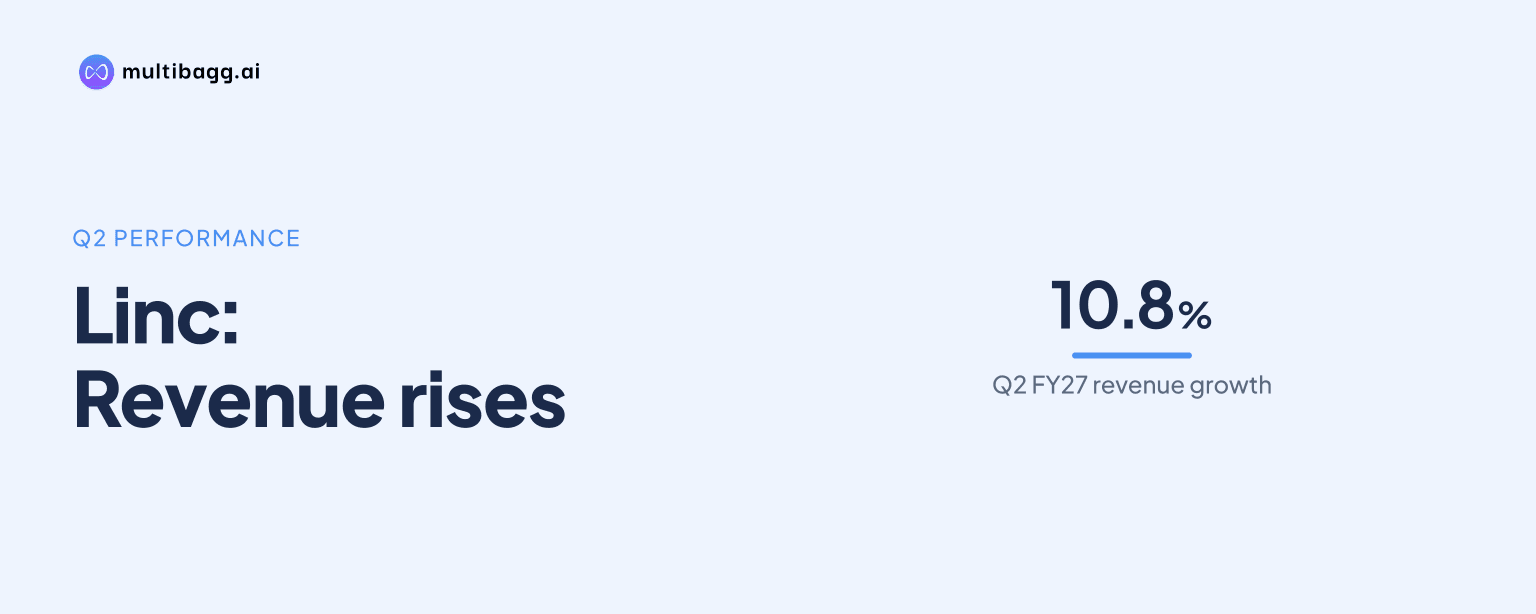
Linc Ltd. reported Q2 FY27 operating income of Rs 154.12 crore, up 10.8% year on year, but profit after tax fell 50.5% to Rs 4.19 crore as operating EBITDA margin declined to 7.3% from 11.3%. Management attributed about 190 basis points of the contraction to raw-material costs and 200 basis points to higher sales expenditure.
Know Linc inside out
Results, valuation, peers and who's buying, in one view.
What drove Linc's Q2 FY27 margin contraction?
Linc's operating EBITDA margin contracted by 393 basis points year on year to 7.3% in Q2 FY27, from 11.3% in Q2 FY26. Management said approximately 190 basis points of the reduction came from higher raw-material costs and approximately 200 basis points from increased sales expenditure. Operating EBITDA fell 27.8% year on year to Rs 11.31 crore even as operating income increased.
Management linked the input-cost increase to geopolitical uncertainties that raised prices for certain raw materials. Linc said the effect varied by material and that its raw-material mix cushioned part of the cost impact. The company maintained its underlying pricing structure while using sales promotions to stimulate demand, resulting in higher sales expenditure during the quarter.
How did Linc's Q2 FY27 earnings compare with earlier periods?
Linc's Q2 FY27 operating income rose against both Q2 FY26 and Q1 FY27, while operating EBITDA and profit after tax declined from both comparison periods. Operating income reached Rs 154.12 crore, compared with Rs 139.07 crore in Q2 FY26 and Rs 138.95 crore in Q1 FY27. The 10.9% sequential sales increase coincided with an EBITDA-margin decline from 8.7% in Q1 FY27 to 7.3%.
Profit before tax was Rs 7.48 crore in Q2 FY27, down 44.3% year on year and 5.7% quarter on quarter. Profit after tax attributable to owners of the parent declined 27.9% from Q1 FY27 and represented a 2.7% margin. Earnings per share were Rs 0.70 in Q2 FY27.
Which Linc product segments accounted for quarterly sales growth?
Linc's own-brand premium writing instruments were its largest disclosed Q2 FY27 segment, increasing 14.8% year on year to Rs 78.41 crore. Their sales contribution rose to 59.9% from 55.1% in Q2 FY26. Licensed writing instruments generated Rs 24.52 crore, while own-brand mass writing instruments generated Rs 16.78 crore.
The disclosed segment trends were uneven in Q2 FY27. Licensed other products grew 30.5% year on year to Rs 7.04 crore, and licensed writing instruments increased 7.2% to Rs 24.52 crore. Own-brand mass writing instruments fell 24.5% to Rs 16.78 crore, while own-brand other products declined 19.7% to Rs 4.08 crore. This revenue breakdown excludes resale of raw material and export incentive and is based on standalone revenue.
For H1 FY27, own-brand premium writing instruments increased 8.2% to Rs 157.48 crore and represented 61.5% of disclosed segment sales, versus 58.9% in H1 FY26. Own-brand mass writing instruments fell 26.3% to Rs 28.79 crore. Licensed writing instruments rose 12.3% to Rs 48.57 crore, while own-brand and licensed other products grew 11.5% and 9.4%, respectively.
Got a follow-up? Ask IRIS
What operating and balance-sheet indicators did Linc disclose?
Linc reported H1 FY27 operating income of Rs 293.07 crore, operating EBITDA of Rs 23.41 crore and profit after tax of Rs 9.99 crore. H1 operating income was more than half of FY26 operating income of Rs 543.01 crore, while H1 EBITDA was below half of FY26 operating EBITDA of Rs 59.49 crore. The period comparison follows the Q2 FY27 margin decline to 7.3%.
As of September 2026, Linc reported net debt of Rs 22.37 crore, return on capital employed of 11.0% and return on equity of 8.5%. It also disclosed 3,175 stock-keeping units in H1 FY27. Its manufacturing base comprised two units in the main company and one unit in a subsidiary.
Linc said it had spent more than Rs 50 crore on brands over the past five years. Advertisement expenditure was 1.9% of revenue in H1 FY27, compared with 1.5% in FY26. The company reported FY26 revenue of Rs 543.01 crore and H1 FY27 revenue of Rs 293.07 crore in its operating-income data.
What is Linc planning after Q2 FY27?
Linc's stated priority is to sustain sales growth while improving the balance between growth investments and profitability. Management said it will monitor raw-material costs and evaluate promotional spending after the 393-basis-point year-on-year EBITDA-margin contraction in Q2 FY27. The presentation did not disclose a numerical margin target or a timetable for recovery.
Management identified categories beyond writing instruments as part of its growth effort. Linc is expanding lifestyle drinkware through Tritonic, its brand of Tritan-based bottles for everyday use, active lifestyles and children. It said Stackoo experience centres in Kolkata and Mumbai bring together writing instruments, stationery and allied products in a retail format.
New product launches and strategic partnerships remain central to Linc's longer-term plans, according to management. Management said Q2 FY27 operating-income growth of 10.8% was supported by sales promotions and growth in categories beyond writing instruments. The presentation leaves open how quickly raw-material costs and promotional expenditure can be balanced with profitability.
Conclusion
Linc delivered higher Q2 FY27 sales, with operating income increasing by Rs 15.05 crore year on year to Rs 154.12 crore, but operating EBITDA fell by Rs 4.36 crore to Rs 11.31 crore. Profit after tax fell to Rs 4.19 crore and the EBITDA margin moved from 11.3% in Q2 FY26 to 7.3%, despite growth in premium own-brand writing instruments and licensed other products.
The next results will indicate whether management's monitoring of raw-material costs and promotional spending affects the 7.3% margin trend. Management has also identified Tritonic, Stackoo experience centres, new product launches and strategic partnerships as components of its longer-term growth plan.