










Schneider has price cover on only 20%-25% of project work
Key highlights
- Schneider said only 20%-25% of project business has price-variation protection.
- Projects account for about 60%-65% of Schneider's overall business mix.
- Quarterly profit after tax fell 43% year on year to Rs 30 crore from Rs 52 crore.
- Q2 EBIT margin improved to 7.2% from about 4.0% in Q1.
powered by IRIS
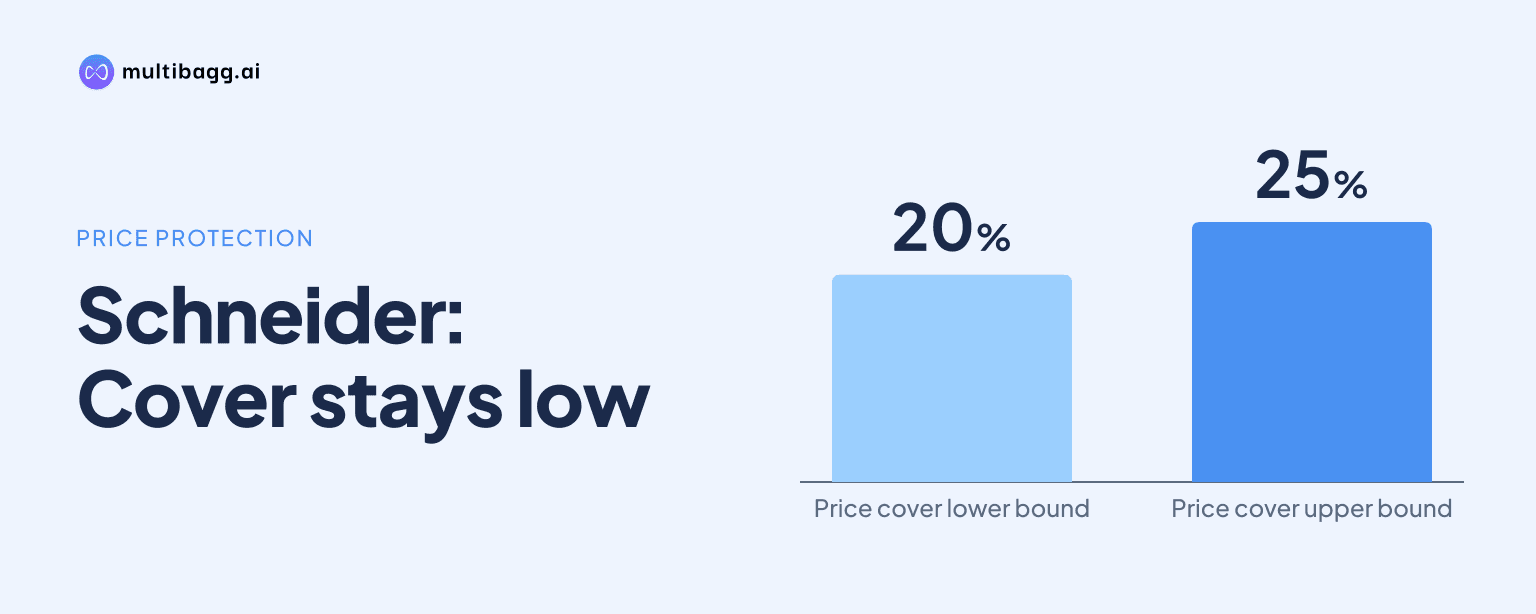
Schneider said only 20%-25% of its project business is protected by price-variation clauses, leaving much of a segment that forms about 60%-65% of its mix exposed to copper and transformer-oil movements. Quarterly profit after tax fell 43% year on year to Rs 30 crore despite about 20% sales growth in Q2.
Know Schneider Electric Infrastructure inside out
Results, valuation, peers and who's buying, in one view.
How much of Schneider's project business has price protection?
Only about 20%-25% of Schneider's project business is protected by price-variation clauses, according to management. Projects account for roughly 60%-65% of the overall business mix, alongside services and standard products, meaning protection covers only part of the project-led operation rather than the entire company.
Management said it aims to include price-variation clauses in all relevant contracts, but customer terms prevent that in some cases. Project and equipment orders are often engineered-to-order, or ETO, and tender-based, while public-sector undertakings and other customers can require firm-price contracts without a variation clause.
In fixed-price work, Schneider includes contingency in tender costing, management said. However, contingency may not fully offset commodity volatility when copper or transformer-oil prices move after an order is secured and before material procurement, which management said generally occurs over three to six months.
Why did Schneider's quarterly profit fall despite sales growth?
Schneider's quarterly profit after tax fell 43% year on year to Rs 30 crore from Rs 52 crore, despite about 20% year-on-year sales growth in Q2. Management identified material-cost pressure as the principal reason and also cited higher employee costs, other expenses and depreciation.
Copper and transformer-oil costs rose both sequentially and from the same quarter a year earlier, management said. Silver provided some relief, but Schneider said its silver consumption was comparatively limited, leaving the larger copper and oil inputs as the more consequential cost movements.
Earnings before interest and tax, or EBIT, margin improved sequentially to 7.2% in Q2 from about 4.0% in Q1, while the first-half, or H1, margin was 6.2%. Management attributed Q1's lower margin to negative operating leverage after customer-dependent execution was delayed; Q2 sales reached about Rs 780 crore.
How do Schneider's price increases work?
Schneider can raise prices more directly in standard products, but management said customer adoption takes time because existing inventory must move through the channel. When it raises prices, Schneider updates standard costs and customer pricing, yet the recovery is not immediate.
The process differs in tender-based ETO equipment and projects. Schneider said tender pricing reflects expected costs on the day of bidding, but procurement can occur three to six months later. A rise in copper or transformer oil during that period can affect profit and loss when a contract does not contain a variation clause.
Order duration adds to that exposure. Management said customer-specific ETO orders typically run for five to six months, while other orders can take five to 12 months. About 20%-25% of total order backlog extends beyond one year, increasing the duration over which a fixed-price order can be affected by input-cost changes.
Got a follow-up? Ask IRIS
What is Schneider doing to manage raw-material risk?
Schneider is pursuing customer price recovery, including contingency in fixed-price tenders and becoming more selective over project risk, management said. Udai Singh said the company is being more selective where it sees larger exposure to raw-material volatility, while remaining hopeful about continued order momentum.
Management expects higher H2 revenue to improve cost absorption and operating leverage. It said some Q2 other-expense increases were temporary timing differences under its quarterly accounting policy, while foreign-currency movements also increased that expense line by 22% year on year.
Depreciation is another reported cost factor. Management said it began partially capitalising the KMVC capacity expansion after board approval in the preceding week, increasing depreciation. It also said finance cost reflected an interest-rate change to 6.7% from 6.1%, rather than incremental borrowing.
Which demand segments could support Schneider's execution?
Schneider reported H1 order growth of 25% after Q2 order intake grew by more than 50% on a like-for-like basis from a weaker Q1. Management said emerging segments contributed to the order backlog, including data centres, semiconductors and renewables, and said Q2 did not contain a separately identified large order.
Management cited data-centre capacity of 1.5-1.6 gigawatts already operating in India and referred to plans for about seven to eight gigawatts over the next three to four years. Schneider has supplied a skid-mounted station to a western India data centre, a plug-and-play format intended to reduce commissioning time.
Schneider also cited power-train supplies, including switchgear and transformers, for a semiconductor application and inverter-duty transformers for renewable projects. In medium-voltage breakers, management estimated an Indian market of about 55,000-60,000 units across 11, 24 and 36 kilovolt applications.
The company has started producing a digitalised and sensorised breaker at its Kolkata plant. Management said the product has twice the operating life and 40% lower maintenance cost than industry-available breakers, while its relevance to revenue or margin was not quantified in the call.
Conclusion
Schneider's Q2 result showed that sales growth and a sequential improvement in EBIT margin did not fully offset input-cost and contract-price pressures. With projects representing about 60%-65% of business and only 20%-25% of that segment protected, copper and transformer-oil volatility remains a material operating issue during project execution.
The next results will show whether H2 revenue growth delivers the operating leverage management expects and whether price recovery improves as contracts are tendered and procured. Investors should also watch Schneider's stated selectivity on higher-risk projects, the pace of execution across five-to-12-month orders, and any change in copper and transformer-oil costs.