










Schneider Electric Infrastructure Limited profit falls 43% in Q2
Key highlights
- SEIL recorded Q2 FY27 orders of Rs 1,265 crore, up 50.9% year on year and its highest-ever quarterly bookings.
- Q2 FY27 sales rose 19.8% to Rs 779 crore, while material costs increased 28.3% to Rs 509 crore.
- Q2 FY27 profit after tax fell 43.3% to Rs 30 crore and EBIT margin declined to 7.2% from 12.5%.
- SEIL reported a Rs 2,701 crore order backlog and disclosed Rs 211 crore of capacity-expansion capital expenditure.
powered by IRIS
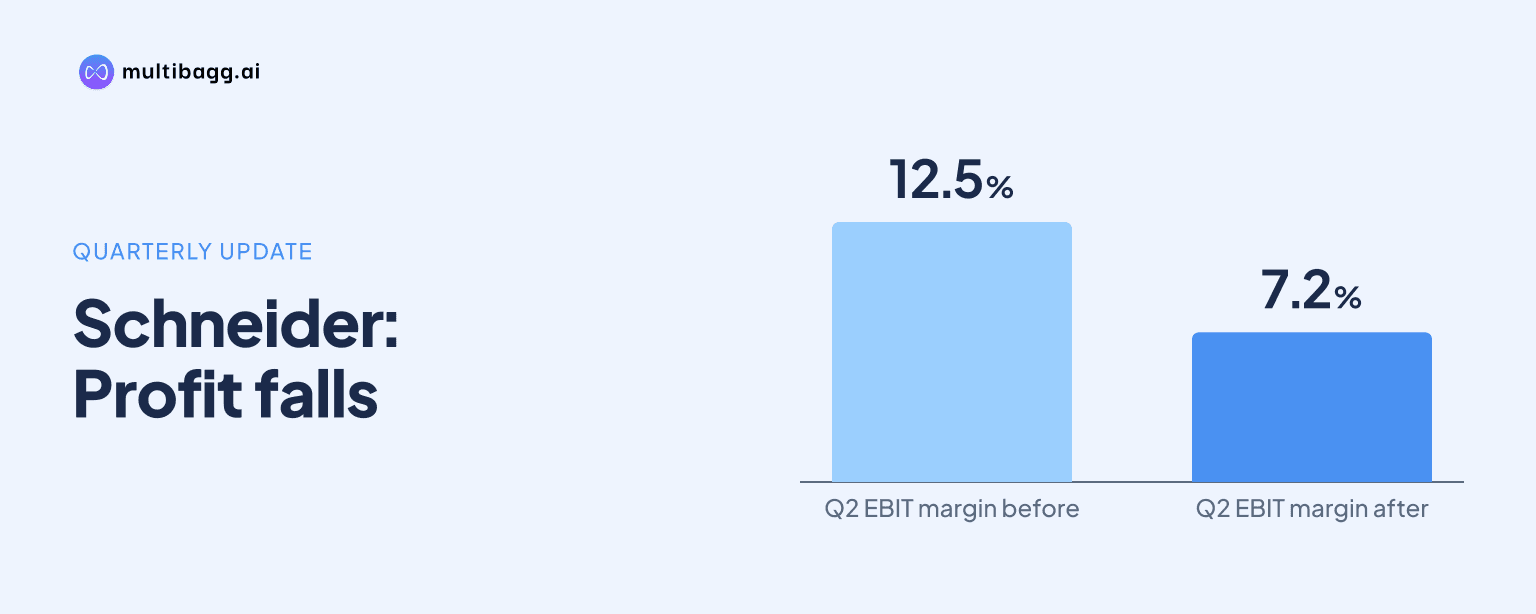
Schneider Electric Infrastructure Limited reported Q2 FY27 profit after tax of Rs 30 crore, down 43.3% year on year, as its EBIT margin fell to 7.2% from 12.5%; record orders of Rs 1,265 crore, up 50.9%, did not offset commodity volatility and a lag in passing on higher input costs.
Know Schneider Electric Infrastructure inside out
Results, valuation, peers and who's buying, in one view.
Why did SEIL's Q2 FY27 profit decline?
SEIL's Q2 FY27 profit declined because material, employee and other costs grew faster than sales while higher input costs were not fully passed through. Sales rose 19.8% year on year to Rs 779 crore, but material costs increased 28.3% to Rs 509 crore. Material costs consequently represented 65.3% of sales, compared with 61.0% in Q2 FY26.
Gross or material margin increased 6.6% in rupee terms to Rs 275 crore from Rs 258 crore, but its share of sales fell to 35.3% from 39.7%. Employee costs rose 25.2% to Rs 98 crore, while other expenses increased 22.4% to Rs 112 crore. Both increases exceeded the 19.8% growth in sales.
Earnings before interest, tax, depreciation and amortisation, or EBITDA, fell 26.2% to Rs 65 crore and its margin contracted to 8.4% from 13.6%. Depreciation rose 30.7% to Rs 9 crore, leaving earnings before interest and tax, or EBIT, at Rs 56 crore, down 31.0% from Rs 81 crore.
Finance cost increased 36.7% to Rs 15 crore, or 2.0% of sales, from 1.7% a year earlier. Profit before tax fell 42.1% to Rs 41 crore and tax expense declined to Rs 11 crore from Rs 18 crore. Profit after tax therefore declined to Rs 30 crore, or 3.8% of sales, from Rs 52 crore, or 8.0% of sales.
How fast did SEIL's orders and sales grow in Q2 FY27?
SEIL recorded its highest-ever quarterly order bookings at Rs 1,265 crore in Q2 FY27, up 50.9% year on year. Management said emerging sectors made a significant contribution, while order conversion into sales was progressing and project execution had picked up.
Orders grew faster than sales, which increased 19.8% to Rs 779 crore. The order backlog was Rs 2,701 crore at the end of the reported period, up 49.6% year on year. The presentation does not disclose the preceding-quarter backlog or the Q2 FY26 order value.
The comparison shows that booking activity expanded while earnings declined. Orders increased by 50.9%, whereas EBIT decreased by Rs 25 crore and profit after tax decreased by Rs 22 crore from Q2 FY26. The disclosed Rs 2,701 crore backlog was also higher than H1 FY27 sales of Rs 1,430 crore.
Got a follow-up? Ask IRIS
What does SEIL's H1 FY27 performance show?
SEIL's H1 FY27 results show that cost pressure extended beyond Q2. H1 orders rose 24.7% year on year to Rs 2,180 crore, while sales grew 12.5% to Rs 1,430 crore. The gap between order and sales growth was therefore also evident over the first six months.
Material costs rose 19.0% to Rs 930 crore from Rs 781 crore, exceeding sales growth of 12.5%. Gross or material margin increased only 2.7% to Rs 512 crore, and its percentage of sales fell to 35.8% from 39.2%. Employee costs increased 19.8% to Rs 198 crore and other expenses rose 21.2% to Rs 209 crore.
H1 EBITDA declined 34.5% to Rs 106 crore, with its margin falling to 7.4% from 12.7%. EBIT fell 40.4% to Rs 88 crore and the EBIT margin reduced to 6.2% from 11.6%. Finance cost rose 38.7% to Rs 31 crore, compared with Rs 22 crore in H1 FY26.
H1 profit after tax was Rs 42 crore, down 55.0% from Rs 94 crore. Its net margin declined to 2.9% from 7.4%, while profit before tax decreased 54.3% to Rs 58 crore. The larger H1 profit decline than the Q2 decline reflects that the first-half margin compression remained material despite management's reported sequential improvement from Q1 FY27.
Are SEIL's margins improving from Q1 FY27?
SEIL said margins were improving sequentially from Q1 FY27, although Q2 FY27 margins remained below the comparable prior-year quarter. Q2 EBIT margin was 7.2%, compared with the H1 FY27 EBIT margin of 6.2%, and Q2 EBITDA margin was 8.4%, compared with 7.4% for H1.
The presentation attributes the profitability impact to commodity price volatility and the lag in passing on higher input costs. In Q2 FY27, material costs were 65.3% of sales, compared with 61.0% in Q2 FY26. Q2 profit after tax margin of 3.8% was also below the 8.0% reported a year earlier.
The disclosed H1 figures do not provide a separate Q1 FY27 profit and loss statement, so the extent of quarter-on-quarter recovery cannot be calculated from the supplied pages. Management's sequential-improvement statement should therefore be read alongside the Q2 year-on-year EBIT-margin decline of 5.3 percentage points.
What capacity investment has SEIL disclosed?
SEIL disclosed capital expenditure of Rs 211 crore to increase vacuum interrupter and breaker capacity. The expansion was presented alongside H1 FY27 orders of Rs 2,180 crore and a Rs 2,701 crore order backlog, but the presentation does not state a commissioning date, capacity addition or return target.
SEIL also presented its EvoPacT HVX 36 kilovolt breaker for solar, data centres, battery energy storage systems and semiconductor end users. The product uses vacuum circuit-breaker technology without sulphur hexafluoride gas and is described as providing up to 40% less maintenance and up to twice as many operations.
Conclusion
SEIL's Q2 FY27 results showed a clear divergence between demand and earnings. Record quarterly orders of Rs 1,265 crore and a Rs 2,701 crore backlog accompanied 19.8% sales growth, but material costs rose faster at 28.3%, compressing EBIT margin to 7.2% and reducing profit after tax to Rs 30 crore.
The next reported results will indicate whether the sequential margin improvement cited by management continues as backlog converts into sales and input-cost pass-through catches up. Progress on the disclosed Rs 211 crore vacuum interrupter and breaker capacity investment is also a key item to watch, since the presentation gives no completion schedule or financial-return target.