










IMFA targets first 100,000-tonne ferrochrome quarter in Q3
Key highlights
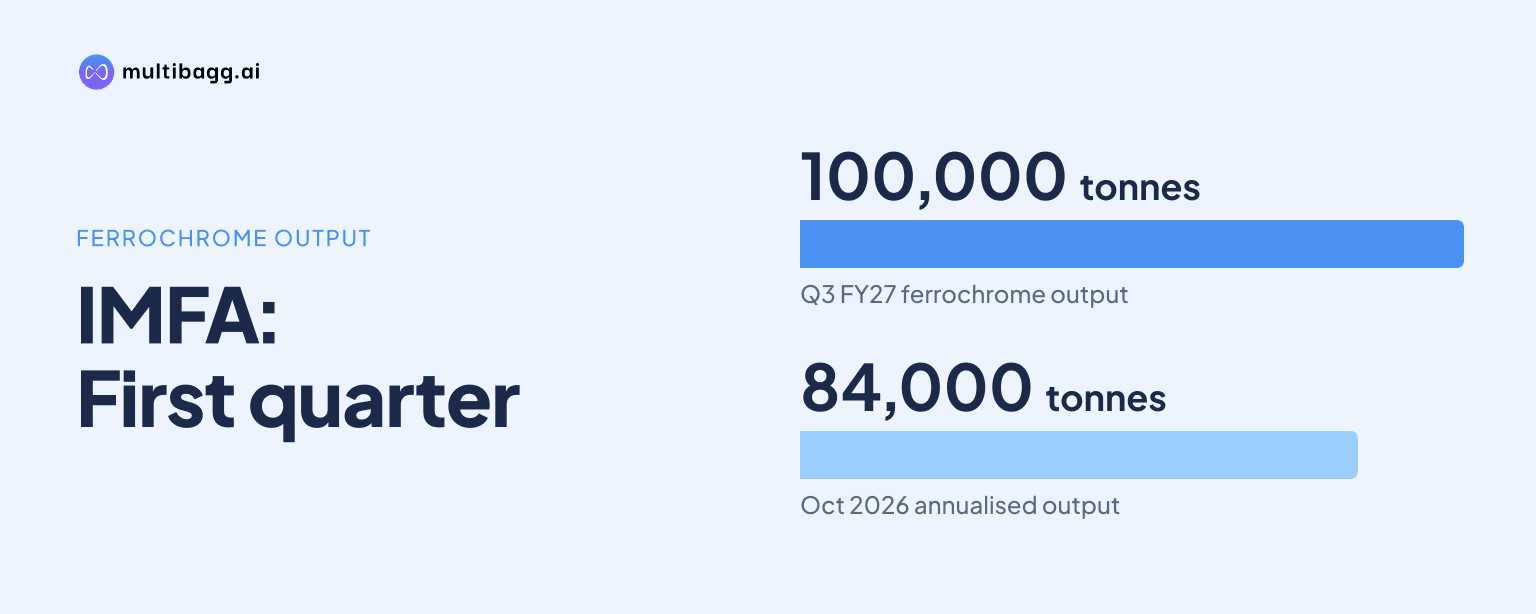
- IMFA expects to cross 100,000 tonnes of ferrochrome output in Q3 FY27 for the first time.
- KNR-2 reached an annualised rate of roughly 84,000 tonnes in October 2026, versus about 100,000 tonnes of rated capacity expected from December.
- IMFA expects KNR-1’s second furnace to achieve hot-metal tapping around November 15, 2026.
- IMFA maintained ferrochrome volume guidance of 380,000 tonnes for FY27 and about 475,000 tonnes for FY28.
powered by IRIS
Indian Metals & Ferro Alloys Limited expects to cross 100,000 tonnes of ferrochrome output in Q3 FY27, its first quarter above that level, after KNR-2 transformer upgrades and the planned November 2026 start-up of KNR-1’s second furnace. Management said higher volumes should offset slightly softer ferrochrome prices and rising metallurgical-coke costs.
Know Indian Metals & Ferro Alloys inside out
Results, valuation, peers and who's buying, in one view.
Can IMFA exceed 100,000 tonnes of ferrochrome in Q3 FY27?
Yes. IMFA expects to exceed 100,000 tonnes of ferrochrome output in Q3 FY27, the quarter ending December 2026, for the first time. Managing Director Subhrakant Panda said the target depends on output increases at both Kalinganagar units, KNR-1 and KNR-2, following capacity additions that lifted Q2 and H1 FY27 performance above the corresponding prior-year periods.
The December-quarter target follows a slower-than-planned first-half ramp at KNR-2, which IMFA began operating in March 2026 after acquiring the unit from Tata Steel. Production was restricted at two furnaces because transformer parameters were not ideal, leading IMFA to limit load. Management described the issue as a ramp-up constraint rather than a change to the unit’s rated capacity.
KNR-2 reached production equivalent to roughly 84,000 tonnes per annum in October 2026. IMFA expects the existing four furnaces to reach about 100,000 tonnes per annum of full rated capacity by December 2026, after changing transformers at the two affected furnaces. The higher rate at KNR-2, alongside the KNR-1 ramp, underpins the Q3 FY27 quarterly-output target.
What is changing at IMFA’s KNR-1 and KNR-2 units?
KNR-1 is bringing on a second furnace while KNR-2 is completing the transformer work required to operate its four furnaces at rated capacity. KNR-1’s first furnace achieved hot-metal tapping on August 25, 2026. By the November 4, 2026 earnings call, IMFA had started pre-commissioning activities for the second furnace and expected hot-metal tapping around November 15, subject to a variation of a few days.
The timing makes Q3 FY27 materially different from Q2 FY27. KNR-1’s first furnace began production only late in the September quarter, whereas the second furnace was expected to begin tapping during the December quarter. At KNR-2, October’s annualised output rate of roughly 84,000 tonnes was below the approximately 100,000-tonne annual rated capacity expected from December 2026.
IMFA also disclosed a later expansion project at KNR-2, where it has a partially built furnace. Management expects the furnace to be operational around July 2027, although Panda said a more accurate timeline could be provided after permissions are in place, potentially within a couple of months. IMFA had received initial environmental clearances and said it was fairly confident of the July 2027 timetable.
Management said commissioning the seventh furnace would take IMFA’s smelting capacity beyond 500,000 tonnes. Its FY27 ferrochrome volume guidance remains 380,000 tonnes, reduced slightly because of lower KNR-1 output and the KNR-2 delay. FY28 volume guidance remains about 475,000 tonnes, incorporating further ramp-up and the expected contribution from planned capacity.
Got a follow-up? Ask IRIS
Will softer prices and higher costs affect IMFA’s Q3 plan?
Management expects margins to tighten somewhat in Q3 FY27, but says higher production volumes should more than offset that effect in absolute terms. Panda said ferrochrome prices moderated from Q1 to Q2 FY27 and were expected to decline slightly again in Q3. He put Q2 FY27 realisation at roughly Rs 1.165 lakh, rather than confirming the Rs 1.16 lakh to Rs 1.18 lakh range raised by an analyst.
Metallurgical coke is the raw material cost that IMFA identified as rising. Management said upstream raw-material prices can move higher when ferrochrome-industry margins are significant. IMFA said it is mostly insulated from its largest raw-material exposure because chrome ore is produced in-house, although that does not eliminate the stated cost pressure from metallurgical coke.
The company’s outlook rests on volume growth rather than an assumption of higher selling prices. Management expects modest price moderation and increased input costs, but said Q3 FY27 output above 100,000 tonnes should compensate for some margin tightening. This remains management’s forward-looking view, as the call covered results for the quarter and half year ended September 30, 2026.
On market supply, Panda said South African ferrochrome output was recovering after falling sharply in 2025, helped by special tariffs. IMFA expects Chinese ferrochrome production to reduce shortly after the South African ramp-up, leaving the market broadly balanced in net terms, according to management. Panda nevertheless acknowledged possible interim turbulence because output changes in South Africa and China would not happen simultaneously.
How will IMFA secure ore for higher ferrochrome output?
IMFA’s FY27 ore-raising target remains 1 million tonnes, which management said is required to support its 380,000-tonne ferrochrome production target. Q2 ore raising was lower because open-cast mining is seasonal and affected by monsoon rainfall. Management said the 2026 monsoon was extended and severe, with more days of heavy rain reducing open-cast production.
The company’s short-term target is 1.2 million tonnes of annual ore raising, split between 600,000 tonnes from Sukinda and 600,000 tonnes per annum from Mahagiri. Management presented this ore base as support for future smelting additions, rather than as an immediate source of Q3 FY27 output. IMFA said further ore availability would enable additional smelting capacity in due course.
On November 4, 2026, the board approved about Rs 375 crore of capital expenditure for Mahagiri underground mine expansion and low-carbon ferrochrome production. The Mahagiri project is intended to raise ore output from 600,000 tonnes to 750,000 tonnes per annum. Management said the added 150,000 tonnes would arrive in 50,000-tonne annual increments starting in 2029, helping IMFA reach 1.2 million tonnes faster before lifting output above that level.
The same Rs 375 crore approval includes low-carbon ferrochrome, which management described as a value-added product intended to diversify IMFA’s product basket and bolster margins. The call did not disclose production capacity, commissioning timing or expected financial contribution for that business. IMFA also said it had participated in critical-mineral auctions but had not achieved a successful breakthrough and had no further update.
Conclusion
IMFA’s planned first quarter above 100,000 tonnes depends on two operating milestones: KNR-2 reaching its approximately 100,000-tonne annual rated capacity after transformer replacements by December 2026, and KNR-1’s second furnace beginning hot-metal tapping around November 15, 2026. Management expects this volume increase to outweigh the impact of slight price moderation and higher metallurgical-coke costs in Q3 FY27.
The next points to watch are completion of the KNR-2 transformer changes by December 2026, commissioning of KNR-1’s second furnace, and delivery against FY27 ferrochrome guidance of 380,000 tonnes. Beyond FY27, management expects the partially built KNR-2 furnace around July 2027, maintains FY28 guidance of about 475,000 tonnes, and plans Mahagiri ore-output additions of 50,000 tonnes per annum from 2029.