










JSW Energy sees group RTC demand reach around 7 GW by 2032
Key highlights
- JSW Energy expects JSW Group RTC power demand to rise from around 3 GW currently to around 7 GW by 2032.
- JSW Energy had 4.5 GW of untied group-company MoUs in Q2 FY27, including 2 GW under advanced discussion.
- JSW Energy targets more than 8.5 GW of C&I and group-captive capacity by 2030, versus 3.7 GW installed in Q2 FY27.
- JSW Energy commissioned 1.4 GW of organic renewable capacity since April and targets 3 GW for FY27.
powered by IRIS
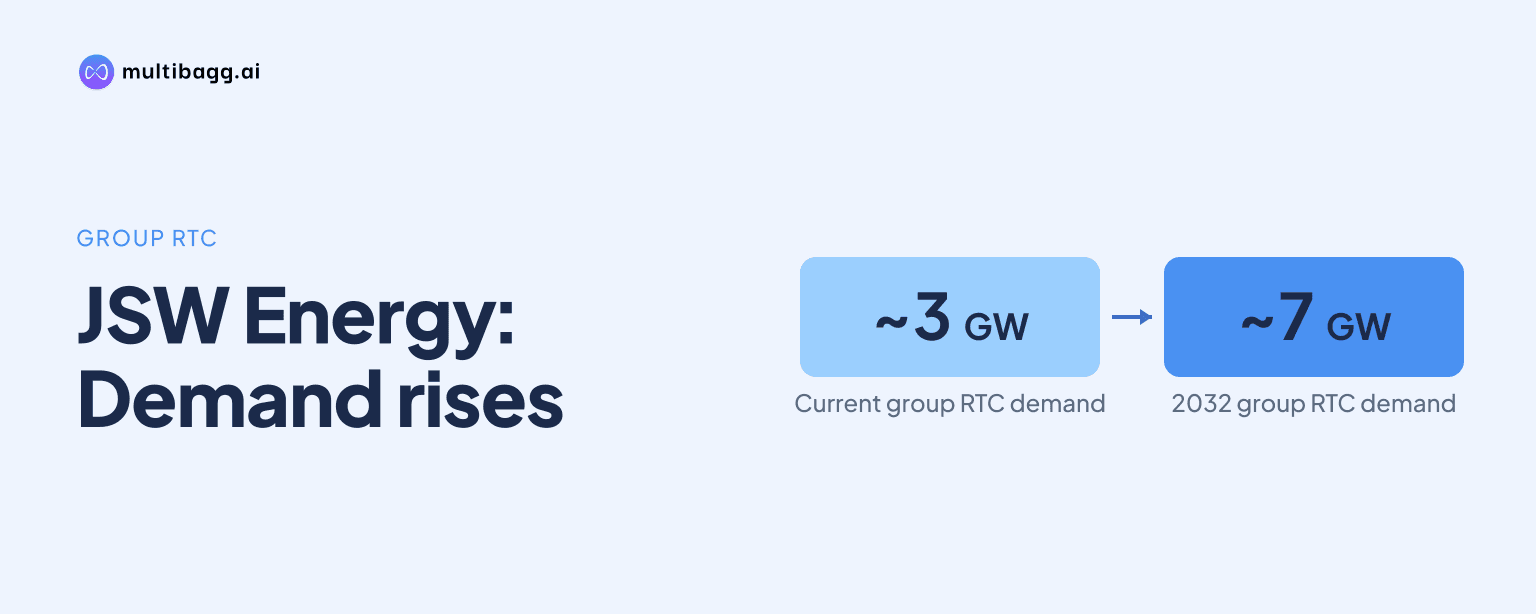
JSW Energy Limited expects the JSW Group’s round-the-clock (RTC) power requirement to more than double from about 3 GW currently to around 7 GW by 2032. Management said 4.5 GW of the 6.2 GW of group-company memoranda of understanding (MoUs) signed in Q2 FY24 remained untied at the October 28, 2026 call.
Know JSW Energy inside out
Results, valuation, peers and who's buying, in one view.
How much group RTC power demand does JSW Energy expect by 2032?
JSW Energy expects the JSW Group’s RTC power requirement to reach around 7 GW by 2032, compared with the around 3 GW of thermal and renewable power it currently supplies across group companies. Management linked the outlook to JSW Steel’s plan to expand capacity to as much as 80 million tonnes per annum and to expansion at other group businesses.
The disclosed requirement would be more than twice the present 3 GW level, making it a potential source of demand beyond JSW Energy’s 30 GW capacity target for 2030. Management said a substantial share of the projected 7 GW requirement would be met through green energy, in line with the group’s decarbonisation ambitions.
Management described reliable RTC supply and increasingly green power as the relevant customer need, rather than presenting the 7 GW as solely a renewable procurement target. Its identified areas of focus after 2030 are thermal capacity, commercial and industrial projects, group-captive projects, hydro and pumped storage.
What is the status of JSW Energy’s group-company MoUs?
JSW Energy said 4.5 GW of the 6.2 GW of MoUs it signed with group companies in Q2 FY24 was yet to be tied up, and 2 GW of that balance was under advanced discussion in Q2 FY27. The 4.5 GW figure is therefore a pipeline of potential projects, not disclosed as signed power supply contracts.
An MoU differs from a power purchase agreement (PPA), and management did not give dates for converting the remaining 4.5 GW into PPAs. It said the group’s announced greenfield and brownfield expansion plans would create demand beyond 2030, while the 2 GW under discussion was expected to close without disclosed tariffs, project locations or commissioning schedules.
Management also said renewable projects under construction or at various stages of execution were backed by PPAs with utilities, commercial and industrial customers, or group-captive buyers. In response to an analyst, it said the 2 GW under discussion was group captive and that its benchmark for projects, including group-captive PPAs, was at least a mid-teen internal rate of return.
How large is JSW Energy’s commercial and industrial business plan?
JSW Energy expects its installed commercial and industrial (C&I) portfolio, including group captive, to grow from 3.7 GW to more than 8.5 GW by 2030. The existing 3.7 GW portfolio represented about 25% of operating capacity after installed capacity rose above 15.1 GW following additions since April and the Maruti acquisition.
The difference between the current 3.7 GW portfolio and the more than 8.5 GW objective is over 4.8 GW of planned growth. Management said group companies would contribute a large share, but it also cited third-party demand, including capacity commissioned for a cement company and projects it expected to commission for Amazon and other customers in the second half of FY27.
JSW Energy said it was in discussions with organisations regarding data-centre opportunities, while citing industry renewable purchase obligations by 2030 as a driver of C&I demand. It commissioned 1.4 GW of organic renewable capacity from April through the Q2 FY27 period, compared with approximately 1.2 GW in the full preceding financial year.
Got a follow-up? Ask IRIS
What supply projects could support JSW Energy after 2030?
JSW Energy said its locked-in pipeline gave it line of sight to the 30 GW target for 2030, while Salboni thermal, the 920 MW Punatsangchhu-III hydro project and further thermal and C&I opportunities could extend its growth runway. It also reported a pumped-storage pipeline of about 26.4 gigawatt-hours (GWh) and expects to commission about 1 GWh of energy-storage projects in FY27.
At Salboni, turbine-generator orders for four 800 MW units, totalling 3,200 MW, had been placed, and management expects the first unit in 2030. For the KSK Mahanadi expansion, it expects the fourth 600 MW unit in FY28 and the balance 1,200 MW in FY29, with equipment orders already placed.
Management said the KSK timetable reflects existing infrastructure sized for 3.6 GW, including coal handling, ash handling, rail links and transmission facilities. For Punatsangchhu-III, it said the detailed project report was under preparation and expected by June 2027, after which it expected to be better placed to discuss costs and timelines.
What could determine conversion of the group power pipeline?
The timing, contract terms and project execution of PPAs will determine how much of the 4.5 GW untied MoU pipeline becomes operating capacity. Management said it would principally pursue long-term PPAs for new thermal output, though it may retain part of future capacity for merchant sales if evening-peak demand continues to rise.
Grid access and storage deployment are additional operating factors. JSW Energy reported curtailment equal to about 4.8% of total generation in H1 FY27, compared with a national level of about 5.4%, and said around 60% of its curtailed capacity on temporary general network access would move to permanent access by the end of Q3 FY27.
Management said solar-plus-battery projects could store output and sell it into evening peaks, and it had applied about eight months earlier for evening connectivity for commissioned solar plants. It also said it planned to build battery projects above its stated 3.2 GWh portfolio, but did not disclose a capacity target or commissioning date for those additional projects.
Conclusion
JSW Energy’s 7 GW group-demand outlook identifies the JSW Group as a potentially material long-term customer base, alongside the company’s target to exceed 8.5 GW of C&I and group-captive capacity by 2030. The comparison with around 3 GW supplied currently indicates the scale of potential growth, but 4.5 GW of MoUs remains untied rather than contracted.
The next disclosed milestones are the potential conversion of 2 GW under advanced discussion, the 3 GW renewable commissioning target for FY27 and permanent network access for curtailed capacity by the end of Q3 FY27. Management also expects a 600 MW KSK Mahanadi unit in FY28, another 1,200 MW there in FY29, and Salboni’s first 800 MW unit in 2030.