










JSW Energy targets 25%-30% lower KSK thermal expansion costs
Key highlights
- JSW Energy expects KSK Mahanadi’s 1,800 MW expansion to cost at least 25%-30% less per MW than the industry average.
- JSW Energy targets the 600 MW KSK Mahanadi fourth unit for FY28 and another 1,200 MW for FY29.
- JSW Energy holds a 10.7% stake in Toshiba JSW Power Systems and has tribunal sanction for the GE Power India boiler-business scheme.
- JSW Energy generated 8.9 billion thermal units in Q2 FY27, up 13% year on year.
powered by IRIS
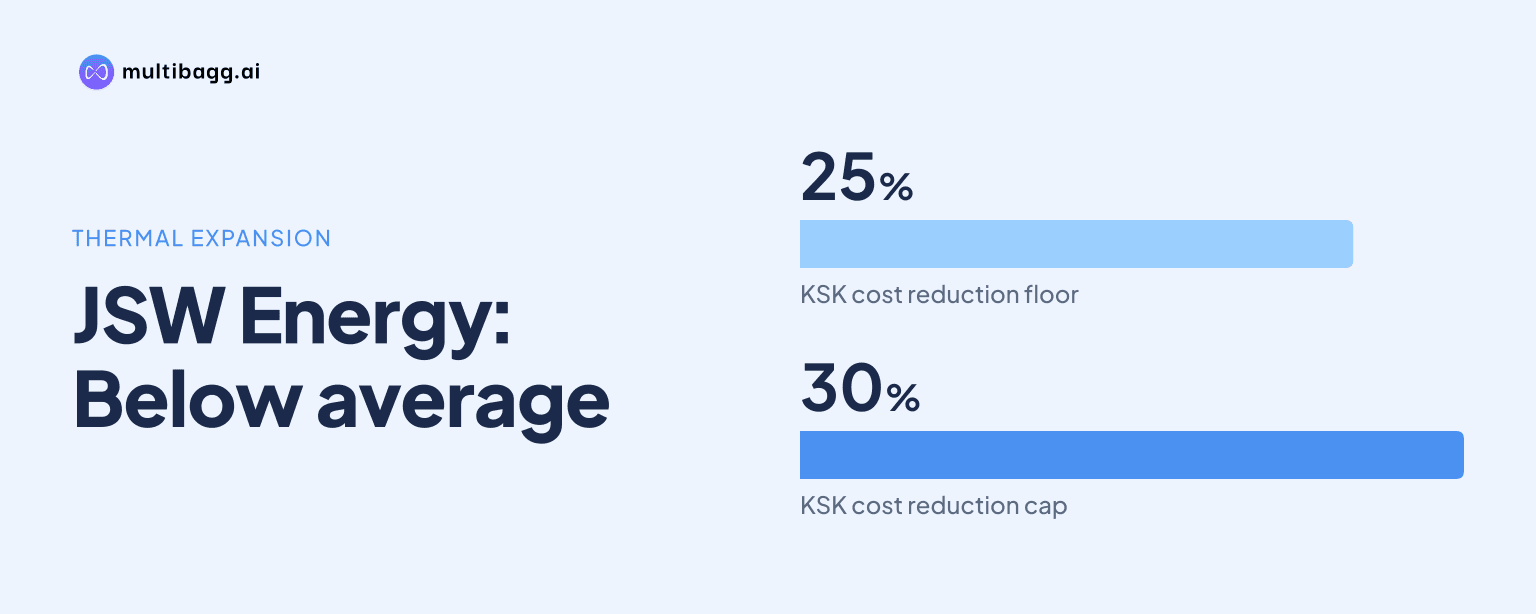
JSW Energy Limited says its 1,800 MW KSK Mahanadi expansion can be built at least 25%-30% below industry-average capital cost per MW, using infrastructure already sized for 3,600 MW and locally procured equipment. Management targets the fourth 600 MW unit for FY28 and the remaining 1,200 MW for FY29.
Know JSW Energy inside out
Results, valuation, peers and who's buying, in one view.
How will JSW Energy reduce KSK Mahanadi expansion costs?
JSW Energy plans to reduce KSK Mahanadi expansion costs by using common systems that were built for 3,600 MW rather than duplicating them for the additional 1,800 MW. Management identified coal handling, ash handling, railway infrastructure for coal transport and transmission infrastructure as systems that are already ready at the site. This brownfield configuration underpins its estimate of capex per MW at least 25%-30% below the industry average.
The expansion comprises a 600 MW fourth unit and a further 1,200 MW of capacity. The fourth unit is on track for FY28, while the 1,200 MW balance is scheduled for FY29. Management said equipment orders for the 1,200 MW have already been placed locally, and contrasted its expected three-year execution period with a greenfield thermal project timeline of about 4.5 to five years.
Why does JSW Energy’s equipment supply chain matter?
JSW Energy says its investments in turbine and boiler manufacturing give it more control over the critical path of thermal-project construction. It increased its stake in Toshiba JSW Power Systems to 10.7% in July. The National Company Law Tribunal sanctioned the scheme to acquire GE Power India’s boiler business, including its Durgapur manufacturing facility, on October 1, and management said the transaction should close soon.
The company has placed the boiler order for the entire 3,200 MW Salboni project with the Durgapur facility, while turbine-generator orders are in place for all four 800 MW units. The Phase II turbine order was placed with Toshiba JSW in September. Management said the combination of Toshiba JSW turbines and boilers from the Durgapur facility would give it control over the crucial supply path, with the first Salboni unit expected by 2030.
KSK Mahanadi and Salboni use different execution advantages. KSK Mahanadi has shared operating infrastructure, local equipment procurement and a planned three-year construction period for the 1,200 MW balance. Salboni is a 3,200 MW greenfield project that requires new site development, although its major turbine and boiler orders have already been placed.
What supports KSK Mahanadi’s operating economics?
JSW Energy said KSK Mahanadi’s proximity to a coal mine gives it a lower fuel cost, which could support both long-term power purchase agreements, or PPAs, and selected merchant or short-term sales. Management said long-term PPAs remain its principal route for the upcoming capacity, but it may retain part of output for merchant sales if evening-peak demand remains elevated. It did not disclose an allocation between contracted and merchant output.
Management described quarterly KSK Mahanadi earnings before interest, tax, depreciation and amortisation, or EBITDA, of about ₹6.5 thousand crore after a tariff adjustment as a base run rate. It also said 100-115 MW was being sold in the merchant market. Across the portfolio, merchant sales were 1.1 billion units in Q2 FY27, equal to about 7% of energy sold and around 4% of capacity.
Thermal generation across JSW Energy rose 13% year on year to 8.9 billion units in Q2 FY27, including 321 million units from the acquired Maruti plant. Consolidated thermal plant load factor, or PLF, was 75%, compared with an all-India thermal PLF of 67.8%. Mahanadi operated at 90% PLF and Utkal at 82%, placing the company’s consolidated thermal utilisation above the national figure in the quarter.
Got a follow-up? Ask IRIS
How does thermal expansion fit JSW Energy’s capacity plan?
JSW Energy is adding thermal capacity alongside renewable energy and storage rather than presenting them as substitutes. It commissioned 1.4 GW of organic renewable capacity from April through Q2 FY27, compared with about 1.2 GW in the preceding full year. It retained a 3 GW renewable commissioning target for FY27 and added 300 MW through the August acquisition of Maruti Clean Coal & Power, taking installed capacity above 15.1 GW.
For FY27, JSW Energy has planned capex of about ₹2 lakh crore and expects to commission about 1 gigawatt-hour of energy storage. Management said capacity additions beyond the current year would include commercial and industrial supply, group-captive projects, pumped storage and thermal capacity. The KSK Mahanadi and Salboni projects extend the thermal pipeline beyond the company’s 30 GW target for 2030.
All renewable capacity currently under construction or in execution is backed by PPAs with utilities, commercial and industrial customers, or group-captive customers, according to management. Of 6.2 GW of memorandums of understanding signed with group companies in Q2 FY24, 4.5 GW remains to be tied up and 2 GW is under advanced discussion. Management did not give a closure date for the 2 GW under discussion.
What are the main execution and funding items to watch?
The immediate execution tests are delivery of KSK Mahanadi’s 600 MW fourth unit in FY28 and the remaining 1,200 MW in FY29. Management said orders are placed and common infrastructure is ready, but PPAs for the new output have not been announced. It said it has time to decide the states and counterparties to target and may use merchant or short-term contracts for a portion of output.
In Q2 FY27, revenue rose 24% year on year to ₹66.58 thousand crore and EBITDA increased 23% to ₹39.07 thousand crore. Profit after tax rose 38% to ₹11.41 thousand crore. Net debt to trailing-12-month EBITDA, excluding debt associated with capital work in progress, was 4.94 times, compared with 5.2 times in FY26.
JSW Energy reported cash and cash equivalents of about ₹1.57 lakh crore and a debt cost of 8.28% in Q2 FY27, down 51 basis points from 8.79% a year earlier. Management said it assumes a 9% borrowing cost across a 25-year project life for new projects. It also said that refinancing projects after commissioning remains a lever, while approximately one-quarter of term debt is at fixed rates.
Conclusion
JSW Energy’s stated thermal-expansion case rests on two mechanisms: KSK Mahanadi’s pre-existing systems are expected to lower capex per MW by at least 25%-30%, while turbine and boiler supply-chain investments are intended to improve control over project equipment. The approach supports a thermal buildout that sits alongside the company’s 3 GW FY27 renewable target and its 30 GW 2030 capacity objective.
The next disclosed milestones are the FY28 commissioning target for KSK Mahanadi’s 600 MW fourth unit, the FY29 target for its remaining 1,200 MW, and the expected closing of the Durgapur boiler-business transaction after the October 1 tribunal sanction. Management’s PPA decisions for KSK Mahanadi will also determine how much of the expansion is contracted versus available for merchant or short-term sales.