










JSW Energy Limited Q3 merchant sales booked at no lower price
Key highlights
- JSW Energy sold 1.1 billion merchant units at around ₹6.9 per unit in Q2 FY27.
- JSW Energy’s Q2 FY27 merchant realisation was around 20% above the ₹5.7 per-unit DAM average.
- JSW Energy said Q3 FY27 merchant sales were fully booked at a price no lower than Q2 FY27.
- JSW Energy identified about 309 megawatts of open merchant thermal capacity across four plants.
powered by IRIS
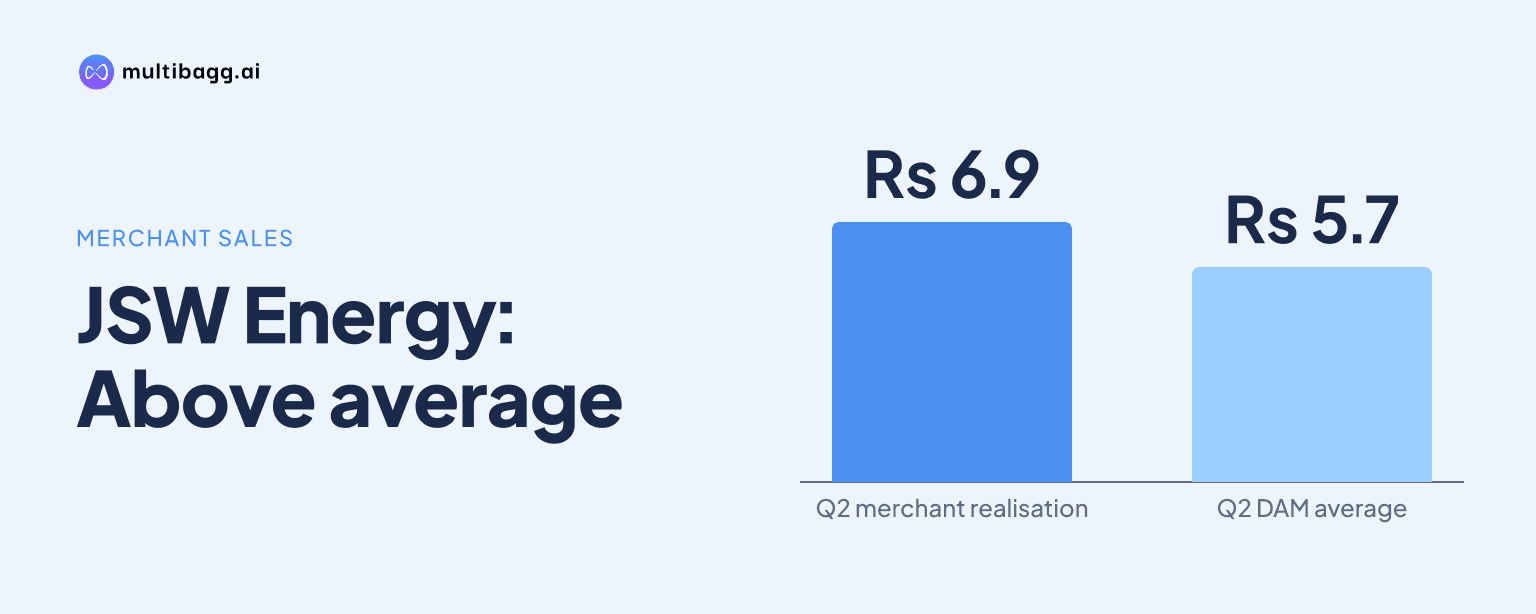
JSW Energy Limited earned around ₹6.9 per unit from 1.1 billion merchant units in the second quarter of fiscal year 2027 (Q2 FY27), and management said Q3 FY27 was fully booked at a price no lower than that level. The Q2 realisation was around 20% above the ₹5.7 per-unit Day-Ahead Market (DAM) average.
Know JSW Energy inside out
Results, valuation, peers and who's buying, in one view.
What did JSW Energy earn from merchant sales in Q2 FY27?
JSW Energy earned around ₹6.9 per unit on 1.1 billion units of merchant sales in Q2 FY27. Management said the result reflected strategic bilateral contracts, placing the company’s realised price about 20% above the ₹5.7 per-unit DAM average for the quarter. The company did not provide a separate price for individual plants or contracts.
The 1.1 billion units sold through long-term and short-term merchant channels represented nearly 7% of JSW Energy’s energy sold in Q2 FY27. That was greater than merchant capacity’s roughly 4% share of the portfolio, showing that the available thermal capacity produced more energy than its capacity weighting would imply during the quarter.
Thermal generation rose 13% year on year to 8.9 billion units in Q2 FY27, including 321 million units from the Maruti plant acquired on August 6. JSW Energy’s consolidated thermal plant load factor (PLF), a measure of generation relative to capacity, was 75%, compared with the all-India thermal PLF of 67.8%; Mahanadi operated at 90% and Utkal at 82%.
Why did JSW Energy’s merchant price exceed the DAM average?
JSW Energy said bilateral contracts, rather than exclusive reliance on exchange sales, lifted its ₹6.9 per-unit merchant realisation above the ₹5.7 DAM average in Q2 FY27. Management said these arrangements generally run for one to three months, allowing the company and buyers to lock in volumes before the supply period.
Power demand and fuel availability formed the market setting for Q2 FY27. India’s power demand increased about 11.1% year on year in the quarter and peak demand reached 270 gigawatts, while management said around 96 plants were classified as critical in October with six to seven days of coal inventory, against a normative 19 to 20 days.
Management said domestic coal sourcing and job-work arrangements at imported-coal plants reduced the company’s exposure to imported-coal price volatility. Maruti is fully domestically fuelled through a long-term fuel supply agreement with South Eastern Coalfields and a linkage under the SHAKTI scheme; about 64 megawatts of its capacity is available for merchant sales and about 195 megawatts net is under Rajasthan power purchase agreements (PPAs) with around 14 years remaining.
Is JSW Energy’s merchant volume fully booked for Q3 FY27?
JSW Energy said its Q3 FY27 merchant sales were fully booked at a price that would be either the same as, or better than, Q2 FY27’s ₹6.9 per unit. Management specifically said the Q3 price would not be lower, but did not disclose the contracted volume, exact price or counterparties.
Management said it had begun discussions for Q4 FY27, consistent with its normal planning window of two to two-and-a-half months before delivery. The Q3 statement is management’s disclosure on booked bilateral sales, not a forecast of DAM clearing prices or a commitment on Q4 pricing.
The company’s use of PPAs remains central to its wider thermal strategy. At Utkal, plant earnings before interest, tax, depreciation and amortisation (EBITDA) more than tripled year on year to ₹368 crore in Q2 FY27 after long-term PPAs with Karnataka and Assam began, compared with greater short-term-market exposure a year earlier.
Got a follow-up? Ask IRIS
How large is JSW Energy’s open merchant capacity?
JSW Energy identified about 309 megawatts of open merchant thermal capacity across four plants: about 90 megawatts at KSK, 95 megawatts at Ratnagiri, 60 megawatts at Utkal and 64 megawatts at Maruti. Management also said Tidong hydro has some merchant capacity, but did not quantify it.
The company can also sell incremental output when contracted plants receive backdowns, management said. These opportunities arise mainly at domestic-coal plants during daytime periods, where lower fuel costs can make additional generation available for merchant sales; the transcript did not quantify the Q2 contribution from such volumes.
Maruti generated about ₹45 crore of EBITDA during the 55 days from its August 6 acquisition to the end of Q2 FY27. Its 300-megawatt acquisition, together with 1.4 gigawatts of organic renewable additions since April, took JSW Energy’s installed capacity above 15.1 gigawatts.
How did Utkal’s PPA shift affect JSW Energy’s earnings?
Utkal’s EBITDA more than tripled year on year to ₹368 crore in Q2 FY27 because the plant operated under PPAs with Karnataka and Assam and improved its operational performance. Management said Utkal had sold most of its capacity in the short-term market in the prior year, when realised prices were below its newer PPA realisations.
Utkal’s 82% PLF in Q2 FY27 also exceeded its availability in Q1 FY27, when operational issues and outages reduced generation. Management said fixed-cost recovery under the Karnataka PPA was not affected, but improved availability in Q2 gave Utkal more scope for additional merchant sales.
This change contrasts with the dedicated merchant portfolio, which was about 4% of capacity in Q2 FY27. Utkal’s contracted sales provide a longer-term revenue mechanism, while incremental merchant output can supplement earnings when plant availability, demand and backdown conditions permit.
Conclusion
JSW Energy’s Q2 FY27 merchant result combined a ₹6.9 per-unit realisation on 1.1 billion units with thermal generation of 8.9 billion units and a 75% consolidated thermal PLF. Bilateral contracts were the stated reason for the price premium to the ₹5.7 DAM average, while domestic-coal availability and incremental output from operating plants supported the company’s merchant flexibility.
The next disclosed marker is Q3 FY27 reporting, when the fully booked merchant sales will show their realised volume and price after management said pricing would be no lower than Q2. Investors can also watch Q4 FY27 contract discussions and Utkal’s availability, following its ₹368 crore Q2 FY27 EBITDA after PPAs with Karnataka and Assam and improved plant performance.